
Understanding Separation Anxiety in Continental Bulldogs
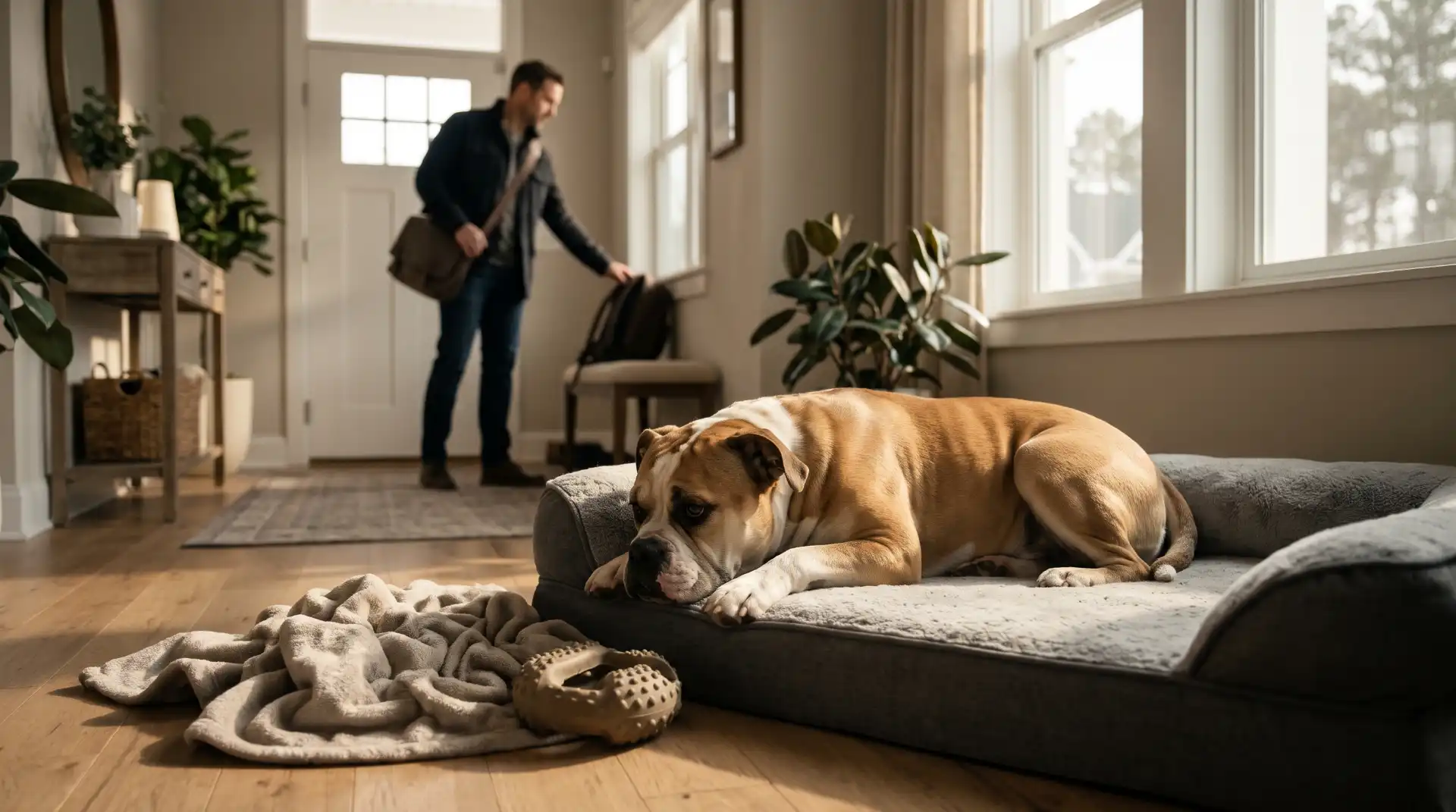
Dogs develop strong relationships with their owners, and many enjoy spending time with their families throughout the day. Whether following someone from room to room, relaxing beside the couch, or greeting family members when they return home, dogs often become closely connected to the people who care for them. However, some dogs struggle when their owners leave, even when the absence is relatively short. Instead of relaxing, they may bark continuously, pace around the house, scratch doors, chew furniture, or experience intense emotional distress.
This behavior is commonly associated with separation anxiety, a condition that can affect dogs regardless of breed, age, or background. Continental Bulldogs can also experience separation-related problems, particularly when they have difficulty adjusting to changes in household routines, extended periods without human company, or unfamiliar environments.
Continental Bulldogs are companion dogs that often enjoy interacting with their families. However, their individual personalities differ, and not every dog responds to separation in the same way. Some can comfortably spend several hours resting at home, while others become distressed when a familiar person moves into another room. A dog’s ability to remain alone depends on several factors, including temperament, early experiences, training, health, previous living arrangements, and the way independence has been introduced.
For American families, separation anxiety can become particularly challenging when owners return to office-based employment, manage changing work schedules, travel frequently, or need to leave home for errands. Persistent barking can create problems with neighbors, while destructive behavior may damage household belongings. More importantly, the dog may experience considerable distress that affects its overall quality of life.
It is important to understand that separation anxiety is not simply disobedience, stubbornness, or an attempt to punish an owner for leaving. A dog experiencing genuine separation distress is not deliberately creating problems. It is responding to an emotionally difficult situation that requires understanding, appropriate management, and sometimes professional treatment.
The good news is that many dogs can improve through carefully structured training and environmental adjustments. Owners can help Continental Bulldogs develop confidence by introducing short periods of independence, providing appropriate mental stimulation, establishing predictable routines, and gradually changing the emotional associations surrounding departures.
This guide explores how separation anxiety develops, how to recognize the warning signs, how to prevent problems in puppies and adult dogs, and how to create practical training routines that help Continental Bulldogs feel more comfortable when left alone.
1. What Is Separation Anxiety in Continental Bulldogs?
Separation anxiety describes a pattern of distress associated with being separated from an owner or another individual to whom a dog is strongly attached. The reaction may begin before the person actually leaves. For example, a Continental Bulldog might become restless when its owner puts on work clothes, picks up car keys, or begins preparing a bag.
Some dogs respond immediately after the door closes, while others become increasingly uncomfortable after several minutes.
Separation-related behavior exists on a spectrum. A dog may show mild frustration when left alone without having a clinical anxiety disorder. Another dog may experience severe distress that involves persistent vocalization, escape attempts, destructive behavior, or physical symptoms.
The distinction matters because the appropriate treatment depends on the severity and underlying cause of the behavior.
Why Continental Bulldogs May Struggle With Being Alone
A Continental Bulldog that enjoys companionship may naturally prefer spending time around familiar people. However, enjoying company is not the same as having separation anxiety.
Problems can develop when a dog has limited experience spending time independently or becomes accustomed to receiving attention whenever it seeks interaction.
For example, a puppy that is constantly carried, followed, entertained, and accompanied may have fewer opportunities to practice relaxing without direct human involvement. If the household suddenly changes from having someone home throughout the day to leaving for eight hours, the adjustment can be difficult.
Previous experiences can also contribute. A dog adopted from a shelter or another household may have experienced changes in caregivers, unstable living arrangements, or frightening periods without companionship.
Other possible influences include:
- Sudden changes in work schedules or household routines.
- Moving into a new home or unfamiliar neighborhood.
- The loss of a family member or another household pet.
- Changes in the amount of attention and companionship available.
- Inadequate opportunities to develop independent resting habits.
- Pain, illness, or other medical conditions that affect behavior.
There is no single explanation for every case. Owners should consider the dog’s complete history rather than assuming that attachment to a family member is the only cause.
Normal Attachment Versus Separation Anxiety
A dog that follows its owner around the house is not necessarily experiencing separation anxiety.
Many dogs prefer staying near familiar people because companionship is rewarding. They may follow someone into the kitchen, lie beside a desk, or wait near the bathroom door without experiencing significant emotional distress.
The important question is what happens when the person actually leaves.
A comfortable Continental Bulldog may briefly notice the departure, investigate its surroundings, and eventually settle down. A dog with separation-related distress may remain agitated, repeatedly attempt to reach the exit, or struggle to relax throughout the absence.
Owners should evaluate the dog’s behavior when alone rather than relying exclusively on how closely it follows them while they are home.
2. Recognizing the Warning Signs of Separation Anxiety
Identifying separation anxiety early can help prevent the problem from becoming more difficult to manage.
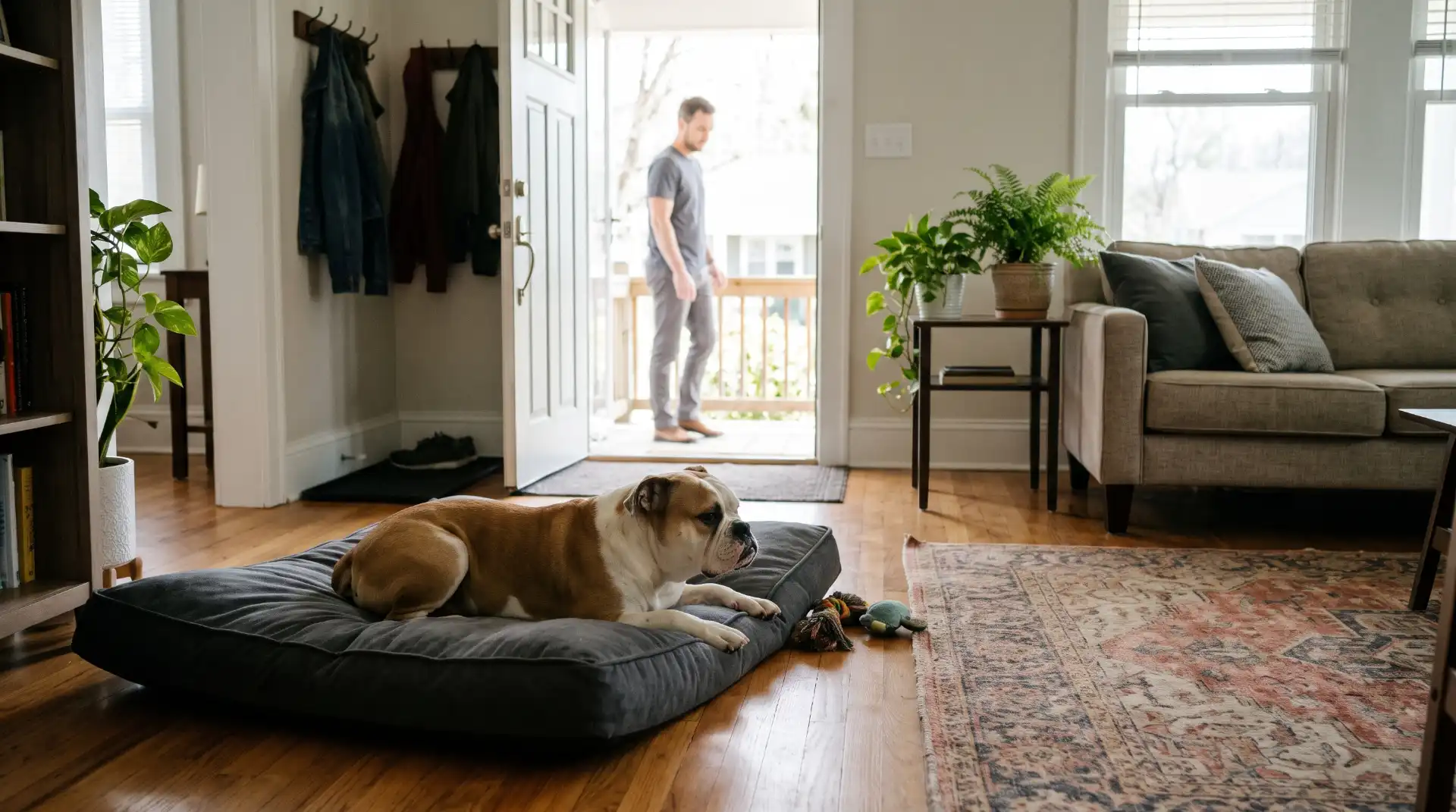
Some symptoms are obvious, such as continuous barking or damaged furniture. Others are less noticeable because they occur only when the owner is away.
A camera or pet-monitoring system can provide useful information about what happens after departure. Even a short recording may reveal whether the dog settles after a few minutes or remains distressed.
Excessive Barking, Whining, and Howling
One of the most recognizable signs is repeated vocalization when the dog is separated from its owner.
A Continental Bulldog may bark near the entrance, whine beside a window, or howl after hearing the sound of a departing vehicle.
The behavior may begin immediately or develop after a short period.
Owners should determine whether the vocalization is associated with separation, outside noises, unfamiliar animals, or another environmental trigger. A dog that barks whenever a delivery truck arrives may have a different behavioral problem from one that vocalizes continuously whenever its family leaves.
Destructive Chewing and Scratching
Some dogs attempt to cope with distress by chewing or scratching objects near exits.
Common targets include:
- Door frames and interior doors.
- Window coverings and blinds.
- Furniture near the entrance.
- Crates or exercise pens.
- Household objects carrying familiar scents.
Destructive behavior can create serious safety concerns. Dogs may swallow fabric, plastic, wood fragments, or other foreign objects while attempting to escape or relieve their anxiety.
Do not assume that the dog is deliberately damaging belongings because it knows the behavior is unwanted. In genuine separation anxiety, destruction is often connected to emotional distress.
Pacing and Inability to Settle
A Continental Bulldog that repeatedly walks between rooms, circles near the entrance, or moves from window to window may be struggling to relax.
Some dogs remain close to the door through which their owner departed. Others repeatedly investigate sounds outside the home.
A dog that cannot settle even when provided with comfortable bedding and familiar toys may need additional support.
House-Soiling During Absences
A previously house-trained dog may urinate or defecate indoors when left alone.
This behavior can be associated with anxiety, although medical problems and other house-training issues should also be considered.
A sudden change in bathroom habits deserves veterinary attention, especially when accompanied by increased thirst, digestive problems, discomfort, or changes in appetite.
Excessive Panting, Drooling, and Trembling
Physical signs may accompany behavioral symptoms.
Some dogs pant heavily, salivate, tremble, repeatedly lick their lips, or appear unusually restless when their owners prepare to leave.
These signs are not specific to separation anxiety. Pain, heat, respiratory conditions, nausea, and other medical concerns can produce similar symptoms.
Continental Bulldog owners should pay particular attention to breathing and temperature regulation. Excessive panting should never automatically be attributed to anxiety, especially if the dog appears weak, overheated, or unable to breathe comfortably.
A veterinarian can help distinguish behavioral distress from medical problems.
Following Owners and Becoming Distressed Before Departure
Some dogs begin showing anxiety while their owners are still home.
For example, a Continental Bulldog may become unusually attentive when someone starts putting on shoes or collecting personal belongings.
It may follow the person from room to room, become restless, or refuse to settle.
These behaviors can indicate that departure-related signals have become associated with an unpleasant experience.
Recognizing these early signs provides an opportunity to begin training before the dog develops more severe reactions.
3. How to Determine Whether Your Continental Bulldog Has Separation Anxiety
Observing behavior is essential, but owners should avoid making a diagnosis based on one isolated incident.
A dog that chews a cushion once may simply have been bored or attracted to an interesting object. A dog that barks after hearing a loud noise may be responding to its surroundings rather than experiencing separation distress.
A more complete assessment involves observing patterns over multiple departures.
Use a Camera to Monitor Your Dog
A basic indoor camera can help owners understand how their Continental Bulldog behaves when nobody is home.
Position the camera so it captures the dog’s preferred resting area and, if possible, the entrance.
Observe the first 30 to 60 minutes of an absence when practical. This period may reveal whether the dog becomes distressed shortly after departure or settles into a normal resting routine.
Look for repeated pacing, barking, scratching, panting, drooling, attempts to escape, or inability to rest.
Do not intentionally leave the dog alone for an extended period simply to collect evidence. If it becomes visibly distressed, return and reassess the training plan.
Keep a Behavior Journal
A written record can help identify patterns and measure improvement.
Record the departure time, absence duration, activities before leaving, observed behavior, and time required for the dog to settle.
For example, an owner might notice that their Continental Bulldog remains calm during short afternoon absences but becomes distressed when left alone first thing in the morning.
This information may reveal that morning departure cues, feeding routines, or the transition from overnight companionship are contributing factors.
A journal also gives veterinarians and professional trainers more useful information when developing a treatment plan.
Rule Out Medical Causes
Behavioral changes sometimes have physical explanations.
A dog that suddenly becomes restless, vocal, or unable to remain alone may be experiencing pain, digestive discomfort, urinary problems, or another medical condition.
Older dogs may also develop cognitive changes that influence their ability to cope with unfamiliar situations or periods of separation.
Schedule a veterinary examination when symptoms appear suddenly, become more severe, or occur alongside physical changes.
A proper assessment helps ensure that behavioral treatment is not overlooking an underlying health concern.
4. Preventing Separation Anxiety in Continental Bulldog Puppies
Prevention begins when a puppy first enters the household.
Puppies need companionship, socialization, exercise appropriate for their developmental stage, and opportunities to explore their environment. They also need to learn that being away from their owners for short periods is a normal and safe part of everyday life.
The objective is not to isolate a puppy or leave it alone for long periods. Instead, owners should gradually introduce independence while making sure the puppy’s physical and emotional needs are met.
Introduce Independent Resting Early
Many owners enjoy allowing their new puppy to sleep beside them, follow them throughout the house, and receive attention whenever it approaches.
These experiences can strengthen the human-dog relationship, but the puppy should also learn how to relax independently.
Start by providing a comfortable bed or designated resting area near the family’s normal activities.
Reward the puppy when it voluntarily lies down and remains relaxed without constant interaction.
For example, if a puppy settles on its bed while someone prepares dinner, calmly offer a small reward. Avoid repeatedly calling the puppy away from the resting area to provide attention.
Over time, the puppy can become more comfortable resting independently even when family members are moving around.
Practice Short Periods of Separation Inside the Home
Begin with very small exercises.
Ask the puppy to settle in a comfortable area while you step a short distance away. Return before it becomes distressed.
At first, the separation may last only a few seconds. Gradually increase the distance and duration when the puppy remains comfortable.
You can also practice briefly closing an interior door while the puppy relaxes on the other side.
The objective is to teach that temporary separation is predictable and does not mean the owner has disappeared permanently.
If the puppy becomes distressed, make the exercise easier rather than forcing it to continue.
Make Departures and Returns Predictable
Puppies may become excited when owners leave and return.
Avoid turning every departure into an emotional event involving extended greetings, repeated reassurance, and dramatic goodbyes.
Instead, establish a calm routine.
Provide an appropriate bathroom opportunity, make sure the puppy has access to a safe resting area, and offer an activity suited to its age and chewing ability.
When returning, greet the puppy calmly and allow it to settle before beginning an energetic play session.
This helps make departures and arrivals ordinary parts of the household routine.
Build Independence Without Ignoring the Puppy
Some owners misunderstand independence training and believe a puppy should be left to cry until it stops.
This is not a reliable approach to preventing separation anxiety.
A puppy that is genuinely frightened may become more distressed when its signals are ignored. Instead, introduce independence gradually and monitor the puppy’s emotional response.
If whining begins, determine whether the puppy needs a bathroom break, is uncomfortable, or has exceeded its current tolerance for separation.
The appropriate response depends on the circumstances.
5. Training Techniques That Help Continental Bulldogs Feel Comfortable Alone
Training for separation anxiety should focus on changing the dog’s emotional response to being alone.
Simply teaching obedience commands is not enough. A Continental Bulldog may know how to sit, stay, and come when called but still become extremely anxious when its owner leaves.
Behavior modification should therefore include gradual exposure to separation, positive associations, and opportunities to relax independently.
Gradual Desensitization
Desensitization involves introducing a stressful situation at an intensity the dog can tolerate and gradually increasing difficulty.
For separation anxiety, this usually means starting with extremely short absences.
A practical starting exercise may involve stepping outside the front door for one or two seconds and returning before the dog shows signs of distress.
If the dog remains comfortable, repeat the exercise after allowing it to settle.
Over subsequent sessions, the duration can gradually increase.
However, progress should not follow a rigid timetable. One dog may comfortably tolerate 15 seconds while another needs to practice for several days at a shorter duration.
The correct starting point is the amount of separation the dog can handle without becoming anxious.
Counterconditioning: Making Alone Time More Positive
Counterconditioning involves changing a dog’s emotional response to a situation by associating it with something enjoyable.
For a Continental Bulldog, this might involve offering a food puzzle or safe enrichment activity during a brief separation.
For example, an owner may provide a suitable food-stuffed toy shortly before stepping outside.
If the dog enjoys the activity and remains relaxed, being alone may gradually become associated with a positive experience.
However, food toys are not a complete solution for every dog.
Some dogs with moderate or severe separation anxiety are too distressed to eat when their owners leave. If your Continental Bulldog ignores a favorite treat, repeatedly abandons the toy, or immediately begins pacing and vocalizing, the absence may be too difficult.
In that situation, shorten the exercise and consider professional guidance.
Practice Departure Cues Without Actually Leaving
Many dogs become anxious before their owners leave because familiar actions predict separation.
These signals may include:
- Picking up car keys.
- Putting on shoes.
- Collecting a handbag or backpack.
- Wearing a work uniform.
- Opening the garage door.
- Turning off lights before leaving.
To reduce the association, practice these activities at different times without completing the departure.
For example, pick up your keys, walk around the living room, and put them back down.
On another occasion, put on your shoes and sit on the couch for a few minutes.
The goal is to help the dog learn that these actions do not always predict a long absence.
Teach a Relaxation Behavior
A useful training goal is teaching the Continental Bulldog to settle comfortably on a designated mat or bed.
Start in a quiet room when the dog is already relaxed.
Reward voluntary movement toward the mat, then reward lying down. Gradually increase the time the dog remains there.
Once the behavior becomes familiar, practice while moving around the room, briefly stepping behind furniture, or walking toward an interior doorway.
This exercise builds the ability to relax without constantly following the owner.
It should remain a positive activity rather than a command used to force the dog to tolerate overwhelming separation.
Increase Duration Gradually and Avoid Setbacks
One common mistake is increasing absence duration too quickly.
A dog that manages two minutes comfortably may not automatically be ready for 20 minutes.
Increase duration in small, manageable steps and monitor behavior.
If your Continental Bulldog starts pacing, panting, barking, or attempting to escape, reduce the difficulty.
It is better to complete several successful short exercises than to repeatedly expose the dog to absences that trigger distress.
The ASPCA explains the importance of gradual desensitization and counterconditioning in its separation anxiety treatment guide. Its guidance also emphasizes avoiding punishment and seeking qualified behavioral assistance when cases are more complicated.
6. Mental Stimulation: Keeping Continental Bulldogs Engaged When Home Alone
Mental stimulation is an important part of a healthy daily routine.
Dogs need opportunities to investigate their surroundings, solve simple problems, use their senses, and participate in rewarding activities.
A Continental Bulldog that receives appropriate enrichment may be better prepared to relax during ordinary periods of inactivity.
However, mental stimulation should not be confused with a treatment for severe separation anxiety. A highly distressed dog may remain anxious even when surrounded by toys.
The best approach combines enrichment with gradual training and appropriate management.
Food Puzzle Toys
Food puzzles encourage dogs to work for part of their daily food allowance.
Some toys require a dog to roll an object, move compartments, or manipulate a container to release kibble.
Start with an easy design that your Continental Bulldog can understand.
If the puzzle is too difficult, the dog may become frustrated rather than engaged.
Choose products appropriate for the dog’s size and chewing behavior. Inspect them regularly for damage and remove any toy that develops loose pieces.
For dogs that have not used food puzzles before, introduce them while someone is home.
This allows owners to determine whether the dog can use the toy safely.
Snuffle Mats and Scent Activities
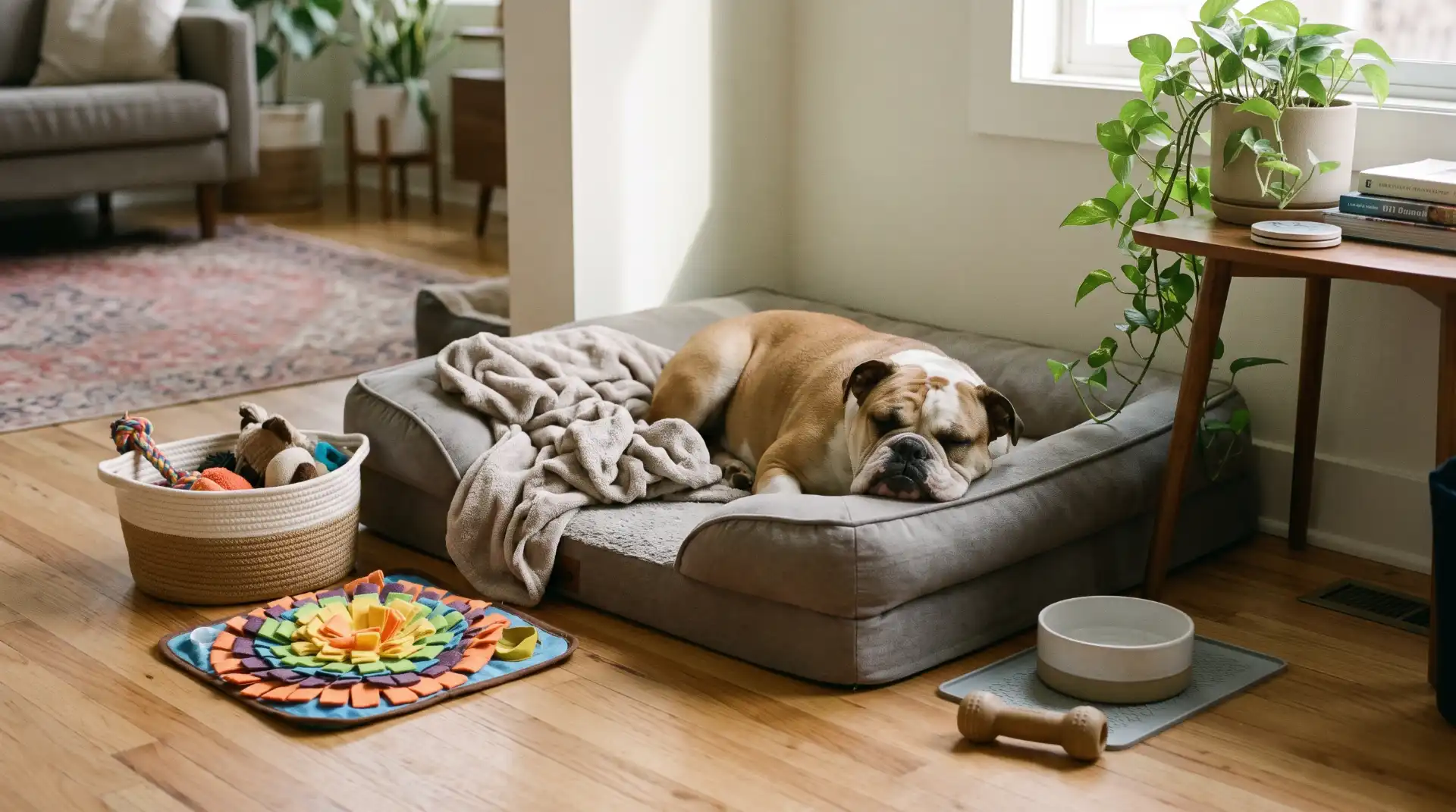
Snuffle mats allow dogs to search through fabric sections for small portions of food.
Scent-based activities can be particularly useful because they encourage natural investigative behavior without requiring intense physical exercise.
Owners can hide kibble in different sections of an appropriate mat and allow the dog to locate it.
Begin with simple arrangements before increasing difficulty.
Never leave a dog unattended with an enrichment item that it may tear apart or swallow.
Safe Chewing Opportunities
Chewing can be a rewarding activity for many dogs.
Provide veterinarian-approved chew products or durable toys suited to the dog’s chewing strength.
Avoid objects that are excessively hard or small enough to create choking hazards.
A dog should be observed while using a new chew item so the owner can determine whether it is appropriate.
Chewing should be considered one component of enrichment rather than a guaranteed way to prevent anxiety.
Rotating Toys
Leaving every toy available at all times may reduce interest in individual items.
Instead, maintain a small collection of safe toys and rotate them periodically.
For example, a Continental Bulldog may receive a particular puzzle toy during a supervised morning activity and a different enrichment item on another day.
Introduce new toys while the owner is present before considering their use during short absences.
Indoor Training Games
Short training sessions can provide both mental stimulation and opportunities to strengthen communication.
Practice simple activities such as touching a target, finding a hidden treat, responding to a name, or moving to a designated mat.
These games can be especially helpful on days when outdoor exercise is limited by rain, excessive heat, or other environmental conditions.
For more training ideas, see Training Tips for Continental Bulldogs: From Puppy to Adult.
Why Mental Enrichment Should Not Replace Companionship
Food puzzles and toys cannot replace every social need.
Dogs still require appropriate human interaction, exercise, bathroom opportunities, preventive healthcare, and opportunities to explore their environment.
A Continental Bulldog that spends most of the day alone should not be expected to remain emotionally healthy simply because several toys are available.
Enrichment works best as part of a balanced lifestyle.
7. Creating a Comfortable Environment for Alone Time
The environment in which a dog spends time alone can influence its ability to settle.
Owners should create a predictable area that provides comfort, safety, and opportunities for rest.
Choose a Suitable Resting Area
A quiet room or appropriately sized gated area may work well for a Continental Bulldog.
The location should have comfortable bedding, appropriate temperature control, fresh water, and access to safe enrichment items.
Avoid placing the resting area beside a noisy street-facing window if outdoor activity causes the dog to become agitated.
Some dogs prefer a room where they can see ordinary household activity. Others relax better in a quieter space.
Observe your dog’s preferences rather than assuming that one arrangement works for every animal.
Crate Training: Helpful for Some Dogs, Unsuitable for Others
Crates are often used for house training, transportation, and providing a designated resting area.
When introduced positively, a crate can become a familiar place where a dog feels comfortable.
However, confinement is not an automatic solution for separation anxiety.
Some dogs become more distressed when placed inside a crate, particularly if they already associate confinement with being unable to escape.
A dog that bites crate bars, scratches continuously, drools excessively, or attempts to force its way out may injure itself.
If these reactions occur, stop using the crate as an alone-time solution and discuss alternatives with a veterinarian or qualified behavior professional.
For additional information about introducing a safe resting space, read the Continental Bulldog Crate Training Guide for New Owners.
Temperature and Indoor Comfort
Continental Bulldogs should be left in a comfortable indoor environment with appropriate ventilation.
Temperature management is particularly important for dogs with individual respiratory sensitivities or reduced tolerance for heat.
During American summers, an air-conditioned room may be more appropriate than an enclosed space without adequate cooling.
Provide fresh water and avoid leaving the dog in a parked vehicle, garage, or outdoor area where temperatures can become unsafe.
If your dog has a history of breathing difficulties, discuss appropriate home temperature management with your veterinarian.
Reduce Disturbing Outdoor Noise
Some dogs become anxious when they hear unfamiliar sounds outside.
Traffic, construction, lawn equipment, delivery vehicles, and neighborhood animals may create repeated stimulation.
Closing curtains, selecting a quieter room, or using moderate background sound may help reduce environmental disturbances.
However, background music or television should not be treated as a cure for separation anxiety.
The objective is to create a comfortable environment without relying on noise to mask significant distress.
8. Developing a Daily Routine for a Continental Bulldog
A predictable schedule can help dogs understand what to expect throughout the day.
Owners do not need to follow an exact timetable, but regular patterns involving feeding, exercise, training, and rest can make daily life easier to manage.
Morning Routine
Begin the day with an appropriate bathroom opportunity and a moderate walk or indoor activity suited to the dog’s health and fitness.
Allow time for sniffing and environmental exploration rather than focusing exclusively on distance or speed.
Afterward, provide breakfast and a brief enrichment activity.
If the dog is practicing alone-time training, complete a short session when it is comfortable and relaxed.
Avoid scheduling difficult separation exercises immediately after an intense or stressful event.
Midday Routine
If the owner is away during the workday, consider whether the dog’s individual needs can be met through an appropriate break.
A trusted dog walker, family member, or qualified pet sitter may provide a bathroom opportunity and companionship.
For puppies, older dogs, and dogs with medical needs, midday visits may be particularly important.
Owners should not assume that every Continental Bulldog can comfortably remain alone for a full workday.
Evening Routine
After returning home, provide an appropriate opportunity for exercise, play, and interaction.
This may include a walk, a supervised scent game, basic obedience practice, or a quiet enrichment activity.
Allow the dog to settle after activity rather than maintaining constant stimulation.
Evening routines can also include short independence exercises that do not involve leaving the house.
Weekend Training
Weekends can provide additional opportunities to practice departure cues and brief absences.
However, owners should avoid using weekends to suddenly increase separation duration.
Continue working at the level the dog can tolerate and maintain a consistent approach throughout the week.
A realistic schedule is more effective than occasional long training sessions followed by several days without practice.

9. Helping Adult and Senior Continental Bulldogs Adjust to Being Alone
Separation anxiety is not limited to puppies.
Adult dogs may develop separation-related problems after changes in employment, family circumstances, housing, or daily routines.
Senior dogs may also experience new difficulties associated with medical conditions, sensory changes, or age-related cognitive decline.
Adult Dogs Adapting to a New Household
A newly adopted adult Continental Bulldog may need time to understand its new environment.
Owners should avoid expecting immediate independence.
Begin by establishing predictable routines and allowing the dog to become familiar with its resting area.
Introduce short periods of separation gradually while observing its behavior.
If the dog has previously lived with someone who was home throughout the day, the transition to an empty household may require additional preparation.
Changes in Family Employment
One common challenge occurs when owners return to an office after working remotely.
During remote work, the dog may have become accustomed to constant human presence.
When the schedule changes, the animal suddenly experiences longer periods without companionship.
To reduce the difficulty, begin practicing short departures before the employment schedule changes.
Arrange appropriate daytime care when necessary and avoid expecting the dog to adapt immediately.
Senior Dogs and Separation-Related Distress
Older Continental Bulldogs may become more sensitive to changes in their surroundings.
Vision or hearing loss can make familiar environments feel less predictable. Pain or mobility problems may also affect their ability to settle comfortably.
Some senior dogs develop cognitive dysfunction, which can influence sleep patterns, orientation, and behavior.
If an older dog suddenly becomes anxious when left alone, arrange a veterinary assessment.
Treatment may involve addressing medical problems, adjusting the home environment, changing daily routines, or using appropriate veterinary therapies.
Do not assume that new behavioral difficulties are simply an unavoidable part of aging.
10. Common Mistakes Owners Should Avoid When Treating Separation Anxiety
Owners naturally want their dogs to feel better as quickly as possible. However, certain approaches can make separation-related distress more difficult to manage.
Leaving the Dog Alone for Too Long Too Soon
A dog that becomes anxious after five minutes should not suddenly be expected to tolerate several hours alone.
Repeated exposure to overwhelming absences may reinforce the negative emotional association.
Instead, work at a duration the dog can manage comfortably and increase difficulty gradually.
Punishing Destructive Behavior
Finding damaged furniture or indoor accidents after returning home can be frustrating.
However, scolding a dog after the event does not teach it how to remain comfortable during future absences.
Punishment may increase anxiety and damage the relationship between the dog and owner.
Focus on identifying the underlying trigger and adjusting the training plan.
Using Exercise to Exhaust the Dog
Exercise is important, but attempting to exhaust a Continental Bulldog before leaving may not solve separation anxiety.
Excessive physical activity can create fatigue, discomfort, and overheating, particularly in dogs with individual respiratory or orthopedic concerns.
Choose appropriate activity based on age, health, weather, and veterinary advice.
Mental enrichment and gradual independence training should complement exercise rather than be replaced by it.
Assuming a Crate Will Fix the Problem
Crates are useful management tools for some dogs, but they can worsen distress in others.
Never force a dog into confinement if it is showing signs of panic or attempting to injure itself.
Choose the resting arrangement that best supports the individual dog’s safety and comfort.
Expecting Immediate Results
Behavior modification takes time.
A Continental Bulldog that has experienced months of separation-related distress may need a structured program lasting several weeks or longer.
Some dogs progress steadily, while others experience setbacks after changes in routine or unexpected absences.
Measure improvement through changes in behavior, recovery time, and the dog’s ability to remain relaxed rather than expecting a particular result by a specific date.
11. When to Seek Professional Help for Separation Anxiety
Mild separation-related difficulties may improve with careful management and gradual training. More serious cases often require professional assistance.
Owners should seek veterinary guidance when the dog experiences persistent distress, self-injury, repeated escape attempts, severe destruction, or physical symptoms associated with departures.
Veterinary Assessment
A veterinarian can evaluate possible medical contributors and discuss appropriate treatment options.
This is particularly important when the behavior begins suddenly, worsens rapidly, or occurs alongside changes in appetite, sleep, mobility, or bathroom habits.
The veterinarian may recommend a referral to a veterinary behaviorist if the case requires specialized behavioral treatment.
Certified Dog Trainers and Behavior Professionals
Qualified trainers can help owners develop a structured independence-training program.
Look for professionals who understand separation-related distress and use reward-based methods.
Credentials may include Certified Professional Dog Trainer (CPDT-KA), Certified Separation Anxiety Trainer (CSAT), or relevant professional behavior qualifications.
A board-certified veterinary behaviorist can assess more complex cases and coordinate behavioral treatment with medical care.
Ask about the professional’s experience treating separation anxiety specifically, rather than assuming that general obedience experience is sufficient.
Medication for Moderate or Severe Anxiety
Some dogs benefit from veterinary-prescribed medication as part of a comprehensive treatment plan.
Medication may help reduce distress enough for the dog to participate in behavior modification.
The choice depends on the individual animal, medical history, symptom severity, and expected duration of treatment.
Never give your Continental Bulldog human anxiety medication, sedatives, or supplements without veterinary approval.
Medication should be monitored by the prescribing veterinarian, who can evaluate effectiveness, side effects, and any need for adjustments.
12. Managing Separation Anxiety When You Work Full-Time in the United States
Many American households have employment schedules that require adults to leave home for several hours.
For owners of Continental Bulldogs, this can create practical challenges when a dog has difficulty remaining alone.
A realistic care arrangement should consider the dog’s training progress, age, health, and ability to tolerate separation.
Consider a Professional Dog Walker
A professional dog walker can provide a bathroom opportunity, supervised activity, and a break in the day.
However, the walker should be selected carefully.
Choose someone experienced with dogs who understands the importance of calm introductions and consistent handling.
A walker should not force a dog into unfamiliar situations or attempt to correct separation anxiety through punishment.
Explore Pet Sitting
Some dogs benefit from having a trusted person remain in the home during an owner’s absence.
A pet sitter may provide companionship, feeding, bathroom breaks, and familiar routines.
This can be especially helpful during the early stages of separation training when longer absences are not yet manageable.
Dog Daycare: Is It Suitable?
Dog daycare can provide supervised social interaction and activity, but it is not appropriate for every Continental Bulldog.
Some dogs enjoy group environments, while others become overwhelmed by unfamiliar animals, noise, and continuous stimulation.
Daycare should also be evaluated according to the dog’s health, temperament, vaccination status, and physical condition.
Do not use daycare as an automatic solution for separation anxiety. A dog may still need to learn how to relax independently even if it attends daycare several times a week.
Arrange Flexible Work or Family Support
Where possible, flexible work schedules, staggered household departures, or assistance from relatives can help reduce the amount of time a dog spends alone.
For a dog undergoing treatment, avoiding absences that trigger severe distress can be an important part of management.
The practical solution will depend on the household’s resources and the dog’s individual needs.
13. Measuring Progress and Maintaining Long-Term Independence
Improvement should be evaluated through the dog’s actual behavior rather than simply the amount of time it spends alone.
A Continental Bulldog may initially manage short absences but become increasingly relaxed as training continues.
Owners should look for signs that the dog is developing confidence rather than merely becoming quieter.
Track Changes in Behavior
Continue recording the duration of absences and the dog’s responses.
Positive developments may include:
- Less pacing after departure.
- Reduced vocalization.
- Increased willingness to use enrichment toys.
- Longer periods of comfortable resting.
- Fewer attempts to approach exit doors.
- Faster recovery after the owner returns.
These changes can indicate that the dog is becoming more comfortable with separation.
Avoid Becoming Dependent on Constant Entertainment
The long-term objective is not to keep the dog occupied every second.
A comfortable adult Continental Bulldog should have opportunities to rest without needing continuous entertainment.
Enrichment should be part of the daily routine, but the dog should also learn that periods of quiet inactivity are normal.
Prepare for Changes in Routine
Travel, holidays, visitors, home renovations, and changes in employment can disrupt established patterns.
Prepare your dog for predictable changes gradually whenever possible.
If a trusted sitter will be caring for the dog, introduce that person before the owner’s departure.
Maintain familiar feeding and resting routines and provide clear instructions about the dog’s training plan.
Continue Practicing Independence
Even after a dog improves, continue occasional short independence exercises.
This helps maintain the skills developed during training and gives owners opportunities to notice changes early.
If the dog begins showing renewed distress, reassess the routine rather than assuming the behavior will disappear on its own.
Conclusion: Helping Continental Bulldogs Become More Confident When Home Alone
Separation anxiety can be challenging for both Continental Bulldogs and their owners, but it does not have to define the dog’s everyday life.
The most important step is recognizing that separation-related distress is an emotional and behavioral concern rather than deliberate misbehavior. Barking, destructive chewing, pacing, and attempts to escape may indicate that a dog is struggling to cope with being alone.
Prevention begins with helping puppies develop independence through short, positive experiences. Adult dogs can also benefit from gradual desensitization, counterconditioning, predictable routines, and comfortable resting environments.
Mental stimulation, food puzzles, scent games, and reward-based training provide valuable enrichment, but they should be used as part of a broader plan rather than treated as a complete cure.
Owners should also consider the practical realities of American work schedules. Dog walkers, pet sitters, family assistance, and appropriate daycare arrangements may help provide companionship while a dog develops better alone-time skills.
When symptoms are severe or persistent, veterinary assessment and professional behavioral support are important. Some dogs require medication alongside training, particularly when anxiety interferes significantly with their quality of life.
Every Continental Bulldog progresses at a different rate. Some may become comfortable with short departures relatively quickly, while others require longer periods of gradual practice and management.
Patience, consistency, and attention to individual needs make the greatest difference. By creating positive experiences around independence and responding appropriately to signs of distress, owners can help their Continental Bulldogs develop greater confidence, enjoy comfortable resting periods, and become better prepared for the ordinary separations that occur throughout family life.