
Creating a Safe and Happy Relationship Between Children and Continental Bulldogs
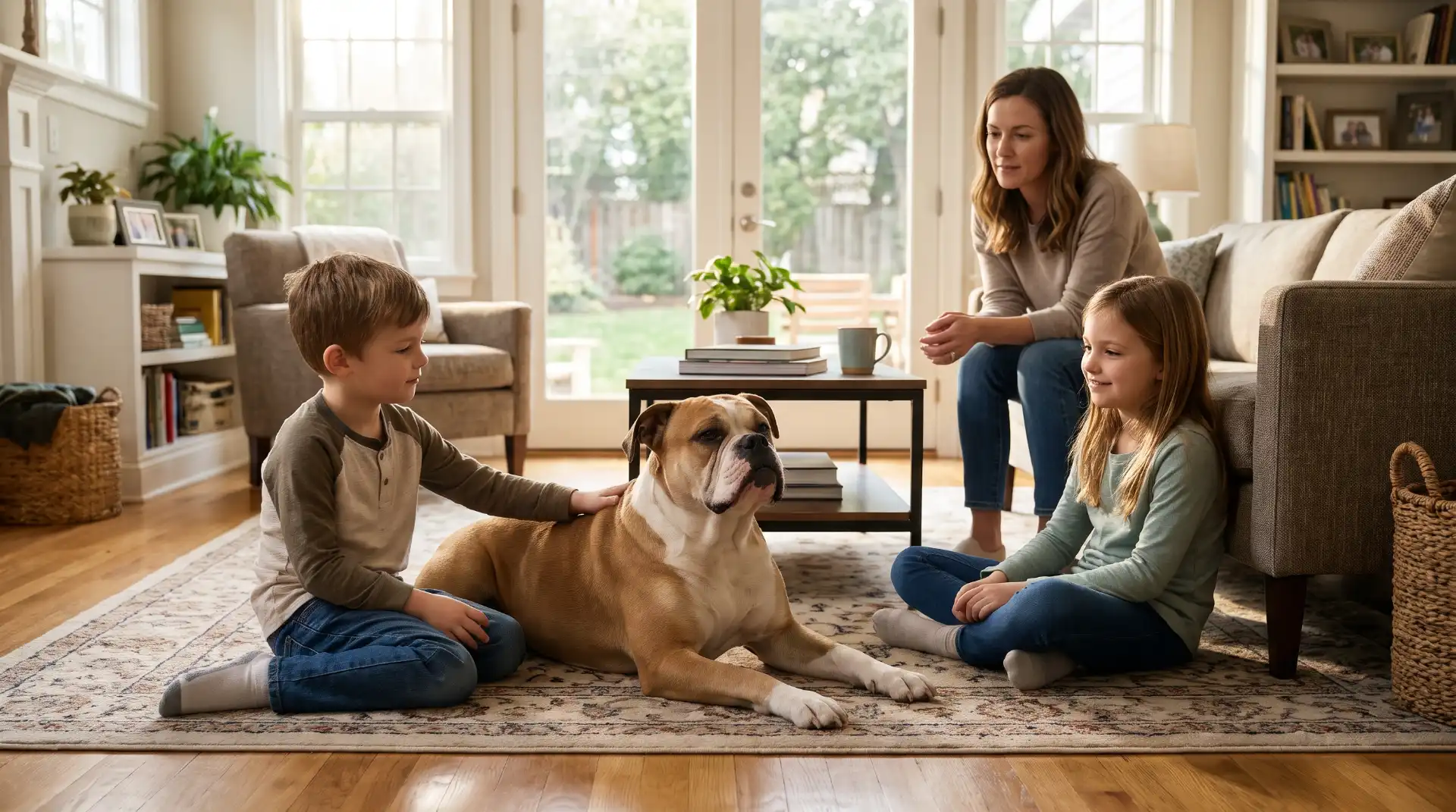
Dogs can become important members of a family, providing companionship, affection, entertainment, and opportunities for children to learn responsibility. For many American households, having a dog means introducing another personality into everyday family life. Children may look forward to playing in the backyard, taking neighborhood walks, helping with feeding routines, and relaxing with their four-legged companion. A Continental Bulldog can become part of these experiences when the household establishes appropriate expectations, consistent training, and safe interactions.
Continental Bulldogs are muscular, athletic companion dogs developed in Switzerland. They are generally known for their balanced appearance and companion-oriented qualities, although individual dogs have different personalities, temperaments, and behavioral needs. Some enjoy being involved in family activities, while others prefer quieter environments and more opportunities to rest. Their suitability for a household with children should therefore be evaluated individually rather than assumed from breed characteristics alone.
The relationship between Continental Bulldogs and children requires more than teaching a dog to follow basic commands. Parents must also teach children how to recognize canine communication, approach animals respectfully, and understand situations in which a dog should be left alone. Similarly, dogs need gradual socialization, positive reinforcement, and predictable household routines to help them feel comfortable around younger family members.
Safety is especially important because even a familiar, affectionate family dog can react defensively when frightened, startled, injured, or overwhelmed. Children may unintentionally create uncomfortable situations by hugging a dog tightly, pulling its ears, disturbing it while sleeping, or attempting to take away a favorite toy. These interactions can result in scratches, falls, defensive reactions, or dog bites.
Fortunately, many preventable incidents can be addressed through responsible supervision, appropriate training, household boundaries, and early education. Families that understand the needs of both children and dogs can create an environment in which everyone feels secure.
This guide explains how to introduce Continental Bulldogs to children, teach age-appropriate dog handling, recognize warning signs, prevent common household accidents, and develop healthy family routines that support a lasting relationship.
1. Understanding the Relationship Between Continental Bulldogs and Children
Before bringing a Continental Bulldog into a household with children, parents should understand that dogs and young people communicate differently. Children often express affection through hugging, touching, chasing, and enthusiastic physical play. Dogs, however, may interpret some of these behaviors as uncomfortable or threatening.
A child might believe that wrapping both arms around a dog’s neck is a friendly gesture. The dog may experience the same interaction as restrictive physical contact. Similarly, a child who approaches a resting dog to offer a toy may not recognize that the animal is tired and does not want to participate.
These differences do not mean children and dogs cannot develop close relationships. They simply mean that successful interactions require education and adult involvement.
Why Individual Temperament Matters
Continental Bulldogs should not automatically be considered suitable for every family simply because of their breed. Their behavior depends on several factors, including genetics, early experiences, socialization, training, health, and the environment in which they live.
Some dogs naturally enjoy being around children and are comfortable with ordinary household activity. Others may be more reserved, sensitive to loud noises, or uncomfortable with sudden movements.
Parents should evaluate the individual dog’s behavior rather than relying exclusively on descriptions of the breed.
When considering an adult Continental Bulldog, ask about its previous experiences with children, reactions to unfamiliar people, handling preferences, resource guarding, and history of fear or aggressive behavior. If possible, arrange a carefully managed introduction with an experienced adult present.
Families considering a puppy should also ask the breeder about the parents’ temperaments, early socialization practices, and the puppy’s observed behavior.
Understanding the Dog’s Need for Personal Space
Children should learn that a family dog is not a toy that must always be available for interaction. Like people, dogs need opportunities to rest, eat, explore, and spend time without being disturbed.
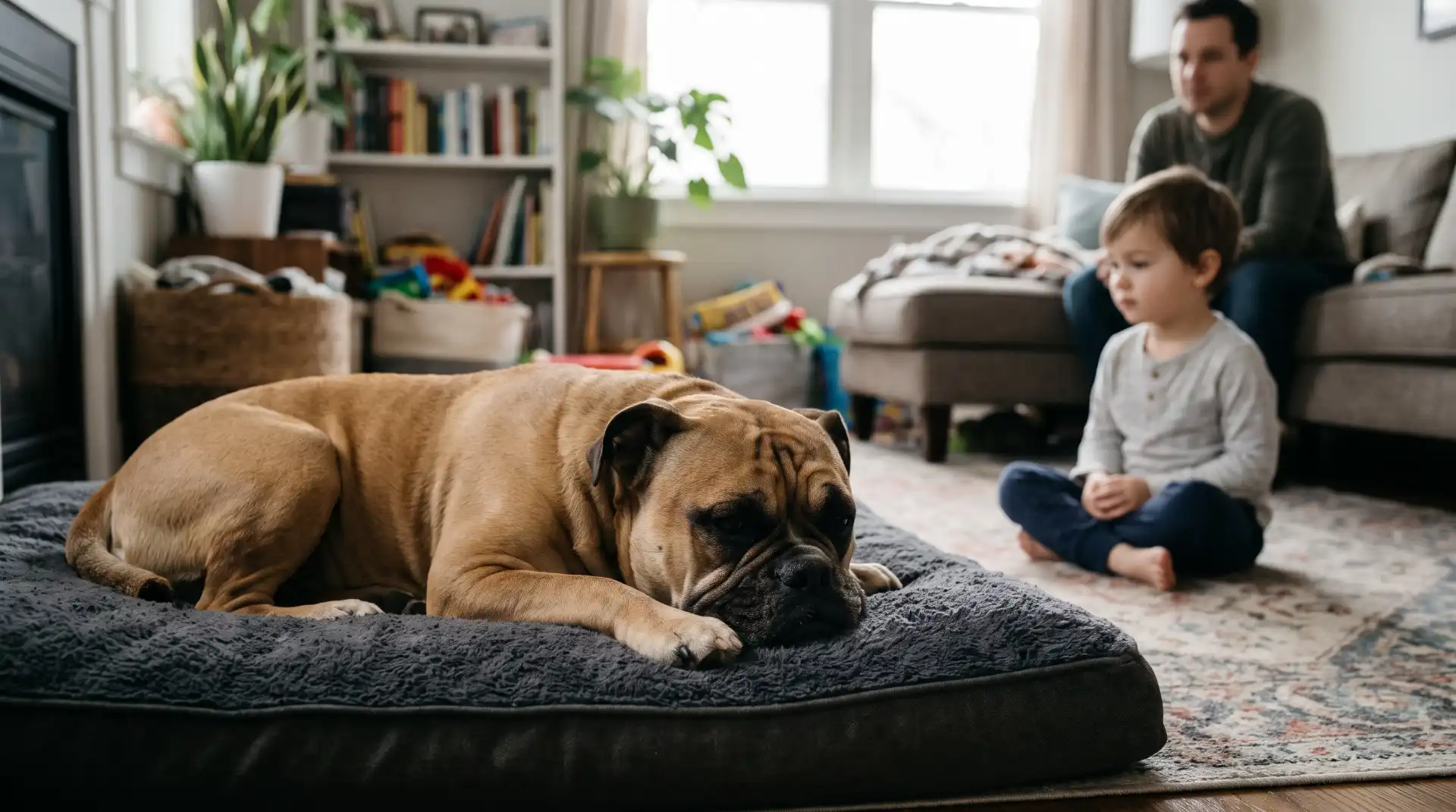
A Continental Bulldog should have a designated resting area where children understand that interaction is not allowed. This could be a comfortable bed in a quiet corner, a crate introduced through positive training, or a separate room protected by a child gate.
The dog’s resting area should remain accessible without requiring it to pass through an active play area. Children should never climb into the dog’s crate, reach inside to retrieve toys, or disturb the animal while it is sleeping.
Giving a dog personal space helps reduce unnecessary stress and teaches children an important lesson about respecting the boundaries of other living creatures.
The Importance of Matching the Dog to the Household
A family’s daily routine should influence the decision to bring home a dog. Parents who work long hours, have several young children, or frequently host large gatherings should consider how these activities might affect an individual dog’s comfort.
A household with toddlers may require more physical separation and adult supervision than one with teenagers who already understand responsible animal handling.
Parents should also consider whether they have enough time for exercise, training, grooming, veterinary appointments, and socialization. A dog that receives inadequate attention or becomes chronically overstimulated may develop behavioral difficulties that make family interactions more challenging.
Choosing a suitable dog involves evaluating the needs of everyone in the household, including the animal.
2. Introducing a Continental Bulldog to Children for the First Time
The first introduction between a Continental Bulldog and a child can influence how both respond to future interactions. Rushing this process or allowing children to overwhelm the dog may create unnecessary anxiety.
A calm, organized introduction is generally preferable to an exciting gathering in which several people approach the dog simultaneously.
Preparing the Home Before the Introduction
Before the dog arrives, parents should prepare the household by establishing designated spaces and explaining basic rules to children.
Remove objects that could create hazards, such as small toys, loose electrical cords, medications, cleaning products, and children’s belongings that the dog might chew. Place food bowls and dog toys in areas where children cannot casually interfere with them.
Parents should also decide where the dog will sleep, eat, and relax. These arrangements should be established before the first introduction so that the dog has predictable places to retreat.
Children should understand that the dog is allowed to walk away from an interaction. Nobody should follow, corner, or force the animal to remain near them.
Making the First Meeting Calm and Controlled
The initial meeting should take place in a relatively quiet environment with an adult controlling the situation.
Allow the Continental Bulldog to observe the child from a comfortable distance. Avoid encouraging the child to run toward the dog, shout its name repeatedly, or immediately attempt to touch its face.
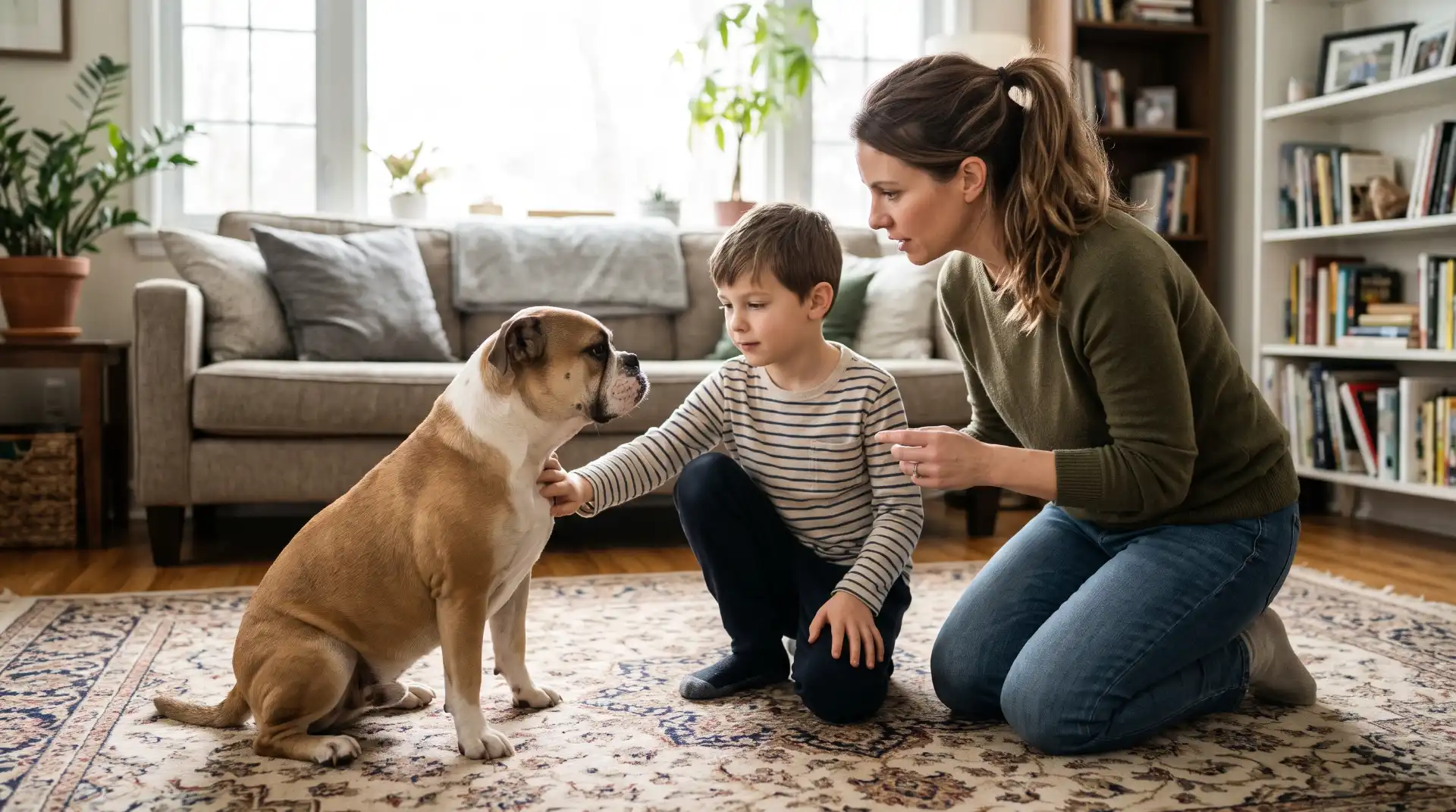
If the dog appears relaxed and voluntarily approaches, the adult can guide the child in offering a calm greeting. The child should remain relatively still and allow the dog to investigate without forcing contact.
Parents should watch both participants throughout the interaction. If the dog moves away, turns its head, becomes tense, or appears uncomfortable, give it additional space.
The first meeting does not need to involve extended petting or play. A short, positive experience is often more valuable than a lengthy interaction that becomes overwhelming.
Introducing a New Puppy to Children
Puppies require additional supervision because they are still learning how to interact with people and their environment.
A young Continental Bulldog may become excited when children move quickly, run across the room, or make sudden noises. Puppies may also explore the world with their mouths, which can lead to playful nipping or accidental scratches.
Parents should explain that puppy teeth are sharp and that rough play can encourage unwanted behavior.
Children can participate in short, supervised activities such as tossing an appropriate toy, rewarding a simple trained behavior, or helping prepare the dog’s food with adult assistance.
However, puppies should not be expected to tolerate constant handling. They need sufficient sleep, appropriate exercise, and opportunities to explore without interference.
Introducing an Adult Continental Bulldog
Adult dogs may have established routines and previous experiences that influence how they respond to children.
An adult dog that has lived in a quiet household may need more time to adjust to a busy family environment. A rescue dog may also have an incomplete behavioral history.
Parents should avoid assuming that a calm first meeting guarantees that the dog will remain comfortable in every situation.
Instead, introduce family routines gradually. Monitor interactions during meals, playtime, visitors, and periods of increased household activity.
If the dog’s history includes biting, serious fear, or aggression toward children, obtain professional veterinary and behavioral guidance before attempting direct interactions.
3. Teaching Children How to Properly Handle a Continental Bulldog
One of the most effective ways to prevent dog-related accidents is to teach children how to interact appropriately with animals.
Children should understand that safe handling is not about controlling a dog or making it perform tricks. It involves respecting its body, recognizing its preferences, and allowing it to participate voluntarily.
The appropriate lessons depend on the child’s age, maturity, and ability to follow instructions.
Teaching Gentle Petting
Children should learn to approach a dog calmly rather than reaching over its head or grabbing its body.
When the dog is comfortable and an adult has approved the interaction, a child can offer a relaxed hand for the dog to investigate. The child can then gently stroke an area such as the shoulder or side of the body.
Avoid encouraging children to pull the ears, touch the eyes, grab the tail, squeeze the muzzle, or repeatedly pat the top of the head.
Parents should also discourage face-to-face contact. Children should not put their faces close to a dog’s mouth or attempt to kiss the animal.
Even a dog that enjoys ordinary petting may become uncomfortable when a person gets too close to its face.
Why Children Should Avoid Hugging Dogs
Hugging is a common way people express affection, but many dogs do not enjoy being tightly embraced.
A child who wraps their arms around a Continental Bulldog may unintentionally restrict its movement. If the dog feels trapped, it may try to escape, struggle, or react defensively.
Instead of encouraging hugs, teach children to show affection through gentle petting when the dog welcomes it, tossing an appropriate toy, or sitting nearby while the animal relaxes.
Parents should explain that allowing a dog to choose when to approach is an important part of friendship.
Teaching Children Not to Disturb Dogs While Eating
Food-related incidents are another preventable source of conflict.
Children should never reach into a dog’s food bowl, take food directly from its mouth, or attempt to remove a chew or toy without adult assistance.
A dog may become protective of something it considers valuable. This behavior is known as resource guarding and can range from moving away with an object to growling or attempting to bite.
Establish a household rule that feeding time is private. Children should remain away from the dog’s feeding area until the animal has finished and an adult has safely removed the bowls.
If a Continental Bulldog shows signs of resource guarding, do not punish the dog for growling or attempt to forcefully take objects away. Consult a qualified reward-based trainer or veterinary behavior professional.
Teaching Children How to Play Safely
Children often want to play physically with dogs, but not every game is appropriate.
Running and chasing, wrestling, roughhousing, and encouraging a dog to jump on people can create dangerous situations.
For a muscular dog such as a Continental Bulldog, accidental collisions may knock a young child off balance even when the dog is only excited.
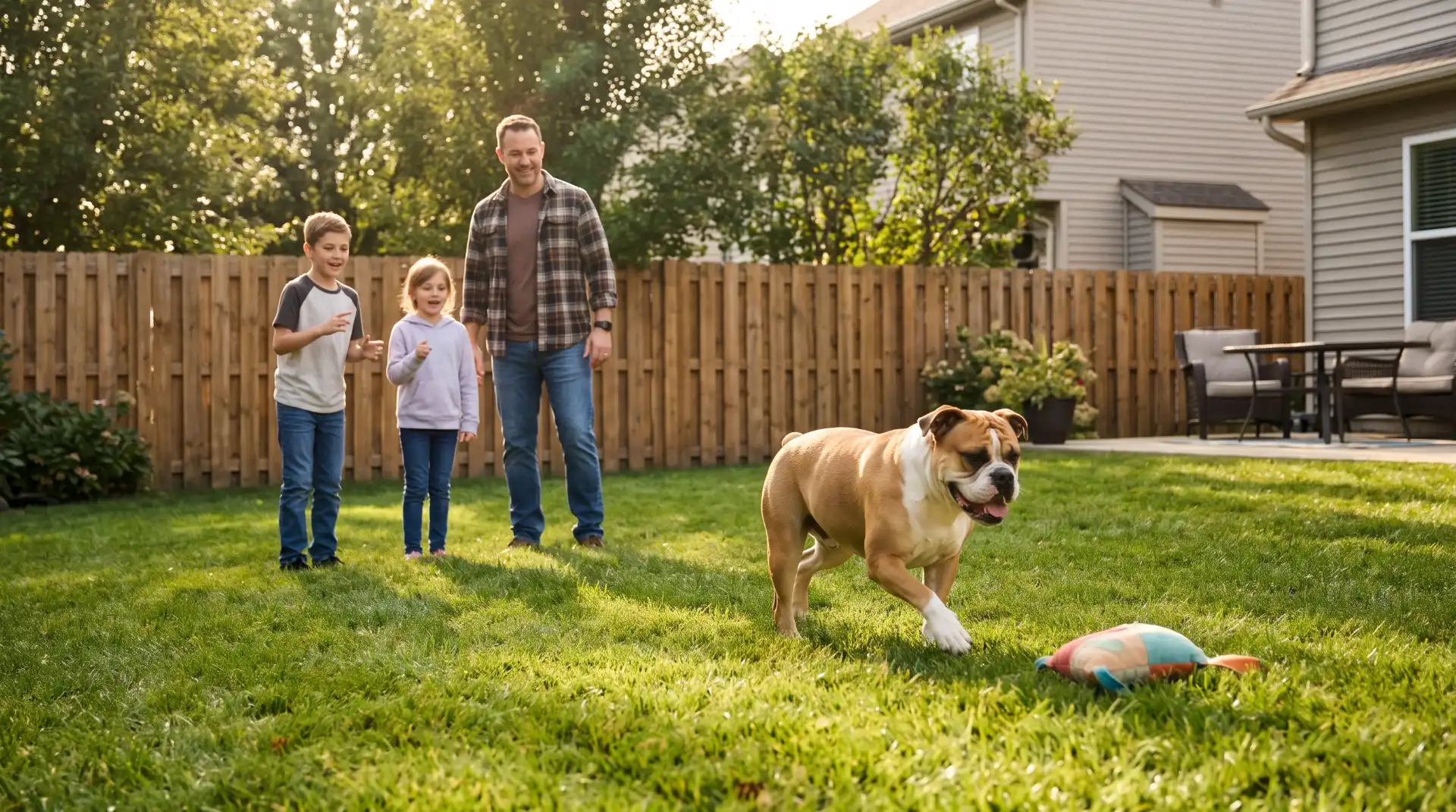
Safer activities include supervised fetch with appropriate toys, simple reward-based training exercises, and scent games in which the dog searches for treats hidden in accessible locations.
An adult should control the activity and end the session if either participant becomes overly excited.
The goal is to make play enjoyable without encouraging uncontrolled physical contact.
Teaching Children to Respect a Dog’s Sleeping Area
A dog that is sleeping or resting should not be disturbed.
Children should never climb onto a dog bed, pull a blanket away, wake the animal by touching its face, or attempt to move it physically.
Parents can explain that dogs need sleep just as children do. A dog that has been resting should be allowed to wake naturally and approach family members when ready.
Establishing this rule early can prevent many avoidable confrontations.
4. Recognizing Continental Bulldog Body Language and Warning Signs
Understanding canine body language is one of the most important skills parents can develop when raising children around dogs.
Dogs communicate through movement, posture, facial expressions, vocalizations, and changes in behavior. Some warning signs are obvious, but others are subtle.
Children may not recognize these signals without guidance, which is why adults must remain responsible for interpreting the dog’s behavior.
Signs That a Dog Is Comfortable
A relaxed dog may display loose body movements, a soft facial expression, and a willingness to approach voluntarily.
It may choose to remain near a child, participate in a game, or return for additional interaction after briefly walking away.
However, no single body-language signal proves that a dog is comfortable. Tail wagging, for example, does not automatically mean an animal is happy or welcoming.
Parents should consider the dog’s overall posture and behavior rather than relying on one feature.
Signs That a Dog Needs Space
Some dogs communicate discomfort by looking away, turning their heads, licking their lips, yawning, flattening their ears, or moving away.
Other signs may include a tucked tail, lowered posture, showing the whites of the eyes, or suddenly becoming unusually still.
These behaviors do not always indicate aggression. They may simply mean that the dog is uncertain, uncomfortable, or seeking a break.
Parents should teach children to stop interacting when these signals appear.
For example, if a child is petting the dog’s back and the animal repeatedly turns its head away, an adult should calmly end the interaction and allow the dog to leave.
Understanding Growling
Growling is a warning signal that should always be taken seriously.
A Continental Bulldog may growl because it feels threatened, is experiencing pain, wants to protect a valued object, or is uncomfortable with an interaction.
Children should never be encouraged to punish a dog for growling or challenge it to stop.
Punishing warning signals can make it harder for people to recognize when a dog is uncomfortable. Instead, adults should calmly separate the child and dog, identify what happened, and seek professional help when necessary.
A growling dog should not be forced to continue interacting with a child.
Why Sudden Stillness Matters
Some dogs become very still when they feel uncomfortable.
A child may interpret this behavior as calmness because the dog is no longer moving. However, sudden stiffness can indicate tension or uncertainty.
Parents should look for other changes, including a closed mouth, fixed gaze, rigid posture, or attempts to avoid contact.
If these behaviors appear, end the interaction and give the dog space.
The American Veterinary Medical Association provides additional information about canine communication and bite prevention in its guide to preventing dog bites.
5. Preventing Dog Bites and Other Accidents at Home
Preventing accidents requires more than teaching children to behave appropriately. Parents must also organize the home so that potentially dangerous situations are less likely to occur.
Even a well-trained dog can become startled, frightened, injured, or overwhelmed.
Always Supervise Young Children Around Dogs
One of the most important rules for households with children is that babies and young children should never be left alone with a dog.
Supervision means that an attentive adult is close enough to intervene immediately. Watching from another room or relying on a child to report a problem is not adequate supervision.
Parents should also avoid becoming distracted by phones, television, household chores, or conversations when a young child is interacting with the dog.
If an adult cannot actively supervise, use a secure physical barrier to separate the child and animal.
The CDC specifically advises that young children should not play with dogs without supervision, even when the dog is familiar to them. Its dog safety guidance provides useful information for American families.
Use Baby Gates and Separate Spaces
Baby gates can help establish boundaries between children and dogs without requiring constant physical restraint.
For example, a gate can protect the dog’s resting area or separate the feeding area from the kitchen’s main activity space.
Parents may also use a secure exercise pen or separate room when children have energetic play sessions or when visitors arrive.
These arrangements are particularly helpful during busy family events, birthday parties, and holiday gatherings.
The dog should always have access to water, comfortable resting space, and a safe opportunity to retreat.
Prevent Accidental Falls and Collisions
Continental Bulldogs are muscular dogs, and enthusiastic movement can unintentionally knock over a small child.
A dog that runs toward a child, jumps during greeting, or changes direction suddenly may cause a fall.
Teach children not to encourage jumping or chase games inside the house. Adults should reward calm greetings and discourage uncontrolled running around young children.
Maintain clear walking areas by removing toys, loose rugs, and objects that could cause either the child or dog to trip.
Outdoor play should take place in a secure area with appropriate adult supervision.
Prevent Food and Toy Conflicts
Children should not compete with dogs over food, toys, or other possessions.
Store dog treats and food in areas that children cannot access independently. Keep small toys, craft materials, and children’s snacks away from the dog’s reach.
Dogs that swallow inappropriate objects may develop choking hazards or gastrointestinal obstructions.
Parents should teach children to ask an adult for help rather than attempting to retrieve something from the dog’s mouth.
If a dog swallows a potentially dangerous object, contact a veterinarian promptly.
Avoid Disturbing Dogs During High-Stress Situations
Household activity can become overwhelming during storms, fireworks, moving days, construction, or large gatherings.
During these periods, provide the dog with a quiet area away from noise and constant movement.
Children should understand that the dog may not want to participate in family activities all the time.
Allowing the animal to rest can reduce stress and help prevent defensive reactions.
6. Building Positive Training Habits for Family Life
Training helps Continental Bulldogs understand household expectations and gives children opportunities to participate in safe, structured activities.
However, training should be led by adults. Children can assist with simple exercises once they understand the rules and can follow instructions consistently.
Start With Basic Obedience
Important foundation behaviors include responding to a name, coming when called, sitting, waiting, and settling on a designated mat.
These behaviors can make everyday interactions more manageable.
For example, teaching a dog to sit before greeting family members can reduce jumping. A reliable recall can help an adult redirect the dog when children are playing.
Training should use rewards, consistency, and realistic expectations.
Avoid harsh corrections, physical intimidation, or methods designed to frighten the animal.
Families can find additional guidance in Training Tips for Continental Bulldogs: From Puppy to Adult.
Teach Calm Greetings
Dogs often become excited when family members return home or visitors arrive.
A child who approaches an excited dog may accidentally get knocked over.
Practice calm greeting routines in which the dog receives attention when it has all four paws on the ground and is behaving appropriately.
Children should wait for an adult’s permission before approaching the dog during these moments.
If the dog becomes too excited, allow it to settle before interaction continues.
Use Positive Reinforcement
Positive reinforcement involves rewarding behaviors that families want to encourage.
Rewards may include appropriate treats, toys, praise, or opportunities to participate in enjoyable activities.
For example, if a Continental Bulldog remains calmly on its mat while children play nearby, an adult can reward that behavior.
Similarly, the dog can receive reinforcement for walking calmly beside an adult or responding to a recall cue.
The purpose is to make desirable behaviors more likely without relying on fear or punishment.
Establish Consistent Household Rules
Everyone in the household should follow the same expectations.
If one family member allows the dog to jump on children while another discourages it, the dog may struggle to understand what is expected.
Parents should agree on rules regarding furniture, feeding, sleeping areas, toys, greeting visitors, and playtime.
Consistency makes daily routines more predictable for both children and dogs.
7. Helping Children Participate in Responsible Dog Care
Including children in appropriate dog-care activities can help them develop empathy, patience, and responsibility.
However, participation should match the child’s age and maturity.
Young children should not be expected to manage essential animal-care responsibilities independently.
Feeding With Adult Supervision
Older children may help measure food or prepare a bowl under adult supervision.
The dog should be in its designated feeding area before food is placed down, and children should leave the animal alone while it eats.
Parents remain responsible for ensuring the correct diet, portion sizes, and feeding schedule.
Helping With Grooming
Children may enjoy watching or assisting with gentle grooming activities.
For example, an older child might help collect grooming supplies or offer a reward while an adult brushes the dog.
However, children should not independently trim nails, clean sensitive areas, or handle potentially painful grooming procedures.
If the dog resists, the activity should stop.
Participating in Walks
Walking a Continental Bulldog can be an enjoyable family activity.
However, young children should not be responsible for controlling the dog independently. An adult should hold the leash and remain responsible for navigation and safety.
Children can walk alongside the adult, help identify interesting outdoor features, or participate in simple training activities when the environment is appropriate.
Teach children not to allow the dog to approach unfamiliar animals or people without permission.
Learning About Veterinary Care
Children can also learn about preventive healthcare by accompanying parents to appropriate veterinary appointments.
Parents can explain why dogs need vaccinations, parasite prevention, dental care, and routine examinations.
These experiences help children understand that responsible ownership involves more than playtime.
For additional background on everyday wellness, see Essential Care Tips for Your Continental Bulldog.
8. Creating a Child-Friendly Environment for Continental Bulldogs
A safe family home should accommodate the physical and emotional needs of both children and dogs.
Parents should think about how household furniture, flooring, storage, and daily activity affect the animal.
Establish a Quiet Dog Zone
Every Continental Bulldog should have a comfortable area where it can rest without being disturbed.
Place the bed away from high-traffic areas and avoid locating it beside a frequently used doorway.
If a crate is used, introduce it through positive reinforcement and never use it as punishment.
Children should understand that the dog zone is private.
Store Dangerous Household Products Safely
Household products can create serious risks for dogs.
Keep medications, cleaning chemicals, laundry products, pesticides, and automotive fluids in secured cabinets.
Small toys, batteries, craft supplies, and children’s accessories should also be stored safely.
Parents should teach children that the dog must never be given human medication, chocolate, grapes, raisins, or other potentially dangerous foods without veterinary approval.
If ingestion is suspected, contact a veterinarian or animal poison control service promptly.
Choose Appropriate Toys
Provide dog toys designed for the dog’s size and chewing habits.
Avoid toys that can easily break into small pieces or create choking hazards.
Children should not give the dog their own toys, stuffed animals, or small play accessories.
Parents should also inspect dog toys regularly for damage.
Consider Flooring and Outdoor Safety
Smooth flooring can increase the chance of slipping, especially during energetic play.
Use appropriate nonslip surfaces where necessary and keep walking areas clear.
Outside, inspect fencing, gates, and play areas for hazards.
A secure yard should prevent the dog from escaping and reduce opportunities for unsupervised encounters with unfamiliar animals or people.
9. Continental Bulldogs and Children at Different Ages
A child’s ability to interact safely with a dog changes as the child develops.
Parents should adjust household rules according to age, maturity, and demonstrated behavior rather than assuming that every child of the same age has identical abilities.
Babies and Toddlers
Babies and toddlers require the highest level of supervision.
They cannot reliably understand canine communication and may unexpectedly grab, pull, crawl toward, or fall against a dog.
Parents should use physical separation whenever they cannot provide direct supervision.
A dog should never be expected to tolerate a toddler’s unpredictable movements.
Even a normally affectionate Continental Bulldog needs protection from uncomfortable interactions.
Preschool-Aged Children
Preschoolers can begin learning simple rules, such as not disturbing a sleeping dog, staying away from food bowls, and asking an adult before petting.
However, these lessons require frequent repetition.
Children at this age may forget instructions when excited, so adults should continue managing the environment and supervising every interaction.
Short, structured activities are generally more appropriate than unrestricted play.
Elementary School Children
School-aged children can often participate in more structured activities.
They may help with basic reward-based training, supervised grooming preparation, or simple feeding tasks.
Parents should continue monitoring their behavior and should not assume that a child can manage an unfamiliar or stressful dog situation.
Children should also learn how to recognize signs of discomfort and immediately call an adult rather than trying to resolve a problem themselves.
Teenagers
Teenagers may be capable of handling more dog-care responsibilities, including supervised walking, training practice, and routine grooming.
However, they should still follow the same safety rules as adults.
A teenager should not be encouraged to challenge a growling dog, physically overpower an animal, or attempt to resolve a serious behavioral problem without professional help.
Older children can also learn about canine welfare, training science, and responsible pet ownership.
10. Preventing Problems When Children Have Friends and Visitors
A family dog must also learn how to coexist safely with visitors.
Children frequently invite friends over for playdates, birthday celebrations, and sleepovers. These events can create unfamiliar activity and excitement for a dog.
Parents should not assume that visitors understand how to behave around animals.
Explain the Household Rules Before Guests Arrive
Before a playdate, tell visiting children that the family dog should not be chased, hugged, disturbed while sleeping, or approached while eating.
Explain that they should ask an adult before interacting with the dog.
Parents should also make it clear that the dog is not required to participate in children’s activities.
Manage Introductions Carefully
Some dogs enjoy meeting visitors, while others prefer to observe from a distance.
Allow the dog to remain in a comfortable area until the household is settled.
If an introduction is appropriate, an adult should manage the interaction and watch for signs of discomfort.
Never encourage a group of children to crowd around the dog.
Separate Dogs During Large Gatherings
Birthday parties, holiday celebrations, and family reunions can become overwhelming.
Noise, unfamiliar people, food, decorations, and sudden movements may create stress.
A quiet room or secure resting area can help the dog avoid unnecessary stimulation.
Provide water and comfortable bedding, and make sure guests understand that the area is off-limits.
11. What to Do if a Dog Bite or Accident Occurs
Even families that follow responsible safety practices should understand how to respond to an accident.
A dog bite can cause puncture wounds, tissue damage, infection, and other complications. Children may be especially vulnerable to serious injuries involving the face and head.
Immediate Steps After a Dog Bite
If a Continental Bulldog bites a child, immediately separate the dog from the child without putting additional people at risk.
Secure the dog in a separate area and assess the child’s condition.
Wash the wound thoroughly with soap and running water. Seek prompt medical evaluation, even if the injury appears minor.
Puncture wounds may be deeper than they look, and a healthcare professional can assess infection risk, rabies considerations, and whether additional treatment is necessary.
If bleeding is severe or the child has a serious injury, call 911.
Parents should also obtain the dog’s current vaccination information, particularly its rabies vaccination records, and follow local public health and animal-control reporting requirements.
Responding to Scratches and Falls
Not every accident involves a bite.
A child may be scratched by an excited dog, knocked over during play, or injured after tripping over a leash.
Clean minor scratches appropriately and seek medical care when necessary.
For falls, assess whether the child has sustained a head injury, significant pain, difficulty moving, or other concerning symptoms.
Do not assume that an accident is harmless simply because the dog was playing.
Investigating What Caused the Incident
After the immediate medical situation has been addressed, parents should determine what happened.
Consider whether the dog was sleeping, eating, injured, frightened, overwhelmed, or protecting an object.
Review whether the child approached the animal suddenly or ignored an earlier warning signal.
The purpose of this review is prevention, not assigning blame.
A veterinarian should evaluate the dog, particularly if the behavior was unusual or could be related to pain.
For repeated or serious incidents, consult a qualified behavior professional who has experience with dogs and children.
Do not simply repeat the same interaction in an attempt to see whether the dog reacts again.
12. Building a Long-Term Family Relationship Based on Trust
A positive relationship between Continental Bulldogs and children develops through repeated experiences.
Families should focus on creating routines in which the dog receives appropriate care, children learn responsible behavior, and adults manage potentially risky situations.
Make Daily Interactions Predictable
Dogs often benefit from consistent routines.
Regular feeding times, exercise periods, training sessions, and rest periods help establish structure.
Children can learn when the dog is available for interaction and when it needs time alone.
Predictable routines can also reduce household confusion because everyone understands the dog’s daily needs.
Encourage Calm Shared Activities
Family activities do not always need to involve physical play.
Children can read beside a resting dog, participate in supervised scent games, or help prepare enrichment activities.
A dog that enjoys simply being near family members should be allowed to do so without constant touching.
These quiet experiences can be just as valuable as energetic play.
Continue Training as the Dog Matures
Training should not stop once a Continental Bulldog learns basic commands.
As children grow and family circumstances change, the dog may encounter new routines, environments, and expectations.
Continue practicing recall, calm greetings, settling on a mat, and appropriate leash behavior.
Reward desirable responses and seek professional assistance when new behavioral problems arise.
Keep Health Care Up to Date
Physical discomfort can influence a dog’s behavior.
Dental problems, ear infections, skin irritation, injuries, and mobility issues may make an animal less tolerant of handling.
Regular veterinary examinations help identify concerns before they become more serious.
Parents should also explain to children that an injured or sick dog needs additional space and should not be disturbed.
Conclusion: Raising Children and Continental Bulldogs Together Safely
Continental Bulldogs and children can develop meaningful family relationships when their interactions are built around respect, supervision, education, and appropriate training.
A successful relationship does not depend on expecting the dog to tolerate every form of handling or asking children to understand canine behavior without guidance. It requires adults to establish clear boundaries and create an environment that protects both the child and the animal.
Teaching children to approach calmly, avoid hugging or disturbing dogs, respect feeding and sleeping areas, and recognize signs of discomfort can significantly improve household safety. Positive reinforcement, consistent routines, appropriate socialization, and carefully managed introductions also help Continental Bulldogs become more comfortable with family life.
Parents should remember that no dog is completely predictable and that breed characteristics cannot guarantee a particular temperament. Every dog has individual preferences, physical needs, and behavioral limits.
Active adult supervision remains essential, especially for babies, toddlers, and preschool-aged children. When supervision is unavailable, secure barriers and separate spaces provide important protection.
The most successful families are those that teach children to appreciate dogs as living companions rather than toys. They recognize that affection should be mutual, play should be controlled, and every dog deserves opportunities to rest and feel secure.
With patience, responsible ownership, and ongoing education, Continental Bulldogs can become valued members of family life while children learn important lessons about kindness, empathy, boundaries, and respect for animals.