
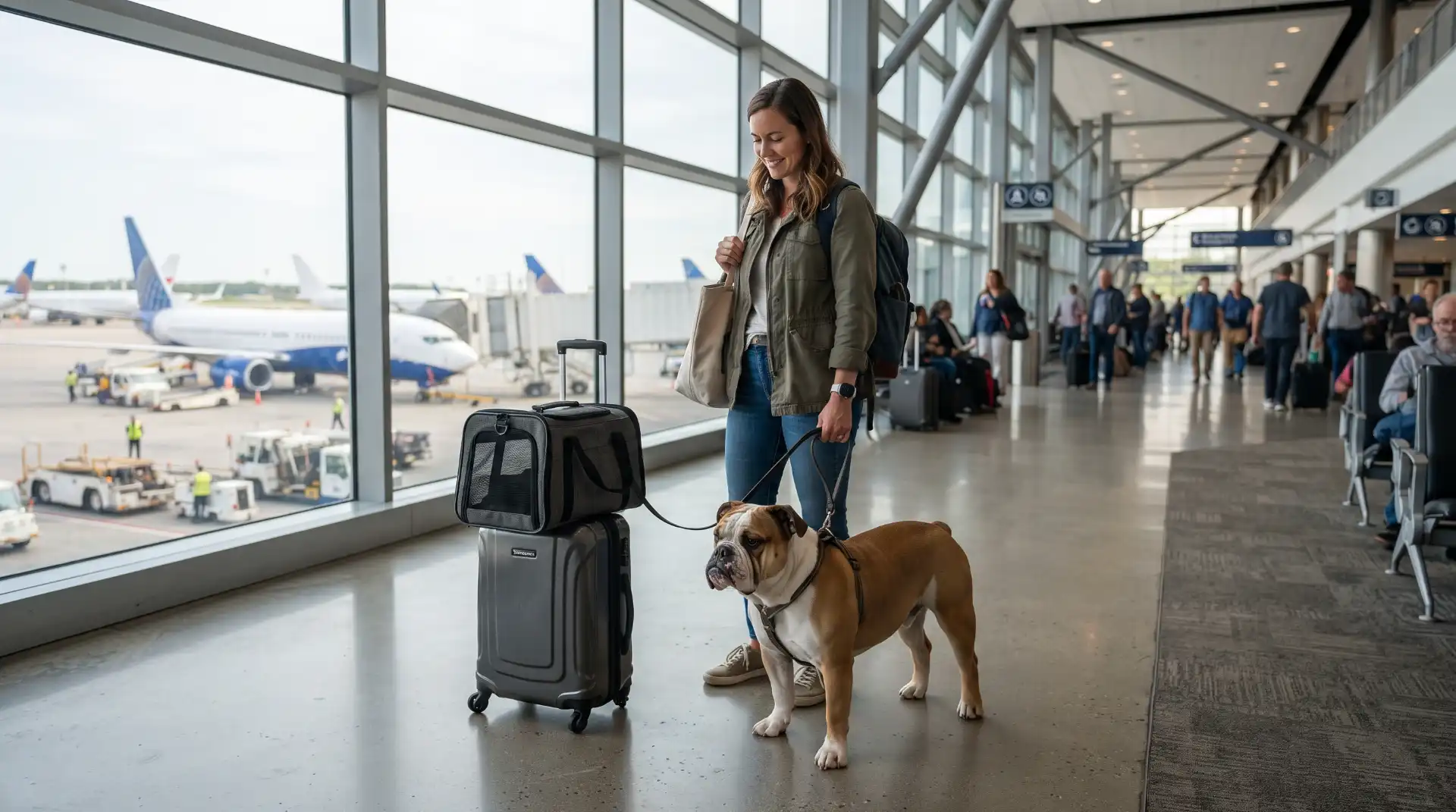
Flying With a Continental Bulldog in 2026
Flying with a Continental Bulldog in 2026 requires significantly more preparation than traveling with an ordinary piece of luggage—or even with many smaller dog breeds. Continental Bulldogs are sturdy, muscular companion dogs, but their bulldog ancestry can create special considerations involving breathing, heat tolerance, body size, stress, and airline breed restrictions.
For U.S. owners, the challenge begins before a ticket is purchased. Airlines have their own pet policies, and those policies can vary considerably. One airline may allow small dogs in the passenger cabin but prohibit bulldog-type dogs from traveling in the baggage hold. Another may permit pets only on certain routes or aircraft. International travel can add vaccination, microchip, health-certificate, import-permit, and U.S. re-entry requirements.
There is also an important distinction between whether an airline allows a Continental Bulldog to travel and whether flying is actually appropriate for a particular dog. An airline reservation does not replace veterinary advice. A dog with noisy breathing, previous heat intolerance, heart disease, severe anxiety, obesity, airway problems, or other medical concerns may face greater travel risks than a healthy, well-conditioned dog.
That is why owners should approach flying with a Continental Bulldog as a health and logistics decision rather than simply a transportation decision.
This U.S.-focused guide explains the major issues to consider in 2026, including airline restrictions, brachycephalic breathing concerns, cabin size requirements, travel crates, veterinary preparation, airport security, weather, international documentation, CDC rules for returning to the United States, and situations in which driving may be a better choice.
Why Continental Bulldogs Need Extra Consideration Before Flying
Continental Bulldogs were developed to be more functional and athletic than some traditional bulldog types, but individual dogs can still have shortened muzzle anatomy. The degree varies substantially from one Continental Bulldog to another.
Dogs with shortened skull and muzzle structures are generally described as brachycephalic. These dogs may have narrower airways, elongated soft tissues, restricted nostrils, or other anatomical features that can make breathing less efficient.
A Continental Bulldog that breathes comfortably during exercise and tolerates moderate temperatures may have a very different risk profile from a dog that pants heavily after minor activity, snores loudly while awake, overheats easily, gags frequently, or struggles to recover after excitement.
Air travel can combine several stressors at the same time. A dog may experience unfamiliar people, loud airport announcements, baggage carts, crowds, security procedures, confinement, temperature changes, delays, turbulence, and limited opportunities to move around or drink.
The U.S. Department of Transportation’s guidance on flying with pets notes that many airlines restrict brachycephalic dogs because of the possibility of breathing problems during air transportation.
For Continental Bulldog owners, this means that airway health should be evaluated before deciding how—or whether—the dog should fly.
Can Continental Bulldogs Fly on U.S. Airlines?
There is no single nationwide airline rule that says every Continental Bulldog can or cannot fly. Each airline establishes its own pet transportation policies subject to applicable federal requirements.
Airlines may distinguish between pets traveling in the passenger cabin, animals transported as checked baggage, and animals shipped through cargo services. The same airline may accept a small dog in the passenger cabin while refusing brachycephalic dogs in the baggage compartment.
Some carriers also maintain specific lists of restricted breeds. Because the Continental Bulldog name may not appear separately on every airline’s list, owners should not assume that the breed automatically qualifies. An airline may classify the dog under a broader bulldog or brachycephalic category.
Before purchasing airfare, contact the airline and identify your dog’s breed clearly. Ask whether the carrier considers a Continental Bulldog a restricted bulldog-type or brachycephalic breed for the transportation method you intend to use.
It is also worth confirming the answer for the exact route and aircraft. Pet policies can vary because not every plane has the same under-seat space, baggage compartment configuration, ventilation system, or cargo capability.
Cabin Travel Is Usually the Preferred Option—When the Dog Fits
When a pet can legally and comfortably travel inside the passenger cabin, owners often prefer this option because the dog remains close to them throughout most of the journey.
However, cabin travel creates a major practical problem for most adult Continental Bulldogs: size.
U.S. airlines that accept ordinary pets in the cabin generally require the dog to remain inside an approved carrier that fits entirely beneath the seat in front of the passenger. The animal usually must remain inside the carrier during the flight.
A full-grown Continental Bulldog is considerably larger than the toy and small companion breeds that typically fit under an airline seat.
Even if the airline does not impose a simple numerical dog-weight limit, the carrier requirement effectively creates a size restriction. A dog should not be squeezed into an undersized carrier merely to comply with airline rules.
The dog must have enough room to remain in a safe, natural position and meet the airline’s carrier standards.
For this reason, in-cabin travel may be possible for some young puppies or unusually small individuals but may not be realistic for an average adult Continental Bulldog.
Do Not Confuse Cabin Travel With Checked Pet or Cargo Travel
Airline terminology can be confusing, and understanding it matters.
An in-cabin pet remains inside the passenger compartment with its owner. A pet traveling as checked baggage typically travels in an aircraft hold while being associated with a passenger on the same journey. Cargo transportation usually operates through a separate airline cargo system and can involve different booking procedures, drop-off locations, documentation, fees, and handling requirements.
An airline that advertises that it “accepts pets” may offer only one of these arrangements.
For a Continental Bulldog, that distinction becomes critical because certain airlines restrict bulldogs and other brachycephalic dogs specifically from baggage-hold or cargo transportation.
When speaking with an airline representative, ask a precise question: “Can an adult Continental Bulldog travel using this specific transportation method on this specific flight?”
That is much more useful than simply asking whether dogs are allowed.
Why Airlines Restrict Brachycephalic Dogs
Breed restrictions involving bulldogs are primarily related to respiratory and temperature-regulation concerns.
Dogs cool themselves largely through panting. Efficient airflow plays an important role in releasing heat. Dogs with shortened facial anatomy may have more difficulty moving air effectively, particularly when they are already stressed or overheated.
An airport environment can make matters worse. A dog may become excited during check-in, spend extended periods inside a carrier, experience warmer outdoor temperatures during ground handling, and then face a long period without normal opportunities to walk or cool down.
Even a dog that is comfortable at home may react differently when separated from its owner or placed in an unfamiliar transportation environment.
These risks explain why some carriers have adopted broad restrictions rather than attempting to assess every dog individually.
Owners should treat those restrictions as a safety issue rather than as an inconvenience to work around.
Ask Your Veterinarian Whether Flying Is Appropriate
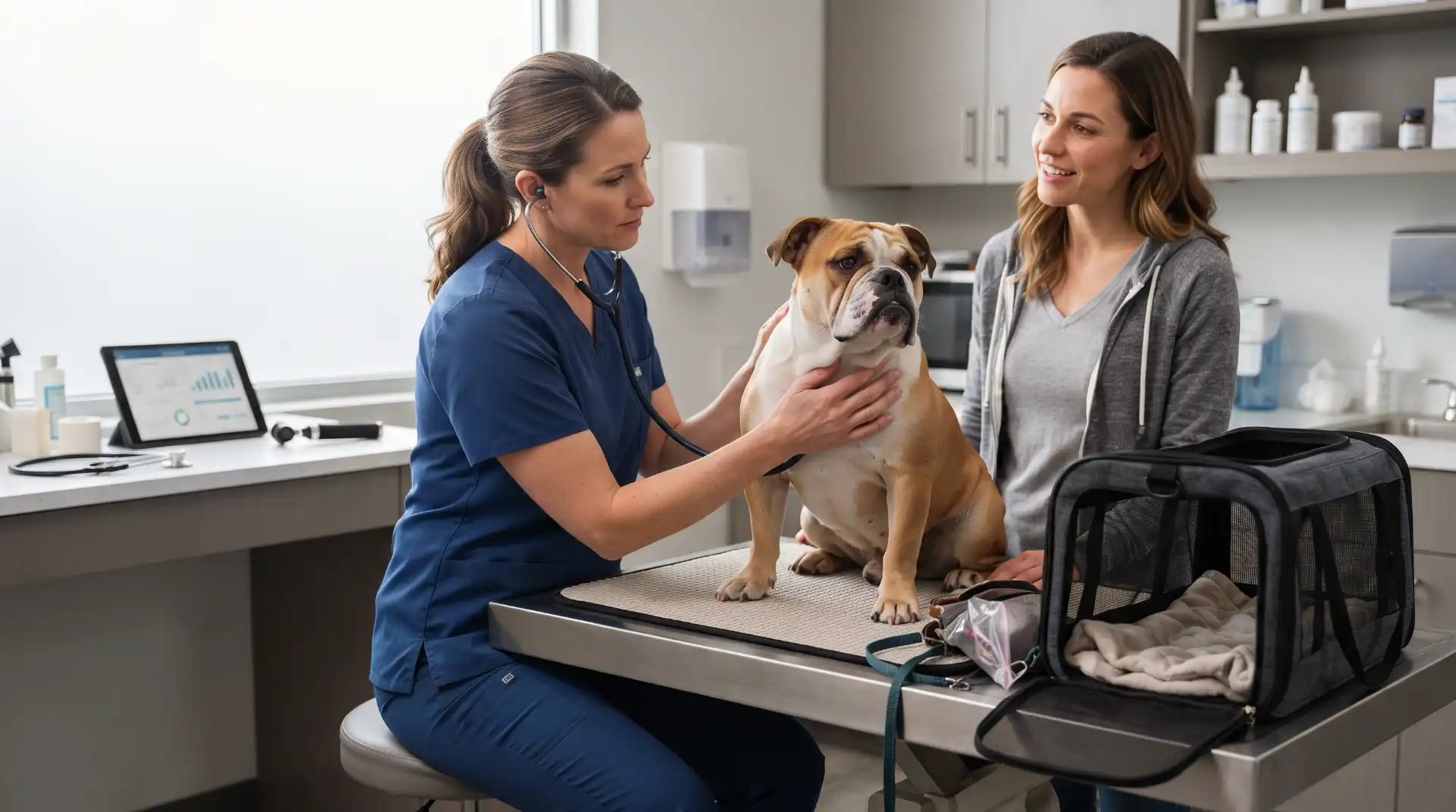
A veterinary consultation should be one of the first steps in preparing to fly with a Continental Bulldog.
Tell your veterinarian that you are considering air travel and provide as much information as possible about the proposed trip. Mention the estimated flight duration, whether the dog would travel in the cabin or separately, the expected climate, number of connections, and whether the trip is domestic or international.
Your veterinarian may evaluate the dog’s heart, lungs, respiratory effort, nostrils, body condition, weight, temperature tolerance, and general health.
Owners should also describe any breathing-related symptoms they have observed at home. Examples include excessive snoring, noisy breathing while awake, frequent gagging, difficulty exercising, unusually prolonged panting, collapse, or previous episodes of overheating.
Do not minimize symptoms because you want approval for the trip. Accurate information helps the veterinarian evaluate risk.
Older dogs and dogs with chronic medical conditions may require additional evaluation before air travel.
Recognize Breathing Warning Signs Before Travel Day
Continental Bulldog owners should know what normal breathing looks like for their individual dog.
Some panting after excitement is normal. Persistent respiratory distress is not.
Concerning signs can include severe effort when inhaling, exaggerated abdominal movement during breathing, inability to settle, extreme drooling combined with distress, weakness, collapse, or gums and tongue that appear unusually pale, gray, or blue.
If these signs appear before departure, the priority should be veterinary care—not making the flight.
Airline tickets, hotel reservations, and vacation plans can be changed. A breathing emergency can become life-threatening quickly.
Heat Is One of the Biggest Concerns for Bulldog Air Travel
Temperature deserves special attention when flying with a Continental Bulldog.
Brachycephalic and bulldog-type dogs may be more susceptible to heat stress because efficient panting is essential to cooling. Humidity can further reduce the effectiveness of evaporative cooling.
The risk is not limited to the temperature inside the airplane. Ground operations can expose animals to outdoor conditions during loading, unloading, transfers, or waits near airport facilities.
Airlines may impose seasonal restrictions or refuse animals when forecast temperatures exceed safe thresholds. Those policies are designed to reduce risk but should be viewed as minimum standards rather than a guarantee of safety for every dog.
If you are traveling from a hot-weather city such as Phoenix, Las Vegas, Dallas, Houston, or Miami during summer, consider whether a very early morning departure would reduce exposure. Even then, your veterinarian and airline should guide the decision.
For some Continental Bulldogs, postponing the trip or driving may be the wiser choice.
Choose Nonstop Flights Whenever Possible
A nonstop flight usually reduces the complexity of traveling with a dog.
Every connection adds more time, handling, noise, waiting, and uncertainty. A flight that looks inexpensive because it includes two connections may produce a much longer and more stressful travel day than a slightly more expensive nonstop option.
Connections also create opportunities for missed flights, baggage transfers, weather disruptions, and unexpected airport conditions.
For an animal traveling outside the passenger cabin, reducing handling is especially valuable.
International connections can introduce another problem: transit-country animal regulations. Some jurisdictions may impose requirements even when the owner never intends to leave the airport.
Whenever practical, choose the simplest route rather than the cheapest route.
Consider the Time of Day When Booking
Flight timing can influence comfort and temperature exposure.
During summer, morning departures may reduce exposure to extreme heat. During colder seasons, midday travel may sometimes avoid the lowest temperatures.
You should also consider your dog’s usual routine.
A Continental Bulldog accustomed to sleeping through the early morning may be calmer during an early departure than a dog traveling during its most active evening period. Conversely, waking a dog in the middle of the night and rushing through a busy airport may increase stress for some individuals.
The ideal itinerary balances weather, total travel duration, airline restrictions, and the dog’s normal schedule.
Crate Training Should Start Weeks Before Departure
A common travel mistake is buying a crate shortly before departure and expecting the dog to remain relaxed inside it for several hours.
The crate should become familiar long before the airport.
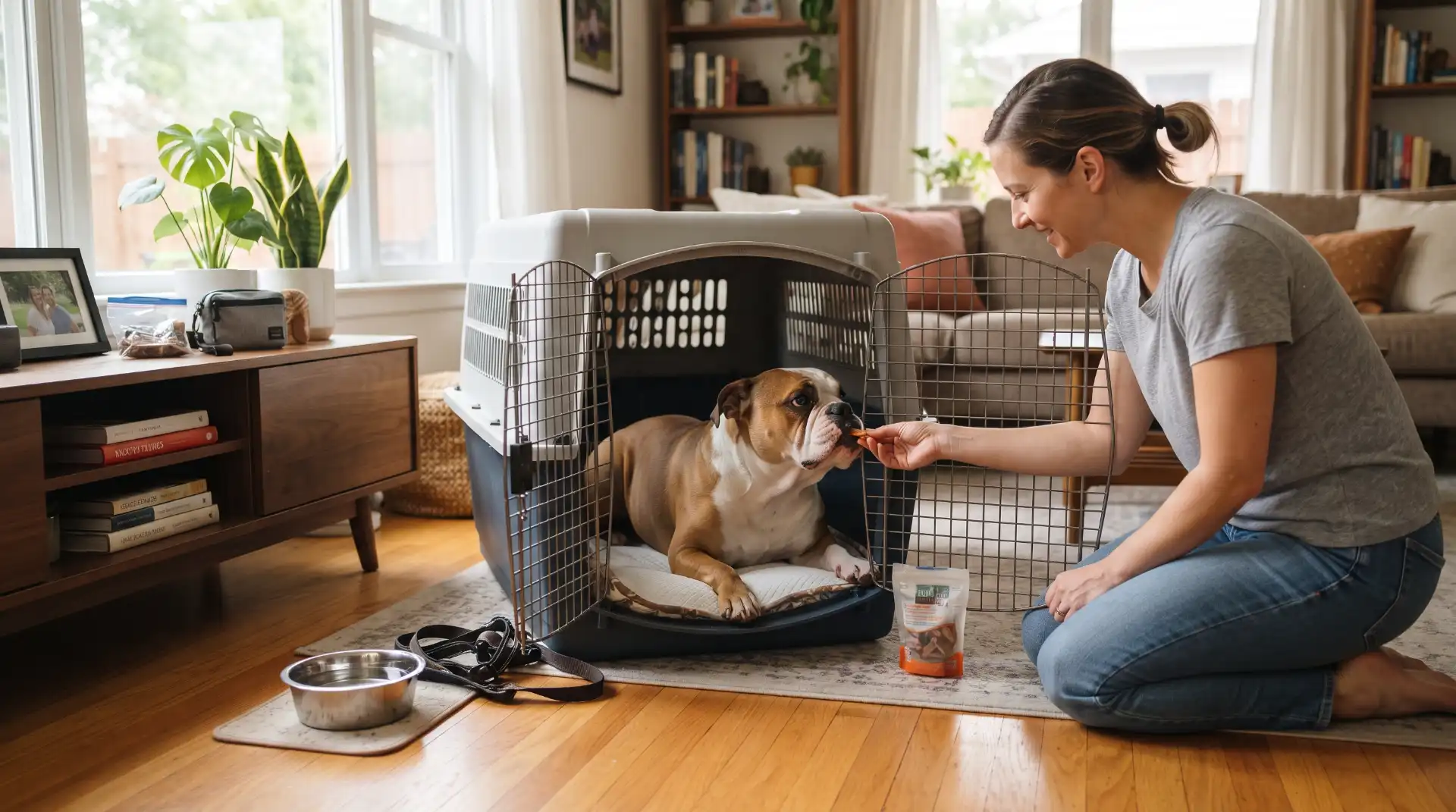
Start by placing it in an area where your Continental Bulldog regularly spends time. Leave the door open and allow voluntary exploration.
You can place treats inside or feed meals near the entrance. Once your dog is comfortable entering, gradually encourage the dog to remain inside for brief periods.
Close the door for only a few seconds initially and reopen it before anxiety develops. Slowly increase duration as the dog becomes comfortable.
Eventually, practice while you move around the room, leave briefly, and return.
The purpose is to teach the dog that being inside the carrier does not automatically predict something frightening.
Crate acclimation can take weeks or longer for dogs that have not previously been confined.
Practice Travel Conditions at Home
Once your Continental Bulldog accepts the crate, introduce mild versions of travel-related experiences.
For example, place the crate safely in your vehicle and take a short drive. Practice settling inside while normal household noises occur. Carry or roll the carrier appropriately if the design allows it.
You may also introduce airport-like sounds at low volume, such as announcements or rolling luggage, while your dog relaxes.
The goal is not to recreate an airport perfectly. It is to prevent every sensation associated with travel from being completely unfamiliar on departure day.
Short, successful sessions are better than long sessions that create frustration.
Choose the Correct Airline Travel Carrier
A travel carrier should be selected based on the airline’s current requirements and the dog’s physical needs.
Do not rely solely on packaging that describes a product as “airline approved.” There is no universal carrier that automatically satisfies every airline, aircraft, and transportation method.
For cabin transportation, airlines commonly specify maximum carrier dimensions based on under-seat space. Soft-sided carriers may be accepted on certain routes because they can fit more easily beneath the seat.
For cargo transportation, the requirements are generally stricter. Airlines may specify rigid construction, ventilation openings, secure fasteners, door design, absorbent bedding, food and water containers, and minimum interior dimensions.
Your dog should be measured carefully before purchasing the crate.
If an airline publishes measurement instructions, follow them exactly.
Never Use a Carrier That Is Too Small
Trying to squeeze a Continental Bulldog into a carrier designed for a smaller dog can increase stress and potentially interfere with comfortable breathing.
A carrier should allow the dog to maintain an appropriate position without being compressed unnaturally.
This is especially important for bulldog-type dogs because unrestricted airflow and comfortable posture matter.
If your Continental Bulldog cannot meet the airline’s size rules without being cramped, the dog does not qualify for that transportation arrangement.
The solution is not to find a way around the measurement. The solution is to choose another travel option.
What Should Go Inside the Travel Crate?
The contents should be simple and safe.
Follow the airline’s instructions regarding bedding, absorbent materials, water containers, and attached food.
A familiar blanket or bedding item may help some dogs feel more comfortable, but bulky items that restrict space or ventilation should be avoided.
Do not place loose toys inside if they could become choking hazards.
For cargo transportation, carriers often require externally accessible food and water dishes so personnel can provide care without opening the main door.
Again, the airline’s current requirements should control the setup.
Should You Sedate a Continental Bulldog for Flying?
Do not independently sedate your dog for air travel.
Owners sometimes assume that a sedative will reduce anxiety, but medication can change breathing, cardiovascular function, balance, responsiveness, and temperature regulation.
Those effects may be especially concerning for a dog with shortened airway anatomy.
Some airlines restrict or prohibit sedated animals.
If your Continental Bulldog becomes highly anxious during travel, discuss the problem with your veterinarian well before departure. The veterinarian can evaluate the dog’s health and discuss whether medication is appropriate for the particular circumstances.
Never give a dog leftover human medication or medication prescribed for another animal.
Prepare Food and Water Carefully
Travel day is not the time to experiment with a new diet.
Use your Continental Bulldog’s regular food and familiar treats. Sudden dietary changes can contribute to vomiting, diarrhea, or stomach upset during an already stressful day.
Ask your veterinarian about appropriate meal timing before flying. Individual recommendations can depend on the dog’s age, health, medication schedule, and trip duration.
Hydration is important, but the exact availability of water will depend on how the dog travels.
Carry a collapsible bowl for use before check-in and after arrival. For cargo travel, follow the airline’s water-container requirements.
Pack enough normal food to handle an unexpected delay or overnight cancellation.
Exercise Before the Airport—but Avoid Overexertion
A moderate walk before departure may help your Continental Bulldog relax and provide an opportunity for urination and bowel movements.
The objective is not to exhaust the dog.
Intense exercise can increase body temperature and panting, especially in warm weather. A slow sniffing walk may be more appropriate than vigorous running.
Allow your dog time to settle before entering the airport.
If your airport has pet-relief areas, identify their locations before arriving. Some facilities are located outside security while larger airports may also provide relief areas inside secure terminals.
Arrive With Enough Time for Pet Check-In
Traveling with a dog can involve procedures that ordinary passengers do not encounter.
You may need to check in at a staffed counter, present veterinary documentation, pay a pet fee, verify the carrier, or complete additional paperwork.
If your dog is traveling through cargo, the cargo facility may be located far from the passenger terminal.
Research this in advance.
Arriving dangerously late creates stress, but arriving many hours too early can unnecessarily extend the dog’s confinement. Follow the airline’s recommended arrival window for passengers traveling with animals.
What Happens at TSA Security With a Cabin Pet?
For dogs permitted in the passenger cabin, Transportation Security Administration screening normally requires the pet carrier to be screened separately.
The dog should not be sent through the X-ray machine inside the carrier.
Owners are generally instructed to remove the animal from the carrier, maintain control of the dog, and carry or walk the pet through the screening process while the empty carrier is screened.
If you are concerned that your dog may escape, ask security personnel about available screening procedures before removing the dog.
A secure harness and properly fitted leash are valuable during airport transitions.
Do not rely solely on a collar if your Continental Bulldog has a history of slipping out of one when frightened.
Use Identification Even When Your Dog Is Microchipped
Microchipping provides valuable permanent identification, but a visible identification tag is still useful.
Your dog’s collar or harness should carry current contact information appropriate for travel.
Before departure, verify that the microchip number can be scanned and that your registration contact details are current.
This becomes especially important for international trips because the microchip number may also appear on vaccination certificates and import documents.
A mismatched digit can create complications at an international border.
Domestic Travel Within the United States
Domestic trips are generally less complicated than international ones, but owners should still research the destination.
Individual states and territories may have animal-entry requirements, particularly concerning rabies vaccination and health documentation.
Hawaii deserves special attention because of its strict animal-entry procedures designed to preserve its rabies-free status.
Travel to Puerto Rico, Guam, and other U.S. territories may also involve requirements that differ from travel between mainland states.
Do not assume that a flight is “domestic” in the everyday sense and therefore requires no animal paperwork.
International Travel Requires Much Earlier Preparation
Flying internationally with a Continental Bulldog can require months of preparation depending on the destination.
Foreign governments may require an ISO-compatible microchip, rabies vaccination, laboratory testing, parasite treatments, veterinary health certificates, government endorsement, import permits, or waiting periods.
The USDA Animal and Plant Health Inspection Service Pet Travel portal provides country-specific guidance for U.S. residents taking pets overseas.
Start with the destination country’s requirements before booking.
Some veterinary procedures must occur in a specific sequence. For example, a microchip may need to be inserted before a vaccination is considered valid for travel documentation.
Other countries require blood testing followed by a waiting period.
A last-minute international booking can therefore make legal pet entry impossible.
Plan the Return to the United States Before You Leave
One of the most important rules for U.S. travelers is to plan the dog’s return before leaving America.
Current CDC requirements apply to dogs entering or returning to the United States. These requirements can depend on where the dog has been during the six months before arrival.
In 2026, every dog entering the United States must be accompanied by a CDC Dog Import Form receipt.
Dogs arriving after being only in countries that CDC considers dog-rabies-free or low risk generally do not require additional CDC documents, although the dog must still meet other federal entry requirements.
Dogs that have been in high-risk rabies countries face additional documentation and entry conditions.
These rules are important even when the dog originally came from the United States.
Current CDC Requirements for Dogs Entering the U.S.
Under the current CDC framework, dogs entering or returning to the United States generally must appear healthy, be at least six months old, and have a microchip that can be detected with a universal scanner.
The CDC Dog Import Form must also be completed for each dog.
When traveling by air, the receipt may need to be shown to the airline before boarding and should be retained for inspection when entering the United States.
The requirements become more extensive if the dog has visited a country considered high risk for dog rabies during the previous six months.
Owners should use the CDC’s official dog importation guidance shortly before travel rather than relying on an old checklist.
High-Risk Rabies Countries Require Additional Documents
The dog’s travel history during the previous six months matters.
If a U.S.-vaccinated Continental Bulldog visits a country that CDC considers high risk for dog rabies, additional requirements apply when the dog returns.
Current CDC guidance states that a Certification of U.S.-Issued Rabies Vaccination form used for this purpose must be completed by a USDA-accredited veterinarian before the dog leaves the United States. It cannot simply be created retroactively after the owner has already traveled abroad.
This is a critical planning issue.
An owner who discovers the requirement only while preparing for the return flight may have created a serious problem that could have been avoided before departure.
Foreign-vaccinated dogs coming from high-risk countries have a separate set of rules and may face additional documentation, rabies serology, designated arrival airports, and requirements involving CDC-registered animal care facilities.
Check Your Dog’s Microchip Before International Travel
Do not simply assume the microchip works because it was implanted years ago.
Ask your veterinarian to scan the chip during the pre-travel examination.
Write down the number and compare it carefully with every travel document.
The CDC states that the microchip may be any brand, but it must be detectable with a universal scanner for U.S. entry purposes.
If the number on the health certificate differs from the number that scans from the dog, travel may become much more difficult.
International travel is an area where administrative accuracy matters nearly as much as packing correctly.
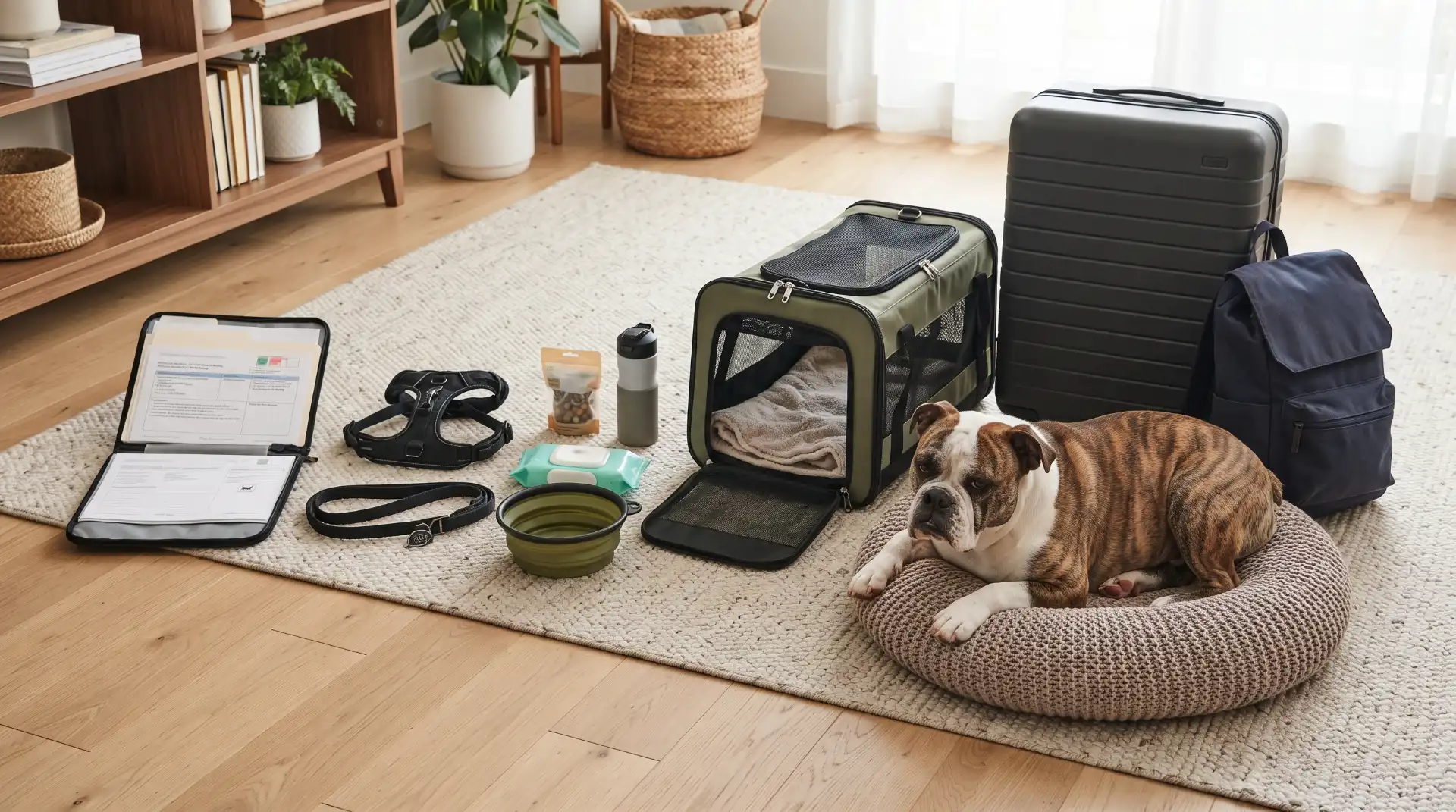
Create a Dedicated Pet Travel Document Folder
Keep all important records together rather than searching through email at the airline counter.
Your travel file may include veterinary records, rabies documentation, health certificates, microchip information, airline confirmations, import permits, USDA endorsements, CDC forms, medication information, and destination-specific documents.
The exact contents depend on the trip.
Carry digital backups, but do not assume a digital copy will satisfy every government requirement. Some destinations require an original signed or endorsed certificate.
Before leaving home, compare the dog’s name, age, breed, microchip number, vaccination dates, and owner details across the documents.
Airline Rules Can Change After You Book
Pet policies are not permanently fixed.
Airlines may change breed restrictions, weather rules, route availability, fees, carrier dimensions, health-certificate requirements, or cargo services.
The aircraft itself can also change.
A carrier that fits under the seat on one airplane may not fit the configuration used after an equipment swap.
Check your reservation several times before departure, particularly if you booked months in advance.
Confirm the pet reservation separately from your passenger reservation because some airlines limit the number of pets permitted on each flight.
Prepare for Flight Delays
A two-hour flight can become an eight-hour airport day when weather or mechanical issues interfere.
Your preparation should account for that possibility.
Carry additional food, medication, cleanup supplies, and access to water. Know where pet-relief areas are located.
If your dog is traveling outside the cabin, ask the airline what happens to animals during significant delays, diversions, and missed connections.
Understand whether the dog is removed from the aircraft, transferred to an animal holding area, or kept with airline personnel.
These are questions worth asking before there is an emergency.
Have an Emergency Plan at Your Destination
Before traveling, identify a veterinary clinic near your destination.
If possible, also locate a 24-hour emergency veterinary hospital.
This is particularly important when traveling during summer or when your Continental Bulldog has a known medical issue.
Save the clinic’s address and telephone number in your phone.
If your dog develops breathing problems or appears unwell after landing, you should already know where to seek help rather than beginning a search during an emergency.
What to Watch for After Landing
Once you arrive, give your Continental Bulldog time to decompress.
Offer water and an opportunity for a bathroom break. Avoid immediately beginning strenuous sightseeing or exercise.
Watch your dog’s breathing, energy level, coordination, appetite, and general behavior.
Mild fatigue after a long travel day may not be unusual, but collapse, persistent respiratory distress, severe vomiting, disorientation, or abnormal gum color warrants prompt veterinary attention.
If the climate at your destination is warmer than your dog is accustomed to, introduce outdoor activity gradually.
Flying With a Continental Bulldog Puppy
Puppies create different issues from adult dogs.
A young Continental Bulldog may physically fit inside an airline cabin carrier, making passenger-cabin travel more realistic than it is for a full-grown adult.
However, age restrictions apply.
Airlines can establish minimum ages for pet travel, and international destinations may have vaccination or waiting-period requirements that make travel impossible for very young puppies.
The CDC currently requires dogs entering the United States to be at least six months old, regardless of whether they are returning pets or newly imported dogs.
Owners should therefore avoid assuming that because a puppy is small enough for the cabin, it automatically qualifies for international transportation.
Flying With a Senior Continental Bulldog
Senior dogs deserve additional veterinary assessment before air travel.
Age alone does not necessarily prohibit flying, but older dogs are more likely to have arthritis, heart disease, respiratory problems, reduced temperature tolerance, or medications that complicate a long journey.
Extended confinement can also be uncomfortable for a dog with mobility problems.
Ask your veterinarian whether the benefit of the trip justifies the stress.
If the purpose is simply a vacation and your senior Bulldog is happiest at home with a trusted caregiver, leaving the dog behind may be kinder than insisting on travel.
What About Dogs With Separation Anxiety?
A dog that becomes extremely distressed when separated from its owner may find cargo transportation particularly difficult.
Signs of significant separation-related distress can include frantic attempts to escape confinement, persistent vocalization, destructive behavior, excessive drooling, or self-injury.
These behaviors should be addressed well before an airline trip.
Crate training alone may not resolve true separation anxiety. Speak with a veterinarian or qualified behavior professional if your Continental Bulldog shows severe distress.
A dog that panics inside a crate at home is unlikely to suddenly become comfortable inside one during a noisy airport journey.
Service Dogs and Ordinary Pets Follow Different Rules
U.S. airline rules distinguish trained service dogs from ordinary pets.
A legitimate service dog is individually trained to perform work or tasks for a person with a disability and is subject to federal air-travel requirements.
Emotional support animals do not automatically receive the same treatment under current U.S. air-travel rules.
Owners should not attempt to describe an ordinary pet as a service dog simply to avoid pet restrictions.
If your Continental Bulldog is an actual trained service dog, consult the airline’s service-animal requirements and the Department of Transportation’s current guidance well before departure.
Is Flying Worth It for a Vacation?
Owners sometimes focus so heavily on how to fly with their Bulldog that they forget to ask whether the dog needs to make the trip at all.
For a permanent move, military relocation, or extended international stay, flying may be necessary.
For a five-day vacation, the calculation may be different.
If your dog is too large for the cabin, dislikes crates, has respiratory concerns, and would need a complicated multi-leg itinerary, a trusted pet sitter or reputable boarding arrangement may produce far less stress.
Being a responsible owner does not mean taking your dog everywhere. Sometimes responsible care means recognizing that the dog is better off staying home.
When Driving May Be Better Than Flying
For many Continental Bulldog owners traveling within the continental United States, driving deserves serious consideration.
Road travel gives you direct control over temperature, ventilation, water, bathroom breaks, meal timing, and rest stops.
You can monitor your Bulldog continuously and stop if the dog appears uncomfortable.
Driving also eliminates many airline breed restrictions.
Long-distance road travel still requires planning. Your dog should be secured in an appropriate vehicle restraint or travel crate. Never allow the dog to ride loose in the bed of a pickup truck.
Never leave a Continental Bulldog alone in a parked vehicle during warm weather, even for a short period.
For a trip that would require a stressful cargo flight, a one- or two-day drive may be the safer and more manageable choice.
Prepare Your Destination for Your Bulldog
Travel planning should continue beyond the airport.
Confirm that your hotel, vacation rental, or family accommodation accepts your dog’s breed and size.
Some accommodations advertise themselves as pet-friendly but impose weight or breed restrictions.
Also consider the physical environment. A rental property with no air conditioning may not be appropriate for a Bulldog during summer. A hotel without nearby grass or pet-relief space may make bathroom routines difficult.
Research these details before departure rather than discovering them after a long flight.
Pack Familiar Items to Reduce Stress
Familiar scents can help a dog settle in a new environment.
When luggage space permits, bring the dog’s regular bedding, familiar food, favorite safe toy, leash, harness, waste bags, grooming supplies, medication, and normal feeding bowls.
Do not change multiple parts of your Bulldog’s routine simultaneously.
Travel already introduces unfamiliar surroundings. Keeping food, sleeping materials, and basic routines consistent can make adjustment easier.
Maintain Your Bulldog’s Routine After Arrival
Dogs often settle faster when their daily schedule remains somewhat predictable.
Try to maintain normal meal times, bathroom breaks, walks, medication schedules, and sleep periods.
Do not immediately overwhelm your Continental Bulldog with crowds, unfamiliar dogs, restaurants, beaches, hiking trails, and sightseeing after a long travel day.
Give the dog an opportunity to rest and become familiar with the new accommodation.
A calm first evening can make the rest of the trip easier.
Common Mistakes Continental Bulldog Owners Should Avoid
One of the biggest mistakes is booking the human ticket first and researching the dog afterward.
Pet eligibility should be confirmed before purchasing nonrefundable travel whenever possible.
Another mistake is assuming that all bulldogs are treated the same by every airline. Policies differ, and terminology can be broad.
Owners also sometimes underestimate carrier size requirements. A dog that appears “medium-sized” at home may be far too large for an under-seat airline carrier.
Waiting until the last week to begin crate training is another avoidable problem.
International travelers sometimes research the destination country’s import rules but forget about the requirements for returning to the United States.
Finally, owners should never assume that a health certificate means the flight is medically risk-free. Veterinary clearance and airline acceptance are pieces of the decision, not guarantees.
A Practical Pre-Flight Routine
A few days before departure, review the reservation and airline pet policy again. Confirm that the aircraft or itinerary has not changed in a way that affects your dog’s reservation.
Check the weather at the departure city, connection points, and destination.
Make sure veterinary paperwork is valid for the travel dates.
Confirm that the microchip information matches the documents and that required vaccines remain current.
Pack essential pet supplies where they can be reached easily.
On departure day, follow your veterinarian’s feeding recommendations, provide a calm bathroom break, avoid strenuous exercise, and leave enough time for pet check-in.
The objective should be a calm, predictable departure rather than a rushed experience.
Should You Fly With a Continental Bulldog in 2026?
There is no answer that applies to every Continental Bulldog.
A healthy individual taking a short, permitted flight under suitable conditions presents a very different situation from an older Bulldog with respiratory problems facing a twelve-hour journey with two connections.
Start with the dog’s health.
Then consider size, airline restrictions, weather, total travel duration, number of connections, crate tolerance, and the reason for traveling.
If several factors create unnecessary risk, choose another option.
The fact that a journey is technically possible does not automatically make it a good idea.
Final Thoughts on Flying With a Continental Bulldog
Flying with a Continental Bulldog in 2026 requires careful coordination between the owner, veterinarian, airline, and—in the case of international travel—government animal-health agencies.
Begin planning early. Do not buy a ticket and assume the dog can simply be added later.
First, determine whether your Continental Bulldog is medically suited to air travel. Respiratory health, body condition, age, heat tolerance, anxiety, and existing medical problems can all influence the decision.
Next, verify the airline’s current policy for the exact transportation method. An airline may accept small pets in the passenger cabin while restricting bulldog-type dogs from cargo or checked transportation. Because most adult Continental Bulldogs are too large for an under-seat carrier, these restrictions can determine whether flying is realistic at all.
If air travel is appropriate, favor simplicity. A nonstop flight during suitable weather is generally preferable to a complicated itinerary with multiple connections. Begin crate acclimation well in advance so the carrier is familiar before the airport.
Prepare veterinary and travel documents carefully. International travelers should use the USDA APHIS Pet Travel portal to research destination-country requirements and the CDC dog importation website to understand the rules for bringing their Bulldog back into the United States.
Current U.S. entry requirements deserve particular attention. Dogs entering or returning to the country must meet CDC conditions that include age, health, microchip, and documentation requirements. Dogs that have visited high-risk rabies countries during the previous six months face additional rules.
Keep copies of important paperwork, prepare for delays, know where veterinary care is available at your destination, and monitor your Bulldog closely throughout the journey.
Most importantly, put the dog’s welfare ahead of the itinerary.
For some Continental Bulldogs, flying may be manageable with proper planning. For others—particularly dogs with breathing problems, poor heat tolerance, significant anxiety, or no safe airline transportation option—a road trip or staying with a trusted caregiver may be the more responsible choice.
Your Continental Bulldog does not care whether the family reaches the destination by airplane or automobile. What matters is arriving safely, comfortably, and ready to enjoy the time together.
Authoritative U.S. Pet Travel Resources
Before booking a flight, Continental Bulldog owners can review the U.S. Department of Transportation’s Flying With a Pet guidance for general information about airline pet transportation.
For international travel from the United States, use the USDA APHIS Pet Travel website to research destination-specific veterinary documentation and animal-entry requirements.
For dogs returning to or entering the United States, consult the Centers for Disease Control and Prevention’s official dog importation guidance and complete the required CDC Dog Import Form when applicable.
Because airline pet policies and government animal-entry rules can change, verify the requirements directly with the airline, your veterinarian, USDA, CDC, and the destination country’s competent authority shortly before travel.