
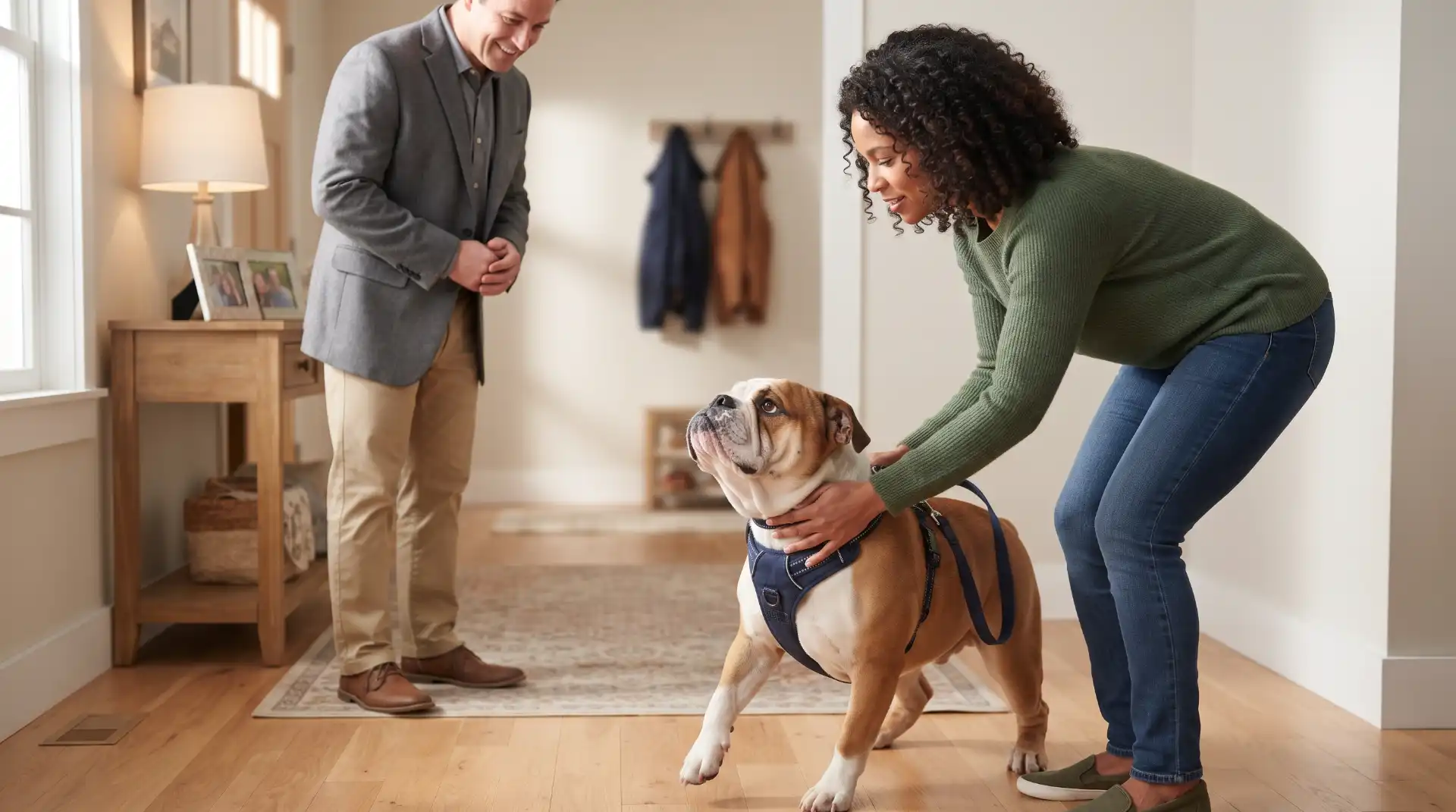
A Continental Bulldog enthusiastically jumping toward someone at the front door may seem harmless at first. The dog may simply be excited to see a visitor and eager to interact. However, Continental Bulldogs are muscular, powerful dogs, and even a friendly greeting can become uncomfortable or unsafe when jumping becomes part of the routine.
A dog that places its front paws on a visitor can scratch skin, dirty clothing, frighten people who are uncomfortable around dogs, or knock someone off balance. Children, older adults, and people with limited mobility may be particularly vulnerable. For that reason, teaching calm greetings is not simply about improving manners. It is an important part of responsible ownership.
Fortunately, jumping is usually a behavior that can be improved with consistent training, thoughtful management, and clear expectations. The goal should not be to suppress your Continental Bulldog’s friendly personality. Instead, you want to teach your dog a safer way to express excitement.
Learning how to stop a Continental Bulldog from jumping on guests requires understanding why the behavior happens, removing the rewards that maintain it, and replacing jumping with a behavior that works better. That might mean sitting, keeping four paws on the floor, waiting on a designated mat, or calmly approaching a visitor only after being released.
The most successful training plans are usually built around repetition. Your dog should experience the same rule every time someone arrives. When calm behavior consistently results in attention and jumping consistently causes attention to pause, the dog begins to understand which choice works.
Why Continental Bulldogs Jump on Guests
Most dogs do not jump on people because they are trying to be difficult. Jumping often develops because it works.
Imagine what happens from your dog’s point of view. A visitor comes through the door. Your Bulldog runs forward, jumps up, and immediately receives attention. The person may say the dog’s name, laugh, touch the dog’s shoulders, push the dog away, or begin petting.
Humans may consider some of those responses corrections, but the dog may simply experience them as interaction. If attention is what the dog wanted, jumping successfully produced the desired result.
This reinforcement can happen repeatedly over months or years. Eventually, the arrival of a guest itself becomes a cue for excitement. The doorbell rings, footsteps approach, voices appear outside, and the dog begins anticipating the familiar greeting routine.
The American Kennel Club explains that dogs repeat behaviors that lead to rewarding consequences. For this reason, successful training usually involves rewarding an appropriate greeting behavior instead of concentrating only on stopping the unwanted one.
Continental Bulldogs can also be very people-oriented. A friendly dog may find direct access to a visitor extremely rewarding. This means the greeting itself can become one of your strongest training tools.
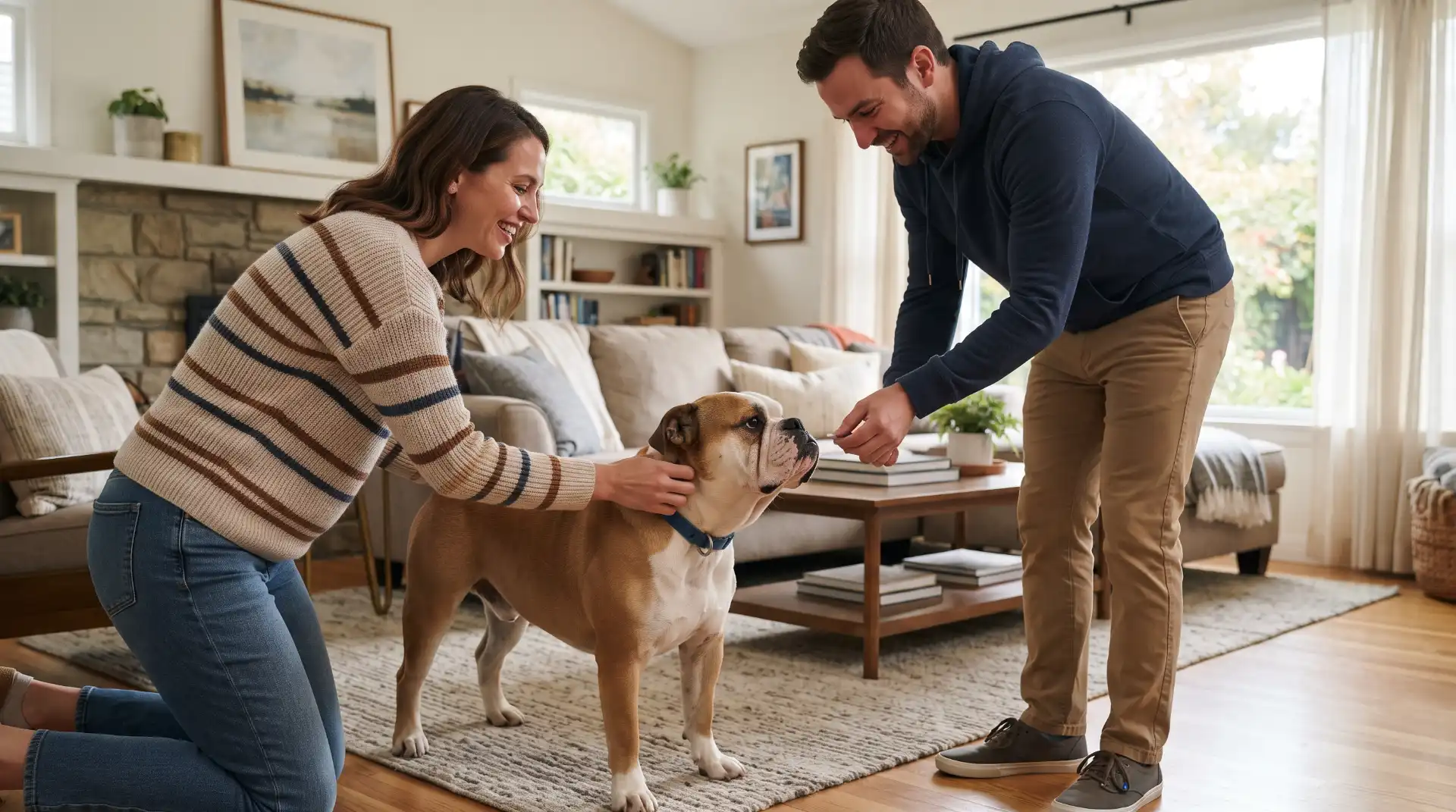
Excitement Is Often the Real Problem
Jumping is sometimes just one part of a larger pattern of overexcitement.
Your Continental Bulldog may hear the doorbell and immediately begin barking, spinning, running between rooms, pawing at the door, or pulling toward the entrance. Once the dog’s excitement rises beyond a certain point, asking for a calm sit may become much more difficult.
This is why successful greeting training begins before the dog reaches maximum excitement.
Owners often make the mistake of waiting until the guest is already entering the house before asking the dog to behave. At that point, the dog may be surrounded by triggers: the sound of the door, the smell of the visitor, movement in the hallway, excited voices, and the expectation of physical contact.
Instead, calm behavior should be practiced separately first. Teach the dog to sit, wait, or remain on a mat when nothing exciting is happening. Then gradually add the pieces of a real visitor arrival.
You might begin by walking toward the door while your Bulldog stays calm. Later, touch the doorknob. Open the door a few inches. Close it again. Ask a family member to knock. Ring the doorbell at a low intensity if possible. Practice repeatedly until those events no longer automatically create a frantic reaction.
This process gives the dog an opportunity to develop self-control in manageable steps.
Start With Basic Obedience Before Practicing Greetings
Polite greeting behavior becomes much easier when your Continental Bulldog already understands basic cues.
A reliable sit is especially valuable. A dog that is sitting cannot simultaneously be jumping against a guest. A “place” cue can be even more useful in homes where visitors arrive frequently because it gives the dog a specific location to move toward when someone enters.
Your Bulldog should first practice these skills in quiet environments with minimal distractions. Once the dog responds reliably in the living room or kitchen, begin practicing closer to the front door.
Owners who are still building basic obedience skills may find our guide to Continental Bulldog training from puppy to adult useful for developing a stronger training foundation.
The important point is that greeting training should not begin with the most difficult version of the task. Build the individual skills first, then combine them.
Teach the Four-Paws-on-the-Floor Rule
One of the simplest approaches is to teach your Continental Bulldog that attention is available only when all four paws remain on the floor.
This rule is easy for visitors to understand and easy for dogs to practice. The dog does not necessarily have to maintain a formal sit throughout the entire interaction. The primary requirement is simply to remain grounded.
Begin with a trusted helper. Keep your Bulldog on a loose leash and stand far enough from the person that your dog can remain reasonably calm.
As the helper approaches, reward your dog while all four paws remain down. If the dog continues behaving appropriately, the helper can move closer and eventually offer calm attention.
If your Bulldog jumps, the helper should immediately stop interacting. They can turn slightly away, step backward, or simply become still. Once the dog returns to the floor, the opportunity for interaction resumes.
Over time, the dog begins learning a very clear rule: staying grounded keeps the person nearby, while jumping makes the person move away.
This method is especially powerful when the dog truly wants social interaction. In that situation, the visitor’s attention may be more valuable than food.
Teach a Sit-to-Greet Routine
Some owners prefer a more structured greeting rule. Instead of simply requiring four paws on the floor, they teach the dog to sit before receiving attention.
Start by practicing the sit away from the doorway. Reward quickly after your Continental Bulldog responds. Gradually increase duration so the dog can remain seated for several seconds.
Next, practice while you move around. Walk toward your dog, step away, return, and reward the sit. Add gentle distractions only after the behavior becomes reliable.
Once your Bulldog understands the exercise, ask a helper to participate.
The helper should begin several feet away. Ask your dog to sit. If the dog remains seated, the helper moves closer. If the dog stands up or begins jumping, the helper stops.
As soon as the dog sits again, the helper may continue approaching.
This makes the visitor’s movement dependent on your dog’s behavior. Calmness brings the guest closer. Excitement pauses the greeting.
Avoid repeating the cue continuously. Saying “sit, sit, sit, sit” while the dog is too excited to respond can weaken the cue. If your Bulldog cannot sit, create more distance and reduce the difficulty.
Why Pushing the Dog Down Usually Does Not Work
When a dog jumps, many people instinctively place their hands on the dog’s chest or shoulders and push downward.
This often fails for two reasons.
First, the dog is still receiving physical interaction. A sociable Bulldog may consider pushing a form of attention or play.
Second, some strong dogs respond by pushing back. This can turn the interaction into a physical game that increases arousal instead of reducing it.
The same problem can happen when visitors shout the dog’s name or repeatedly say “off.” Although those responses may be intended as corrections, they still provide eye contact and attention.
A cleaner training strategy is to make jumping unrewarding while immediately reinforcing the behavior you want.
When the dog stays down, attention happens. When the dog jumps, attention disappears.
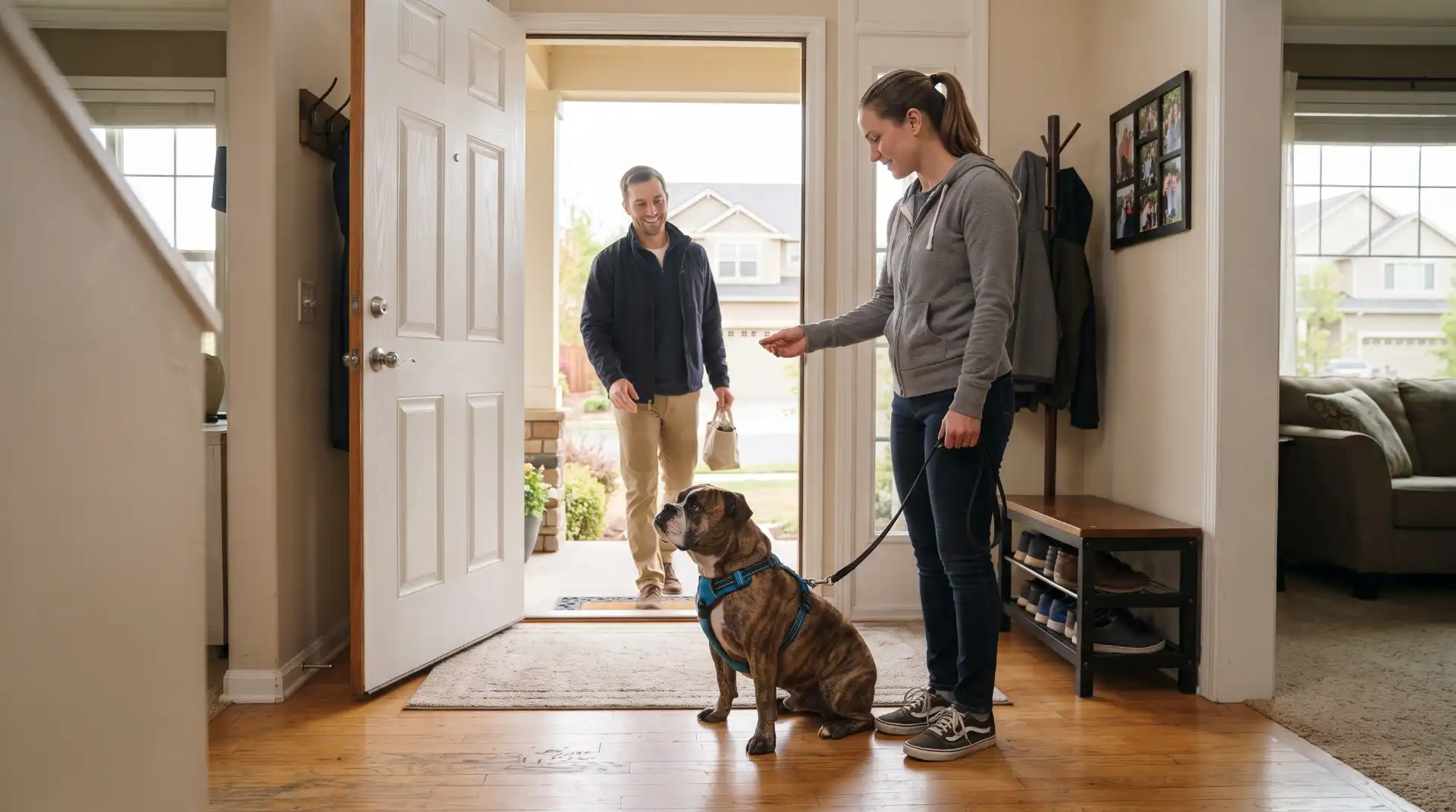
Tell Guests About the Training Plan Before They Enter
Your training will be much more successful when visitors understand the rules.
Before opening the door, explain what you want them to do. A simple instruction such as, “Please don’t pet him until all four paws are on the floor,” can prevent confusion.
This is especially important when guests are enthusiastic dog lovers. Some visitors naturally bend down, clap their hands, call the dog’s name, or encourage energetic greetings. They may not realize that they are reinforcing the exact behavior you are trying to change.
Ask visitors to keep their entrance calm. They should avoid high-pitched greetings, rapid movements, or immediate physical contact if your Bulldog is already excited.
When the dog settles, the visitor can provide attention.
Children should never be expected to manage this training themselves. An adult should supervise greetings and control the dog when younger visitors are present.
Use a Leash for Safe, Controlled Greetings
A leash can be extremely helpful during early training.
Attach the leash before the guest enters rather than trying to grab your Bulldog after excitement has already begun.
The leash should function primarily as a management tool. Its job is to prevent the dog from reaching the guest and rehearsing the unwanted behavior. It should not be used for repeated jerking or physical punishment.
Maintain enough distance that the dog can respond to you. If your Bulldog is pulling intensely toward the visitor, move farther away and allow the dog to settle.
The American Veterinary Society of Animal Behavior supports reward-based dog training methods and recommends teaching desired behaviors rather than depending on aversive corrections.
Reward-based training still includes boundaries. You can prevent the dog from reaching a visitor, end an interaction when jumping begins, and control access to greetings without using fear or pain.
Use Baby Gates and Barriers When Necessary
Management tools are especially valuable when your dog is still learning.
A baby gate can create a physical boundary between your Continental Bulldog and visitors. This allows the dog to see and smell the guest without immediately gaining physical access.
You can reward calm behavior behind the barrier and wait until the dog’s excitement decreases before allowing a controlled greeting.
An exercise pen or separate room may also be appropriate when multiple visitors arrive at once.
There is no benefit in placing your dog into a situation that is too difficult simply to test whether the training works. Good management prevents the unwanted behavior from being practiced while creating opportunities for success.
Teach a Reliable Place Command
A designated mat or dog bed can become one of the most valuable tools in your visitor routine.
Start by making the mat rewarding. Place it in a quiet part of the room and reward your Bulldog for approaching it. Then reward standing on it, sitting on it, and eventually lying down.
As the behavior becomes reliable, introduce a word such as “place.”
Gradually increase how long your Bulldog remains there before being released.
Next, add distractions. Walk toward the door while the dog stays on the mat. Touch the doorknob. Open and close the door. Have a family member knock. Eventually, ask a trusted helper to enter.
The goal is for your Bulldog to learn that doorway activity predicts going to the mat rather than charging toward the entrance.
Position the mat far enough from the door that the dog can succeed. As training improves, you may be able to reduce that distance.
Reward Calm Behavior Before the Jump Happens
One of the biggest improvements owners can make is learning to reward desirable behavior before things go wrong.
Many people wait until the dog jumps, correct the dog, and then reward once the dog settles. While that can still produce progress, it misses many opportunities.
Instead, watch for the moment your Continental Bulldog notices a guest but has not yet jumped. Reward immediately.
Reward when your dog looks at the visitor and then looks back at you. Reward when the dog takes a breath, loosens its body, sits voluntarily, or remains still while the guest moves.
These small moments of self-control are exactly what you want to strengthen.
The more frequently your dog is reinforced for calm choices, the more likely those choices become in future greetings.
Use High-Value Treats for Difficult Situations
Not every reward has equal value.
Your Continental Bulldog may happily work for ordinary kibble in a quiet kitchen but completely ignore it when a favorite visitor arrives.
For challenging greeting sessions, use small pieces of a higher-value dog-safe treat your Bulldog truly enjoys.
The pieces should be small because training may require numerous repetitions. The goal is not to provide a large snack every time the dog sits. The food is a quick marker that tells the dog, “That behavior was correct.”
Food should also complement the social reward. Once the dog behaves appropriately, the visitor can greet them.
This creates two rewards: food from the owner and attention from the guest.
Do Not Reward Jumping Sometimes and Correct It Other Times
Inconsistent rules are one of the biggest reasons jumping persists.
If your Bulldog is allowed to jump on you when you return home but is expected to stay down when visitors arrive, the distinction may be difficult for the dog to understand.
The same problem occurs when one family member discourages jumping while another laughs and pets the dog.
Dogs learn from outcomes. If jumping occasionally works, it can remain surprisingly persistent.
For faster progress, everyone in the household should follow the same standard.
Decide whether the rule is four paws on the floor, sitting, or going to a mat. Then use that same rule for greetings with family members, friends, neighbors, and other familiar visitors.
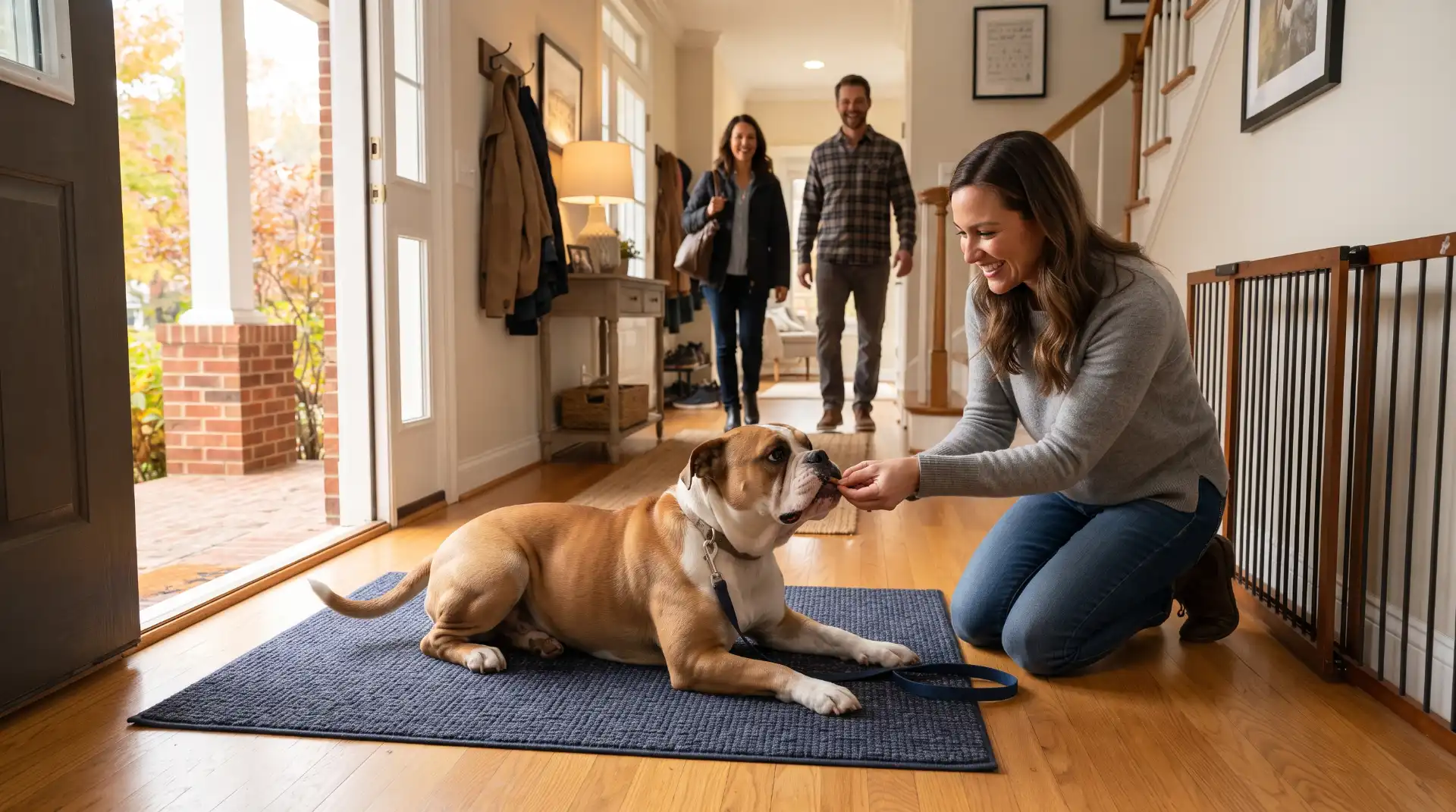
Practice With Different People
Dogs do not always generalize learned behavior automatically.
Your Continental Bulldog may greet one person beautifully and still jump on someone else.
This does not necessarily mean the training failed. The dog may simply need practice with different people and circumstances.
Once your Bulldog performs well with one helper, practice with several trusted volunteers.
Include different types of visitors. One person might enter quietly. Another might wear a hat. Someone else may carry a bag or jacket. Eventually, practice with people who naturally create more excitement for your dog.
Change only one factor at a time when possible so the difficulty increases gradually.
Socialization Can Reduce Chaotic Greetings
A well-socialized dog is often better prepared to handle new people without becoming overwhelmed.
Socialization does not mean allowing your dog to rush toward every stranger. It means exposing the dog to people, sounds, environments, and situations in a controlled way so those experiences become more familiar.
Our guide to socializing your Continental Bulldog discusses how appropriate exposure can help dogs become more confident and adaptable.
A dog that has learned to calmly observe people in different settings may find household visitors less overwhelming.
Give Your Continental Bulldog Exercise Before Visitors Arrive
A dog carrying a large amount of unused energy may have a harder time staying calm.
If you know someone will be visiting later, provide an appropriate amount of activity beforehand.
A relaxed walk, sniffing session, short obedience workout, food puzzle, or scent game can help meet both physical and mental needs.
The goal is not to completely exhaust the dog. Excessive exercise can be inappropriate, particularly during hot weather or for dogs with individual health limitations.
Instead, choose moderate activity that helps your Bulldog feel satisfied and ready to settle.
Mental stimulation can be especially useful. Ten or fifteen minutes of focused training may help a dog settle more effectively than simply allowing the dog to run around the yard.
Create a Consistent Doorbell Routine
The doorbell itself can become a powerful trigger for jumping.
You can change that association through practice.
Ring the bell when no actual guest is arriving. Immediately ask your Bulldog to perform a familiar behavior such as going to a mat.
Reward the response.
Repeat occasionally during calm parts of the day.
Eventually, the doorbell can become a cue for going to the designated location rather than charging toward the door.
Keep practice sessions short. A few successful repetitions are usually more valuable than a long session in which the dog becomes increasingly frustrated or excited.
What to Do When a Real Guest Arrives
A predictable routine makes real-world situations much easier.
Before opening the door, secure your Continental Bulldog with a leash or barrier if needed. Ask for the behavior you have practiced.
Allow the visitor to enter only when you are ready.
If the dog remains calm, reward immediately.
If excitement begins rising, create more distance. Do not rush the interaction.
Your guest can sit down and ignore the dog for a few minutes if necessary. Once your Bulldog is calmer, you can try a controlled greeting.
If the dog jumps, calmly end access to the visitor. Reset the dog and try again.
The household should treat this as ordinary training rather than a confrontation. The calmer the humans remain, the easier it may be for the dog to settle.
Should You Turn Your Back When Your Bulldog Jumps?
Turning away can be useful in some situations because it removes attention.
However, it works best when the dog is not able to continue jumping against the person’s back.
For a strong Continental Bulldog, combining the technique with a leash or sufficient distance can be more practical.
The important principle is not the exact body position of the guest. The important principle is that jumping does not produce the desired social interaction.
As soon as the dog returns to appropriate behavior, attention can resume.
Avoid Kneeing or Physically Correcting the Dog
Some outdated advice suggests raising a knee into a jumping dog’s chest or stepping on the dog’s toes.
These methods can cause pain, create fear, or damage the dog’s trust without teaching a clear alternative behavior.
Physical corrections can also create negative associations with visitors. If discomfort consistently occurs when strangers arrive, a dog may begin viewing visitors as predictors of unpleasant experiences.
A better strategy is to teach a specific behavior that earns rewards.
Your dog should understand what to do, not simply what to avoid.
Training Continental Bulldog Puppies Not to Jump
Puppyhood is the easiest time to establish polite greetings.
A small puppy placing its front paws on your legs may look adorable, but that same behavior becomes much less charming when the dog is fully grown.
Begin reinforcing calm greetings immediately.
When your puppy approaches with all four paws on the floor, provide attention. If the puppy jumps, pause the interaction briefly.
Keep training sessions short because young dogs have limited attention spans.
Puppies should also receive plenty of appropriate social exposure and structured routines. Our Continental Bulldog puppy care guide from birth to six months offers additional information about early development, socialization, training, and daily care.
Can an Adult Continental Bulldog Learn to Stop Jumping?
Yes. Adult dogs can absolutely develop new greeting habits.
The process may simply take longer if the dog has been jumping on people successfully for several years.
Think about the dog’s reinforcement history. If jumping has resulted in attention hundreds of times, it is unrealistic to expect the behavior to disappear after two or three training sessions.
Owners should focus on gradual improvement.
An adult Bulldog may initially jump several times during a greeting. Later, the dog may jump once and then settle. Eventually, the dog may begin waiting automatically.
Those intermediate changes matter.
Continue reinforcing the new behavior while preventing unnecessary opportunities to practice the old one.
Why Your Bulldog May Suddenly Start Jumping Again
Training progress is not always perfectly linear.
Your Continental Bulldog may behave well for several weeks and then suddenly jump on a particularly exciting visitor.
This does not mean all previous training has been lost.
The environment may simply have become more difficult. Perhaps the visitor is someone the dog loves, several people entered at once, the dog had not exercised that day, or the greeting occurred in an unfamiliar location.
Return temporarily to easier training conditions.
Increase distance, use the leash again, provide stronger rewards, and help the dog succeed.
As the behavior becomes reliable, difficulty can increase again.
When Jumping Is Connected to Fear or Anxiety
Not every dog rushing toward a visitor is expressing friendly enthusiasm.
Some dogs behave chaotically because they are anxious, uncertain, frustrated, or fearful.
Watch the entire body rather than focusing only on the jumping.
Concerning signs can include a stiff body, intense staring, growling, snapping, repeated avoidance, trembling, tucked posture, or escalating barking.
Do not force greetings when these behaviors are present.
A veterinarian can help determine whether pain, health issues, or anxiety may be contributing. More serious behavior problems may also benefit from help from a qualified professional who uses evidence-based, humane training methods.
How Long Does Training Usually Take?
There is no exact timeline for stopping a Continental Bulldog from jumping on guests.
A young puppy may show noticeable improvement quickly because the behavior has not been reinforced for very long.
An adult dog with years of practice may need more repetition.
Progress also depends on how often you train. If your household receives visitors only occasionally, consider scheduling practice sessions with trusted friends rather than waiting months between opportunities.
Consistency matters more than speed.
Look for gradual improvements such as your dog hesitating before jumping, responding to “place” faster, remaining seated longer, or recovering from excitement more quickly.
Common Mistakes That Slow Down Training
One of the biggest mistakes is allowing jumping when it seems convenient while correcting it at other times.
Another is expecting too much too quickly. A dog that can sit calmly around family members may not immediately be capable of doing the same when several guests arrive carrying bags and talking loudly.
Some owners also rely entirely on verbal corrections without teaching an alternative behavior.
Telling your Bulldog “no” does not necessarily explain what should happen instead.
Finally, many owners practice only when real visitors arrive. Controlled training sessions with helpers are usually much more effective because you can repeat the situation several times without social pressure.
Create a Greeting Routine Everyone Can Follow
The easiest long-term strategy is to create one predictable household routine.
For example, the doorbell rings and your Bulldog goes to the mat. The owner opens the door. The visitor enters and ignores the dog briefly. The dog receives a reward for remaining calm. Once excitement decreases, the owner releases the dog for a controlled greeting.
Your exact routine may look different, and that is fine.
The important part is consistency.
Your dog should not have to guess whether jumping will be allowed today.
Final Thoughts on Stopping a Continental Bulldog From Jumping on Guests
Teaching a Continental Bulldog to greet guests politely is a combination of training, management, and patience.
Jumping usually persists because it has historically produced something the dog values, especially attention. Changing that pattern requires making calm behavior more rewarding than jumping.
Start with simple obedience skills. Teach four paws on the floor, a sit-to-greet routine, or a reliable place command. Practice when no visitors are present and gradually add realistic doorway distractions.
Use a leash, gate, or additional distance when necessary to prevent your Bulldog from repeatedly rehearsing unwanted behavior. Ask visitors to cooperate by withholding attention during jumping and providing interaction when your dog is calm.
Reward good choices early instead of waiting for mistakes.
Most importantly, keep the rules consistent across the household.
A Continental Bulldog does not need to lose its friendly, affectionate nature in order to develop good manners. The objective is simply to channel that enthusiasm into a greeting that is safer and more comfortable for everyone involved.
With regular practice, your Bulldog can learn that sitting, waiting, staying on a mat, or keeping four paws on the floor is the fastest way to earn the social interaction it wants.
That creates a better experience for your dog, your household, and every guest who walks through the door.