
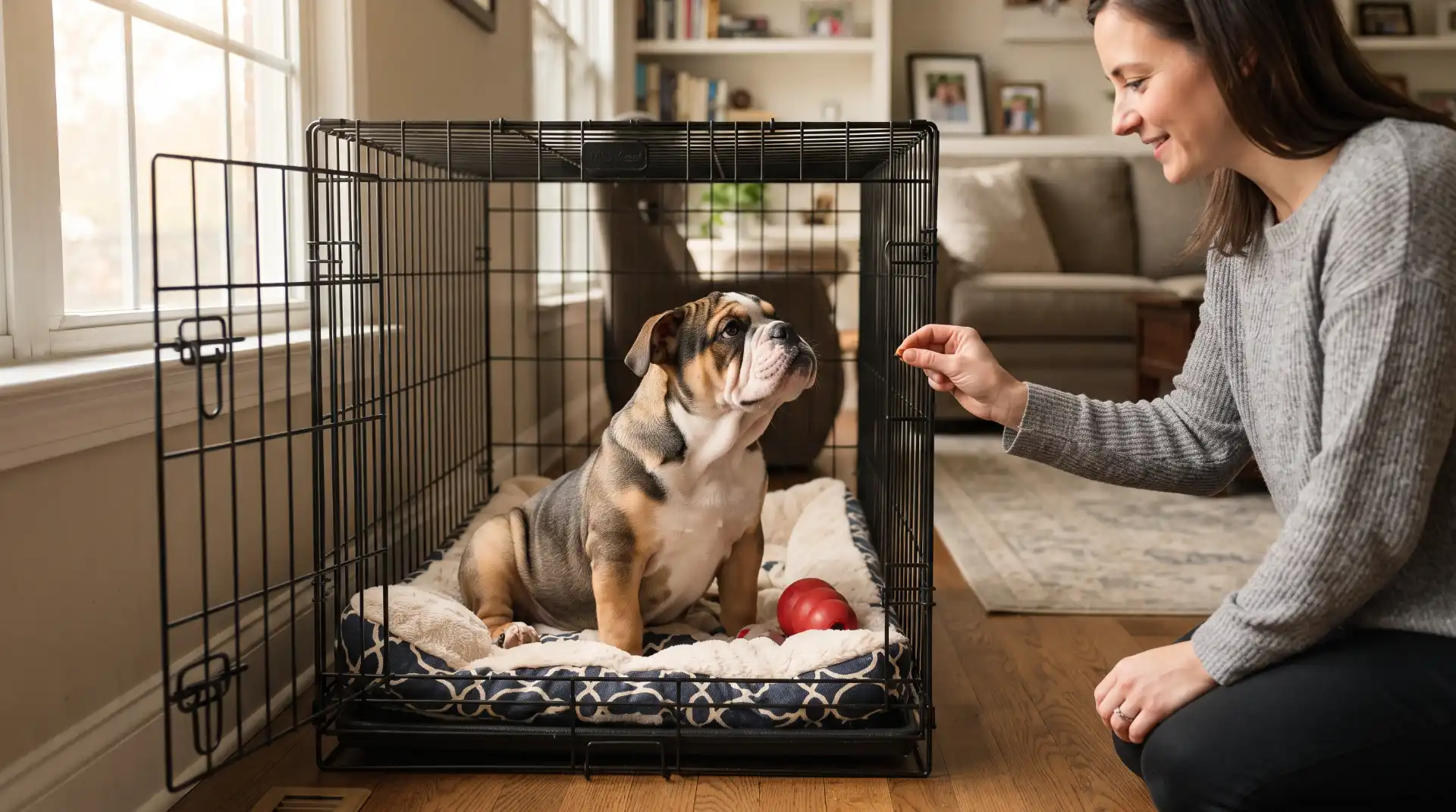
Bringing a Continental Bulldog puppy home is an exciting experience, but the first few weeks also involve a significant amount of teaching. Your puppy has to learn where to sleep, where to eliminate, what objects are appropriate to chew, how to settle down, and how to cope with short periods away from you. Crate training can help organize many of these lessons when it is introduced gradually and used as a positive part of the puppy’s daily routine.
For U.S. puppy owners, a crate can become more than a house-training tool. It can provide a predictable resting place at home, help with safe transportation, make veterinary visits less stressful, and give your puppy a familiar space when visitors, maintenance workers, or other household activity temporarily make the home more chaotic.
The important distinction is that crate training should not mean simply putting a puppy behind a closed door and expecting the puppy to accept confinement. A successful crate-training program teaches the Continental Bulldog that the crate is a safe and comfortable place to relax. The goal is voluntary cooperation rather than fear or forced compliance.
Continental Bulldogs can be intelligent, affectionate, and responsive to positive reinforcement, but individual puppies learn at different speeds. Existing training guidance on the site also emphasizes consistency, patience, and reward-based methods for this breed.
When crate training is approached as a gradual learning process, it can become one of the most useful skills you teach your puppy during the first year.
What Is Crate Training?
Crate training involves teaching a dog to comfortably spend appropriate periods of time in a designated crate. The crate becomes a predictable resting area where the dog can sleep, relax, chew an appropriate toy, or remain safely contained when direct supervision is temporarily unavailable.
The crate should not be thought of as a punishment room. It should function more like a personal resting space.
This distinction matters because the emotional association your puppy develops with the crate can influence future behavior. If the crate consistently predicts meals, treats, naps, quiet time, and positive interactions, your puppy has a reason to enter it willingly.
The American Kennel Club recommends introducing the crate gradually and using positive associations rather than punishment. It also emphasizes that puppies should not simply be left in crates for excessive periods.
For a Continental Bulldog puppy, the crate can become part of a broader routine that includes potty training, sleep, supervised independence, and household management.
Why Crate Training Can Be Useful for a Continental Bulldog Puppy
One of the biggest advantages of crate training is predictability. Puppies thrive when their day follows recognizable patterns. When your puppy learns that sleeping, eating, playing, potty breaks, training, and quiet time happen in a consistent sequence, the household becomes easier to understand.
The crate can also help you prevent problems before they occur.
A young puppy that is tired but still roaming around the house may start chewing furniture, investigating electrical cords, grabbing household objects, or getting into places that have not been puppy-proofed. If you cannot supervise the puppy directly, a properly introduced crate can provide a safer alternative.
Crate training can also complement house training. Puppies naturally need frequent bathroom opportunities, and a properly sized crate can encourage them to remain clean while resting. However, the crate does not magically create bladder control. A puppy that physically cannot hold its bladder should not be expected to remain confined simply because it is inside a crate.
The existing Continental Bulldog potty-training guide on this site recommends using crate training as part of a broader potty-training routine rather than treating the crate as a substitute for regular bathroom breaks.
Another benefit is travel. A Continental Bulldog that is comfortable in a crate may find transportation less stressful because the crate represents something familiar. This can be especially helpful when traveling to a veterinarian, boarding facility, training class, or family destination.
Choosing the Right Crate for a Continental Bulldog
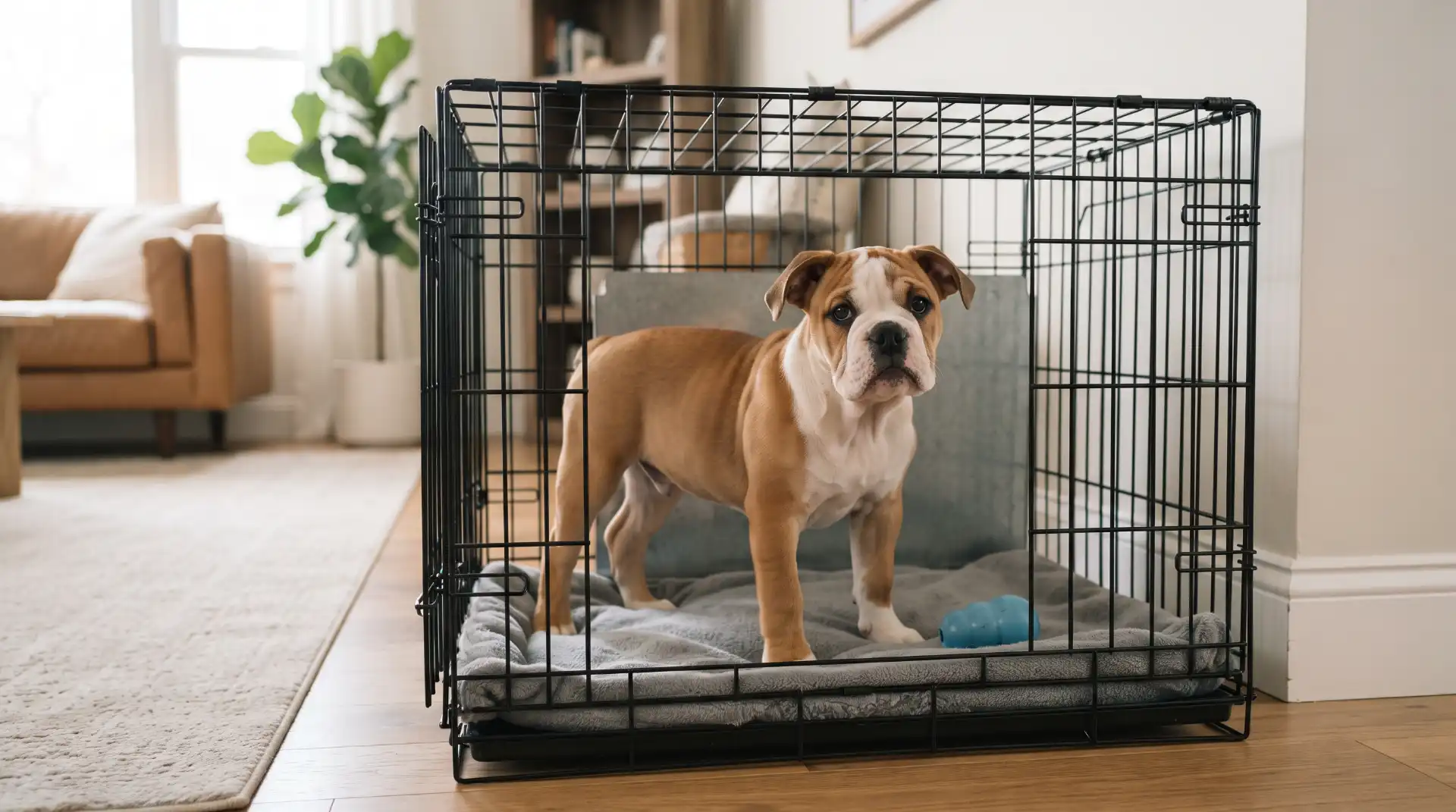
The crate should be large enough for your puppy to stand normally, turn around, lie down comfortably, and change sleeping positions.
At the same time, buying an enormous crate and giving a small puppy access to all of it immediately may make house training more difficult. Some puppies may use one area for sleeping and another area as a bathroom.
A crate with an adjustable divider can be practical for a growing Continental Bulldog. You can provide enough space for the puppy’s current size and gradually expand the available area as the puppy grows.
The type of crate also matters.
Wire crates provide good ventilation and visibility. Many puppies enjoy being able to see what is happening around them, although some become more relaxed when part of the crate is visually covered.
Plastic travel kennels can provide a more enclosed environment and may be particularly useful for transportation. Soft-sided crates can work for certain dogs and situations, but they are generally less appropriate for puppies that are still chewing and exploring with their mouths.
Whichever style you choose, inspect it carefully for sharp edges, loose components, damaged panels, or openings that could trap a paw or collar.
Because Continental Bulldogs have a sturdy build, owners should think about the puppy’s expected adult size when purchasing equipment. The crate needs to accommodate growth without creating an unnecessarily oversized sleeping area during early house training.
Where Should You Put the Crate?
Location can make a major difference during the first several weeks.
Many U.S. families find it helpful to place the crate in an area where the puppy can see and hear normal household activity without being directly in the middle of constant traffic.
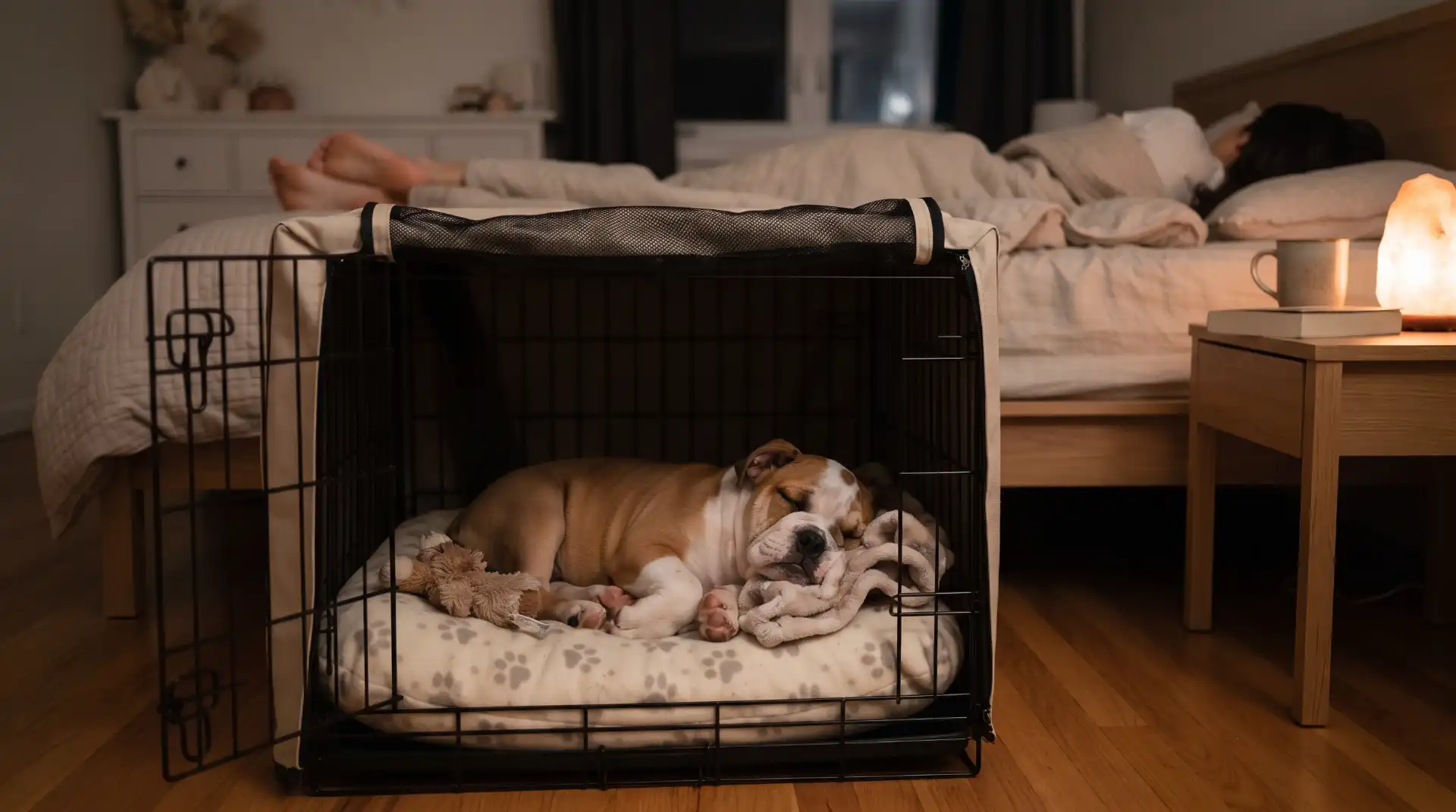
A family room can work well during the day because the puppy can observe people while resting. At night, some owners prefer to move a second crate into the bedroom or place the primary crate nearby.
Keeping the puppy close during the first nights can also make it easier to recognize when the puppy genuinely needs a bathroom break.
Avoid placing the crate in an area that becomes extremely hot, cold, noisy, or isolated. A garage, unfinished basement, outdoor shed, or exposed patio may not provide an appropriate environment for a young puppy.
Temperature deserves particular attention in American homes. A room that feels comfortable during the afternoon can become significantly warmer or colder overnight. The crate should be positioned away from direct sunlight, heating vents, fireplaces, and strong drafts.
The goal is a quiet but connected location where the puppy can rest without feeling completely separated from the household.
Preparing the Crate Before the Puppy Enters
Before beginning formal crate training, make the crate inviting.
Place comfortable bedding inside if your puppy is unlikely to chew or destroy it. If your puppy is an enthusiastic chewer, start with simpler, durable bedding or a crate-safe surface that is easy to clean.
A safe puppy toy can also help create a positive association.
The door should initially remain open.
Do not push your puppy inside and immediately shut the door. Instead, allow your puppy to investigate the crate at its own pace.
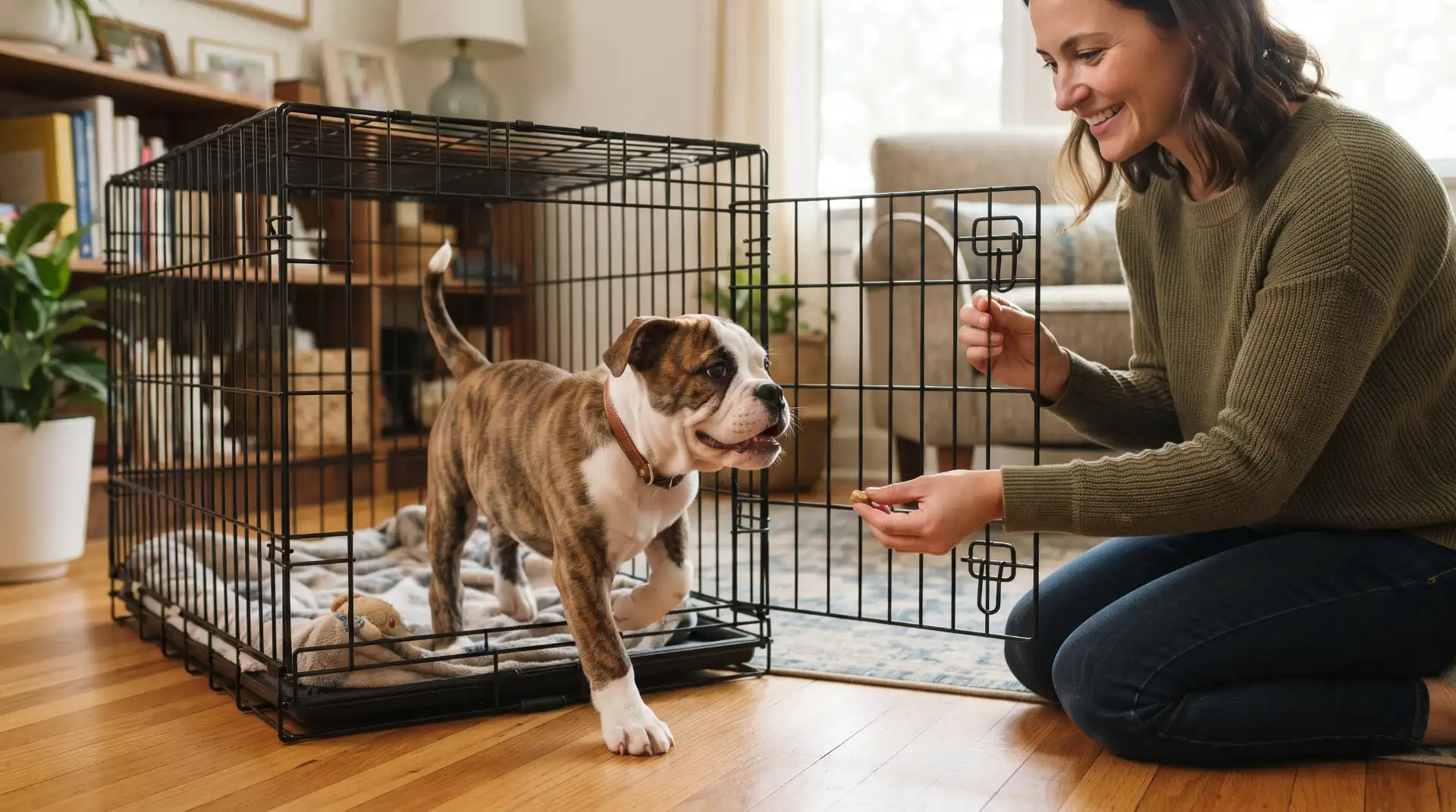
You can place a few small treats near the entrance and gradually move them farther inside.
If your puppy steps inside, allow the puppy to come back out.
Repeat the process.
The objective during these first sessions is not duration. It is confidence.
Your puppy is learning that entering the crate does not cause anything bad to happen.
The First Step: Let Your Puppy Explore
Start with the simplest possible exercise.
Leave the crate door open and allow your Continental Bulldog puppy to investigate it.
Some puppies will walk inside immediately. Others may sniff the entrance and walk away. Both reactions are normal.
Do not rush.
Reward curiosity. If your puppy looks at the crate, approaches it, sniffs it, or places one paw inside, calmly reinforce that behavior.
Eventually, you can place a treat farther inside.
When the puppy enters, give another reward.
You can also feed some meals near the crate and gradually move the food bowl inside as your puppy becomes more comfortable. The American Kennel Club recommends using food, toys, and rewards to establish positive associations during the early stages of crate training.
At this stage, avoid repeatedly calling the puppy into the crate only when something unpleasant is about to happen. If every crate invitation means nail trimming, being left alone, or the end of playtime, your puppy may quickly learn that entering the crate predicts something undesirable.
Teaching the Puppy to Stay Inside
Once your puppy willingly enters the crate, begin increasing the amount of time spent inside.
Give the puppy a safe chew or food toy and allow the puppy to remain inside while the door is still open.
If the puppy settles down, praise calmly.
Eventually, close the door for only a few seconds.
Then open it.
Repeat this process several times.
The next session might involve keeping the door closed for slightly longer.
The exact progression will depend on your puppy. One puppy may be comfortable for a minute while another becomes restless after ten seconds. There is no requirement to follow a rigid schedule.
Progress should be based on your puppy’s behavior.
If your puppy remains relaxed, you can gradually increase duration. If the puppy begins showing clear distress, you have probably progressed too quickly.
This is one reason crate training should not be treated as a race.
Build Duration Gradually
The biggest mistake many new owners make is increasing crate time too quickly.
A puppy that comfortably spends two minutes inside is not automatically ready for thirty minutes.
Instead, think of crate duration as a skill that develops through repeated successful experiences.
You might begin by sitting beside the crate while your puppy rests inside. Then stand up and move several feet away. Later, walk briefly into another room and return.
Eventually, you can leave the room for longer periods.
This teaches two separate skills: staying calmly in the crate and being temporarily separated from the owner.
Both skills matter.
If you immediately jump from having your puppy beside you to leaving the house for several hours, the puppy may associate the crate with sudden isolation.
The American Kennel Club similarly recommends increasing crate time gradually and not using the crate for excessive periods.
Use a Consistent Crate Cue
Once your puppy is entering the crate voluntarily, you can introduce a verbal cue.
Choose one phrase and use it consistently.
For example, you might say “crate,” “kennel,” or “bed.”
Say the cue calmly as the puppy begins moving toward the crate.
When the puppy enters, reward the behavior.
Over time, the puppy can learn that the word predicts a specific action.
Avoid repeatedly saying the cue when the puppy has no intention of entering. You want the word to remain meaningful.
The existing Continental Bulldog training guidance on the site emphasizes consistent cues and positive reinforcement as useful foundations for teaching this breed.
Crate Training and Potty Training
Crate training and potty training often work well together because they can create a predictable daily rhythm.
For example, a puppy may wake up, leave the crate, go outside, eat breakfast, play, receive a short training session, go outside again, and then return to the crate for a nap.
This pattern teaches the puppy that crate time is part of normal daily life rather than a consequence for bad behavior.
Timing is particularly important with young puppies.
A puppy commonly needs to go outside after waking, eating, drinking, playing, and periods of excitement. The puppy’s age and individual development also affect how frequently bathroom breaks are necessary.
The mistake to avoid is using the crate to postpone a bathroom break.
If your puppy is showing signs of needing to eliminate, take the puppy outside.
A successful outdoor bathroom trip should be followed by calm praise and reinforcement.
For more detailed house-training guidance, you can naturally connect this article to the site’s existing How to Potty Train a Continental Bulldog Puppy guide.
How Long Can a Continental Bulldog Puppy Stay in a Crate?
There is no single number that works for every puppy.
Age, bladder development, sleep patterns, feeding schedule, activity level, health, and individual temperament all affect how long a puppy can comfortably remain confined.
A young puppy generally needs more frequent bathroom opportunities than an older, house-trained dog.
Owners should also distinguish between sleeping and being awake.
A puppy may sleep comfortably for a period that would be much harder to tolerate while awake. An active puppy may need to move, eliminate, drink, play, and interact with people much sooner.
The crate should therefore be incorporated into a schedule rather than used as a convenient place to keep the puppy for long periods.
If you work a full-time job outside the home, plan ahead. A young puppy may need someone to provide bathroom breaks and interaction during the day. Depending on the puppy’s age, your options may include a family member, trusted friend, professional pet sitter, or appropriately managed puppy-care arrangement.
Crate training should make responsible puppy ownership easier, not replace it.
Creating a Daytime Crate Routine
A useful daytime routine might involve alternating periods of activity and rest.
Your Continental Bulldog puppy could start the morning with a bathroom trip, breakfast, gentle play, and a short training session. Afterward, the puppy may become tired and return to the crate for a nap.
When the puppy wakes, another bathroom trip can follow.
Later, the puppy might have supervised household time, another short training session, and another period of rest.
This rhythm helps puppies learn that they do not have to be active every minute of the day.
It also teaches them how to settle.
The broader Continental Bulldog puppy-care guidance on the site recommends predictable routines and positive early training during the first months of development.
Crate Training at Night
Nighttime can be one of the most challenging parts of crate training.
A young puppy may cry because it needs to eliminate, feels unfamiliar with the new environment, or simply misses its mother and littermates.
The first few nights should therefore be approached with patience.
Keeping the crate near your bedroom can make nighttime supervision easier. If the puppy wakes and appears to need a bathroom break, take the puppy outside calmly.
Avoid turning nighttime potty trips into exciting play sessions.
Keep the lights low, interaction minimal, and return the puppy to the crate afterward.
The puppy gradually learns that nighttime is for sleeping rather than playing.
Some crying may simply reflect adjustment, but owners should avoid assuming that every vocalization should be ignored indefinitely. Persistent distress deserves attention, and the training approach should be adjusted if the puppy is becoming increasingly frightened or anxious.
What About Crying in the Crate?
Crying is one of the issues that causes the most confusion for new puppy owners.
There is a difference between brief protest and significant distress.
A puppy may complain because the door has closed and the puppy would rather continue playing. That does not necessarily mean something is wrong.
However, intense or escalating distress should not simply be dismissed.
Signs that your puppy may be struggling include frantic attempts to escape, excessive drooling, repeated panic, destructive behavior directed at the crate, or behavior that appears substantially different from normal protest.
The American Kennel Club cautions against approaches that create negative associations with confinement and recommends gradual, positive crate experiences.
If your puppy becomes distressed, consider shortening the training interval and returning to an easier stage.
The goal is to teach calmness, not force endurance.
Never Use the Crate as Punishment
One of the most important rules of crate training is simple: the crate should not be used as a punishment.
If your Continental Bulldog chews a shoe, jumps on a visitor, steals food, or has an accident, sending the puppy into the crate angrily can change how the puppy perceives the space.
Instead, separate training and punishment from the crate.
The crate should remain associated with rest, safety, rewards, sleep, and positive experiences.
If you need to interrupt unwanted behavior, calmly redirect the puppy and manage the environment so the behavior is less likely to occur again.
This approach supports the positive-reinforcement principles recommended for Continental Bulldog training.
Making the Crate Comfortable Without Creating Problems
Comfort is important, but owners should avoid filling the crate with unnecessary items.
A bed, mat, and appropriate toy may be enough.
Too many blankets, stuffed toys, loose bedding, or accessories can create chewing and ingestion risks for puppies that like to tear things apart.
Observe your individual puppy.
If your puppy immediately destroys soft bedding, use a safer setup until the chewing behavior becomes more manageable.
Water also requires consideration. A puppy should have appropriate access to water throughout the day, but leaving a large open water bowl inside the crate can result in spills and unnecessary wet bedding. Your veterinarian can help you determine the best arrangement for your puppy’s specific age, health, feeding, and activity routine.
The crate should always remain clean.
If an accident occurs, clean the affected area thoroughly using a pet-safe cleaner so lingering odors do not encourage repeated elimination.
Crate Training When You Work From Home
Working from home can create an unusual challenge.
Because you are physically present, your puppy may become accustomed to having access to you all day.
That can make future separation harder.
You do not need to isolate your puppy for long periods, but short periods of independent rest can be useful.
For example, after play and potty time, you might allow your puppy to settle in the crate while you work nearby.
Later, you can practice briefly leaving the room.
The objective is to teach the puppy that being separated from you for a reasonable period is a normal part of daily life.
This should be gradual and balanced with plenty of social interaction.
Crate Training for U.S. Apartment and Condo Owners
Crate training can be especially useful for owners living in apartments or condominiums.
A predictable rest routine can help reduce unnecessary nighttime wandering, chewing, and attention-seeking behavior.
However, apartment owners should also think about noise.
A puppy crying repeatedly in a crate may disturb neighbors, and simply allowing the puppy to vocalize for long periods is not a good long-term strategy.
A better approach is to work gradually on crate comfort during the daytime and build positive associations before expecting long nighttime periods.
Place the crate away from direct hallway noise if possible. White noise or another consistent background sound may help some puppies settle, provided it does not become another source of stimulation.
Apartment owners should also maintain a dependable potty schedule because getting outside may take longer than simply opening a backyard door.
Crate Training During Road Trips
Crate training can be particularly valuable when traveling by car.
A puppy that already sees its crate as a familiar resting space may have an easier time using the same type of setup during transportation.
Before a long U.S. road trip, practice short car rides.
Begin with the vehicle parked and the puppy calmly secured. Then try short drives around the neighborhood before gradually increasing travel time.
Never allow a puppy to roam freely around the vehicle.
For longer trips, plan regular stops for bathroom breaks, hydration, movement, and supervised rest.
The American Kennel Club also identifies safe travel as one of the practical benefits of crate training.
Crate Training and Veterinary Visits
A crate-trained Continental Bulldog may also be easier to transport to veterinary appointments.
If the puppy is comfortable entering the crate at home, the same skill can reduce the stress of getting the puppy into a carrier or vehicle.
Owners can reinforce this association by occasionally practicing calm crate entry without actually going anywhere.
That prevents the puppy from learning that entering the crate always means a veterinary appointment.
A predictable routine can make future transportation easier.
Common Crate Training Mistakes
One common mistake is introducing the crate only when the owner is leaving the house.
If every crate session is followed by several hours alone, the puppy may quickly learn that the crate predicts separation.
Another mistake is increasing duration too rapidly. Puppies need repeated successful experiences before longer periods become comfortable.
Using the crate as punishment is another serious problem because it damages the positive association owners are trying to build.
Some owners also make the crate too large or too small. A puppy needs enough space to stand, turn, and lie down comfortably, but an unnecessarily oversized crate can complicate house training.
Another mistake is ignoring the puppy’s physical needs. A crate cannot replace exercise, bathroom breaks, social interaction, training, or appropriate mental stimulation.
Finally, owners sometimes expect every Continental Bulldog puppy to progress at exactly the same speed. Individual temperament matters. One puppy may love the crate within a few days, while another may require a slower introduction.
How to Know Crate Training Is Working
Successful crate training is not necessarily dramatic.
The best signs are often subtle.
Your puppy may begin entering the crate voluntarily, lying down without being asked, chewing a toy calmly, or sleeping inside while household activity continues around them.
Eventually, you may notice your Continental Bulldog walking into the crate simply because it is tired.
That is an excellent sign.
The ultimate goal is not merely to make your puppy tolerate confinement. It is to make the crate a familiar place where the puppy feels comfortable settling.
When You Should Reconsider Your Approach
If your puppy consistently shows severe distress around the crate despite gradual training, do not simply increase confinement time.
Consider whether the crate location is appropriate, whether the crate is comfortable, whether the puppy needs a bathroom break, whether the puppy has received enough exercise and interaction, or whether the training progression is moving too quickly.
Some dogs may need alternative management strategies while crate comfort is developed.
A qualified positive-reinforcement trainer can help identify what is going wrong.
If your puppy displays extreme anxiety, attempts to injure itself, or develops unusual behavioral changes, consult your veterinarian and consider professional behavioral guidance.
Crate training should improve your puppy’s quality of life rather than create chronic stress.
Building Crate Training Into Everyday Life
The most effective crate training does not feel like a separate project forever.
Instead, it becomes part of normal household life.
Your Continental Bulldog may sleep in the crate at night, nap there during the day, relax there while you clean the house, and use it during transportation.
You can occasionally reward voluntary crate entry even after your puppy is fully trained.
That helps preserve the positive association.
At the same time, there is no reason to keep a well-adjusted adult dog confined simply because the crate is available.
As your Continental Bulldog matures, you can gradually provide more freedom based on reliable behavior.
If your adult dog can relax safely in the house without supervision, the crate can remain available as an optional resting space.
Connecting Crate Training With Broader Puppy Training
Crate training works best when it is connected to other skills rather than treated as an isolated exercise.
Your puppy should also learn basic cues, household boundaries, leash manners, appropriate chewing, social behavior, and how to settle calmly.
The site’s existing Training Tips for Continental Bulldogs: From Puppy to Adult article provides a useful companion resource for owners who want to build broader obedience and behavior skills alongside crate training.
Your puppy’s developmental stage matters as well. The site’s Continental Bulldog Puppy Care: The First 6 Months guide provides additional information about the transition into the new home and early puppy development.
Together, these resources can help owners view crate training as one component of a larger puppy-development plan.
A Practical Crate Training Routine for New U.S. Owners
For a new owner, the easiest approach is to think in terms of repetition rather than a strict calendar.
During the first stage, keep the crate open and reward investigation.
Once your puppy willingly enters, begin rewarding short periods of calm behavior inside.
Then introduce brief door closures while you remain nearby.
After your puppy is comfortable, gradually increase the distance between you and the crate.
Later, practice leaving the room briefly.
Only after your puppy is reliably comfortable should you begin working toward longer periods of independent crate time.
Throughout the process, maintain normal potty breaks, feeding, play, training, and social interaction.
This structure prevents the crate from becoming the center of the puppy’s life. It is simply one predictable part of a balanced routine.
Frequently Asked Questions About Continental Bulldog Crate Training
Should I start crate training as soon as my Continental Bulldog puppy comes home?
Yes. Crate training can begin when the puppy arrives home, provided the process is gentle and gradual. The first objective should be comfort and positive association rather than long periods of confinement.
Should the crate be used for potty training?
It can be a useful part of a potty-training routine, but it should not replace regular bathroom trips. Young puppies have limited bladder control and need frequent opportunities to eliminate outside.
What if my Continental Bulldog puppy cries at night?
First consider whether the puppy needs to go outside. If a bathroom break is necessary, keep the trip calm and return the puppy to the crate afterward. If the puppy is repeatedly experiencing significant distress, slow the training process and consider professional guidance.
Can I crate my puppy while I work?
Short, age-appropriate periods may be incorporated into a workday routine, but a young puppy should not be left confined for unreasonable periods. Arrange appropriate potty breaks, exercise, social interaction, and supervision.
Should I put toys in the crate?
A safe, durable toy can make the crate more rewarding, but choose items appropriate for your puppy’s chewing habits. Avoid objects that can easily break apart or become choking hazards.
Should I cover the crate?
Some puppies relax more easily when part of a wire crate is covered, while others prefer visibility. If you use a cover, ensure adequate ventilation and monitor the puppy’s response.
Is crate training cruel?
When introduced correctly, crate training is not inherently cruel. The crate should provide an appropriate resting space and should never be used for excessive confinement or punishment. The American Kennel Club specifically describes crates as useful tools when introduced appropriately and emphasizes gradual training and reasonable confinement.
Final Thoughts
Continental Bulldog crate training is most successful when it is based on patience, consistency, and positive associations.
The crate should never become a place where your puppy is sent because you are angry. Instead, it should become a familiar environment where your puppy can sleep, rest, chew an appropriate toy, and safely settle when direct supervision is temporarily unavailable.
For U.S. puppy owners, the crate can be particularly valuable because it supports several practical aspects of everyday life, including house training, household management, travel, veterinary visits, and establishing a predictable routine.
The most important lesson is to progress at your puppy’s pace. Start with an open crate, reward curiosity, build short periods of calm behavior, gradually introduce closed-door sessions, and increase duration only when your puppy is comfortable.
A successful Continental Bulldog does not simply learn to stay inside a crate. The puppy learns that the crate is a safe and predictable part of life.
When that association is built correctly, crate training can become a valuable lifelong skill rather than a temporary puppy-management technique.
For additional authoritative guidance on crate training, puppy owners can also consult the American Kennel Club’s crate-training resources, which provide general guidance on positive crate introduction, appropriate crate use, and gradual progression. American Kennel Club — Crate Training Guide