
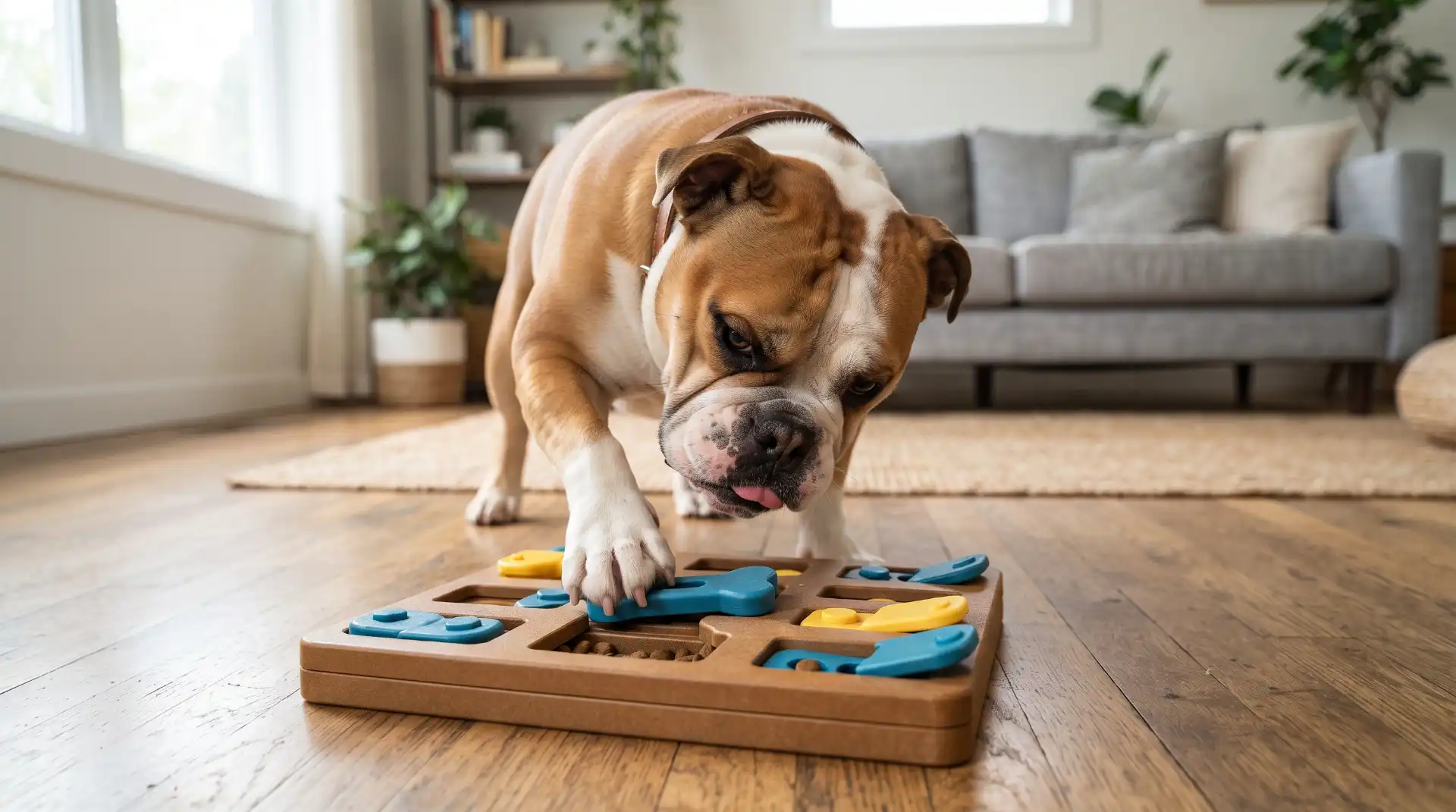
A Continental Bulldog does not need to spend every waking hour running around the house to have a fulfilling day.
Mental stimulation can be just as important as physical activity. Giving your dog opportunities to think, investigate, learn, solve simple problems, and interact with you can help make everyday life more interesting.
For Continental Bulldog owners in the United States, mental enrichment can be particularly useful on days when weather, work schedules, or other circumstances limit outdoor activities. A hot summer afternoon in Texas, a snowy winter day in Minnesota, or a rainy day in Washington can make a long outdoor walk less practical. Indoor enrichment gives your dog another way to stay engaged.
The good news is that mental stimulation does not have to involve expensive equipment or complicated training programs.
A few minutes of structured training, a food puzzle, a scent game, or a new household activity can turn an ordinary day into an opportunity for learning.
The key is variety.
What Is Mental Stimulation for a Continental Bulldog?
Mental stimulation involves activities that encourage your dog to use its brain.
Dogs naturally investigate their surroundings through smell, sight, hearing, touch, and taste. They also learn through interaction, repetition, problem-solving, and social communication.
For a Continental Bulldog, mental enrichment might include learning a new command, searching for hidden treats, working with a puzzle feeder, exploring a safe new environment, or practicing calm behavior around everyday distractions.
Mental stimulation should not be confused with simply tiring a dog out.
A dog may become physically exhausted after intense activity but still benefit from activities that require concentration and problem-solving.
Likewise, mental stimulation does not have to be difficult. In many cases, simple activities are extremely effective because they encourage natural behaviors.
Why Mental Stimulation Matters
Dogs can become bored when their daily environment provides little variation.
A bored dog may look for its own entertainment. Depending on the individual dog, this can involve chewing household objects, barking, digging, repeatedly seeking attention, or becoming restless.
This does not mean that every unwanted behavior is caused by boredom. Medical problems, anxiety, inadequate training, environmental stress, and other factors can also contribute to behavioral changes.
However, appropriate enrichment can be an important part of a well-rounded routine.
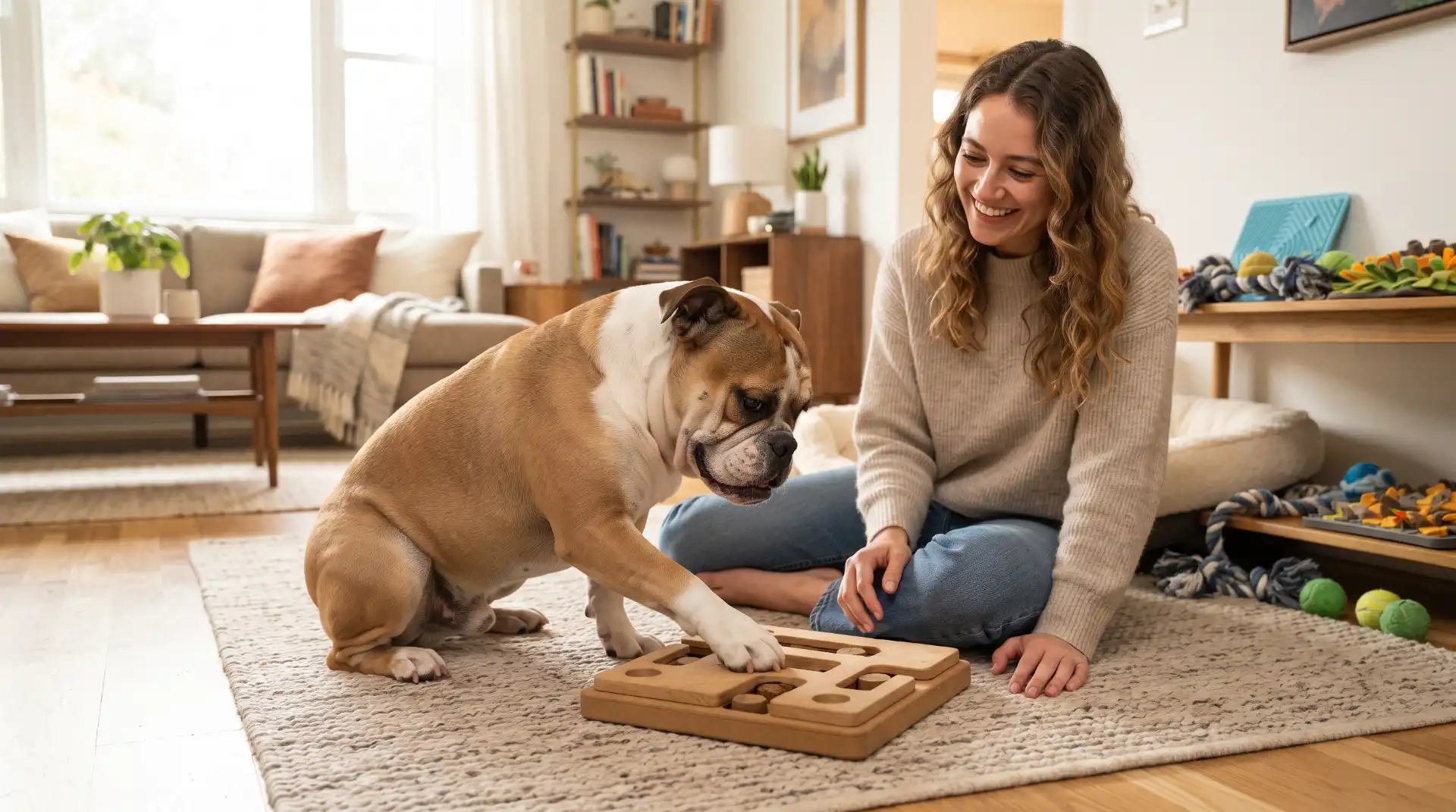
Mental stimulation can also strengthen communication between an owner and dog. Training exercises require your Continental Bulldog to pay attention to you and learn how certain behaviors produce desired outcomes.
Over time, these interactions can help build a stronger everyday relationship.
Use Food as an Enrichment Opportunity
One of the easiest ways to add mental stimulation to your Continental Bulldog’s routine is to change how meals are delivered.
Instead of serving every meal in the same bowl at the same time, owners can sometimes use an appropriate food puzzle or slow-feeding device.
The dog may need to push, roll, sniff, or manipulate the object to access portions of its meal.
This turns eating into an activity that requires concentration.
However, owners should choose enrichment products appropriate for their dog’s size, chewing habits, and individual needs. Dogs should be supervised when using unfamiliar toys.
You should also account for food used in enrichment when calculating your dog’s overall daily intake.
Extra treats on top of regular meals can contribute to unnecessary weight gain.
Try a Simple Treasure Hunt
You do not need an expensive puzzle toy to create a mental challenge.
A simple treasure hunt can encourage your Continental Bulldog to use its powerful sense of smell.
Start by allowing your dog to watch you place a small amount of its regular food or an appropriate treat somewhere easy to find.
Give your dog a cue to search.
Once your dog understands the game, gradually make the hiding locations more challenging.
You might place food behind a piece of furniture, near a safe corner of the room, or beside a dog toy.
Always make sure the area is safe and that your dog cannot access harmful substances, electrical cords, small objects, or anything it might swallow.
The goal is to encourage searching, not create a dangerous obstacle course.
Practice Short Training Sessions
Training is one of the best forms of mental stimulation because it requires your dog to listen, remember, make decisions, and respond.
You do not need to conduct a one-hour training session.
In fact, short sessions can be easier for many dogs.
Spend five to ten minutes practicing commands such as:
- Sit
- Stay
- Come
- Down
- Leave it
- Place
- Wait
- Touch
Once your Continental Bulldog understands the basics, you can gradually introduce more complex behaviors.
For example, teach your dog to go to a specific mat and remain there while you move around the room.
This combines obedience, impulse control, and concentration.

Teach Your Dog the Names of Toys
Another fun activity is teaching your Continental Bulldog to identify individual toys.
Begin with one toy.
Hold it up and say its name.
When your dog interacts with it, provide positive reinforcement.
After your dog learns the first toy, introduce another.
Eventually, you can ask your dog to find a specific toy.
For example, you might say “Find your ball” and encourage your dog to search for it.
This can become a fun indoor game that combines memory, listening, and scent.
Do not expect your dog to understand the names immediately. Learning should be gradual and enjoyable.
Create a Safe Indoor Obstacle Course
On days when outdoor exercise is limited, you can create a simple indoor activity area.
Use safe household objects to create opportunities for your dog to move around, walk between objects, step onto an appropriate low surface, or follow you through a designated area.
Avoid activities that require excessive jumping or sharp movements.
This is particularly important because dogs differ in physical structure, fitness, age, and joint health.
The goal is mental engagement rather than extreme physical exertion.
For puppies, senior dogs, or dogs with known orthopedic concerns, ask your veterinarian what types of physical activity are appropriate.
Introduce Scent Games
Scent-based activities are particularly useful because dogs experience the world heavily through smell.
You can start with a simple game.
Ask your Continental Bulldog to stay in one area while you hide a treat somewhere nearby.
Then release your dog and encourage it to search.
As your dog improves, make the hiding places more challenging.
You can eventually create several hiding locations around one room.
Scent games can also be useful because they allow a dog to work independently while you supervise.
Do not make the game unnecessarily difficult. If your dog repeatedly fails to find the reward, simplify the challenge.
Successful problem-solving creates a more positive experience than constant frustration.
Rotate Toys Instead of Leaving Everything Out
If every toy is available every day, some dogs may eventually lose interest.
Toy rotation can introduce variety without requiring you to purchase new products constantly.
Keep some toys stored safely and offer a different selection periodically.
After your Continental Bulldog becomes interested in one group, replace them with another.
This can make familiar toys feel more interesting again.
Inspect toys regularly for damage. If a toy becomes broken or presents a choking or swallowing hazard, remove it.
Use Interactive Toys Carefully
Interactive toys can provide excellent mental stimulation.
Treat-dispensing toys, puzzle feeders, snuffle-style enrichment products, and other interactive devices can encourage dogs to work for food.
However, not every product is suitable for every Continental Bulldog.
Consider your dog’s chewing strength and behavior when selecting a toy.
A dog that aggressively destroys toys may need different enrichment options from a dog that gently manipulates them.
Supervise new toys until you understand how your dog uses them.
Turn Everyday Activities Into Training
You do not need to schedule every enrichment activity.
Everyday household activities can become training opportunities.
Ask your dog to sit before opening a door.
Practice “wait” before putting down a food bowl.
Reward calm behavior when visitors arrive.
Ask your dog to go to its bed while you prepare dinner.
Practice recall inside the house.
These small moments can add up to significant mental engagement.
They also help your Continental Bulldog understand what behaviors are expected in different situations.
Practice Impulse Control
Impulse control is another useful form of mental exercise.
Dogs naturally want access to things they find interesting. Teaching your Continental Bulldog to pause and wait can require concentration.
For example, place a treat in your closed hand.
Allow your dog to investigate.
When your dog stops trying to access the treat and waits calmly, reward it.
Gradually increase the difficulty.
You can eventually practice waiting before going through a doorway, receiving a toy, or approaching its food bowl.
The objective is not to suppress natural behavior. It is to teach your dog that patience can produce a positive result.
Give Your Dog a “Job”
Many dogs enjoy having predictable responsibilities.
Your Continental Bulldog can have simple household “jobs.”
For example, your dog might carry an appropriate toy from one room to another, retrieve a designated object, go to its bed when asked, or wait calmly while you perform a household task.
These activities give your dog something to focus on.
Dogs do not need human-style employment. A “job” simply means providing a predictable activity that encourages attention and cooperation.
Use Calm Enrichment
Mental stimulation does not always need to be exciting.
Some dogs benefit from calm activities that encourage concentration without increasing arousal.
Lick mats, appropriate chew products, sniffing games, quiet training, and food puzzles can provide this type of enrichment.
Calm enrichment can be particularly useful before bedtime or after a busy day.
The goal is to help your dog remain engaged without creating excessive excitement.
Social Interaction Is Mental Enrichment
Your Continental Bulldog does not need another dog in the house to experience social enrichment.
Time spent interacting with you can be valuable.
Talk to your dog, practice commands, play appropriate games, groom your dog, or simply spend quiet time together.
Dogs learn a tremendous amount from human interaction.
For puppies, controlled socialization is especially important.
Socialization does not mean forcing a puppy to interact with every person or dog it encounters. Instead, puppies should gradually experience different sights, sounds, surfaces, people, environments, and situations in a safe and positive manner.
Your existing Continental Bulldog puppy-care content can be linked here for readers raising young dogs.
Change the Environment Safely
Dogs can become more interested in their surroundings when something changes.
You can safely introduce small environmental changes inside your home.
Move a few enrichment items to a different room.
Introduce a new safe household sound.
Set up a temporary indoor sniffing area.
Provide a new texture that your dog can safely investigate.
The change does not need to be dramatic.
Even small differences can encourage your dog to investigate its environment.
Use Outdoor Exploration When Weather Allows
Mental stimulation is not limited to the living room.
When temperatures and conditions are appropriate, take your Continental Bulldog on walks that allow time for sniffing and exploration.
A walk does not have to be a race from one point to another.
Allowing your dog to safely stop and investigate smells can provide mental enrichment.
Choose appropriate locations and keep your dog under control according to local rules.
During hot U.S. summers, avoid excessive exercise during peak heat and watch for signs of overheating.
In colder areas, consider weather conditions, ice, salt, and other hazards that may affect your dog’s paws.
Mental Stimulation for Puppies
Puppies have developing bodies and minds.
Their enrichment activities should therefore be age-appropriate.
Short training sessions can introduce basic commands while helping puppies learn how to interact with people.
Food puzzles can provide supervised enrichment.
Safe toys can encourage exploration.
Gentle socialization can introduce puppies to new experiences.
Avoid making every activity physically demanding.
A puppy may become mentally tired after a short training session, so there is no need to continue until the dog becomes frustrated or exhausted.
Mental Stimulation for Adult Continental Bulldogs
Adult dogs can usually handle more complex enrichment activities, assuming they are physically healthy.
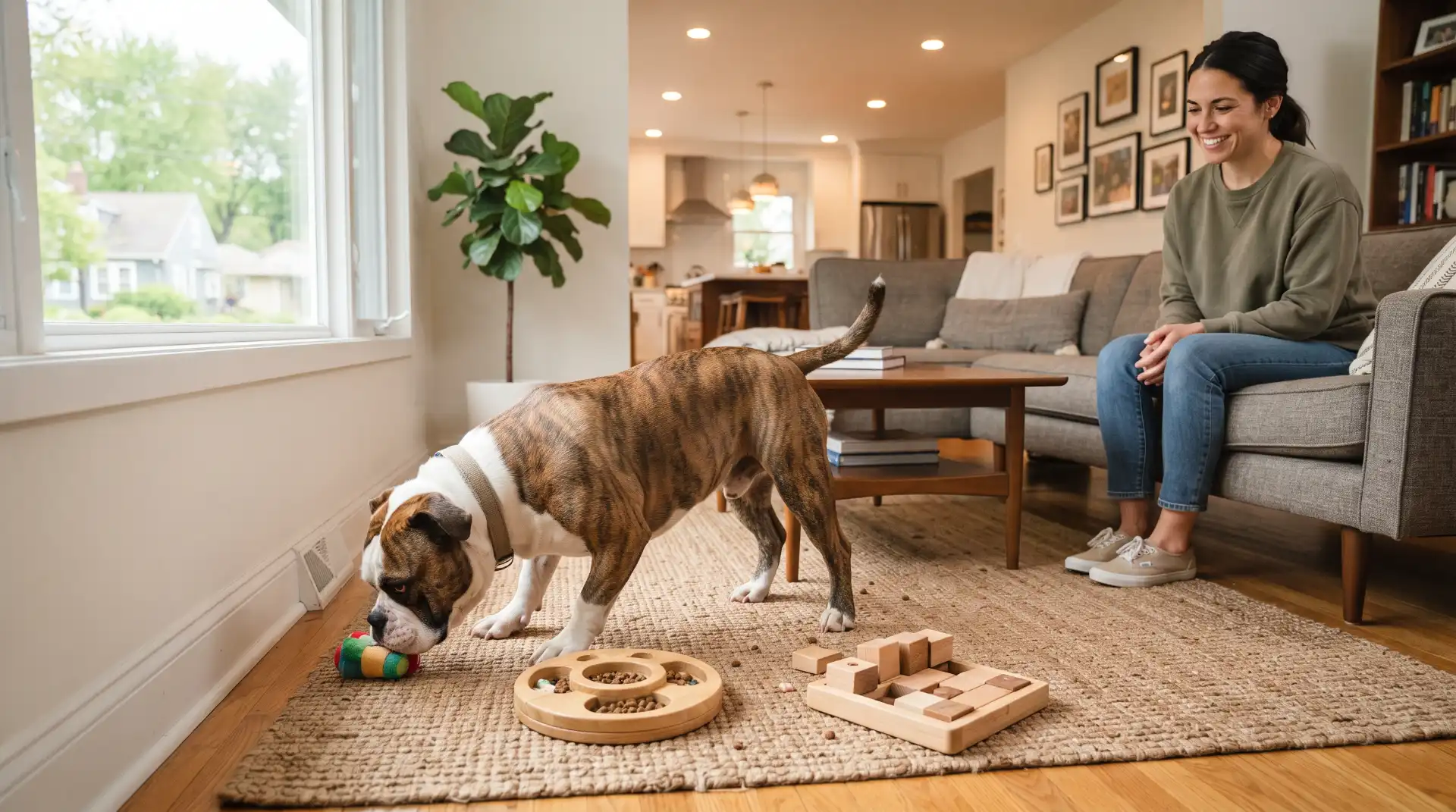
Owners can increase the difficulty of scent games, introduce more advanced obedience training, use food puzzles, practice toy retrieval, and create structured indoor games.
Variety is important.
If your dog performs the same puzzle every day, gradually introduce new challenges.
However, complexity should always remain appropriate.
The goal is engagement, not frustration.
Mental Stimulation for Senior Continental Bulldogs
Older Continental Bulldogs can continue enjoying enrichment.
The activities may simply need to change.
A senior dog with reduced mobility may enjoy scent games, gentle obedience exercises, food puzzles, and interactive toys that do not require jumping or climbing.
If you notice a significant change in your senior dog’s interest in activities, behavior, movement, hearing, vision, or appetite, discuss it with your veterinarian.
A sudden change should not automatically be attributed to age.
How Much Mental Stimulation Does a Continental Bulldog Need?
There is no universal number of minutes that works for every Continental Bulldog.
Age, personality, health, training level, environment, and daily routine all influence a dog’s needs.
Instead of focusing entirely on a specific number, observe your dog.
A well-enriched dog should have opportunities to relax as well as opportunities to engage.
If your dog seems persistently restless, destructive, excessively demanding, or unable to settle, consider whether its physical activity, mental stimulation, training, environment, and overall health need to be reassessed.
If behavioral changes appear suddenly or are severe, consult a veterinarian.
Signs Your Dog May Need More Enrichment
Boredom can sometimes contribute to unwanted behavior, although it is not the only possible cause.
Possible signs that your dog may benefit from more appropriate engagement include repeatedly seeking attention, destructive behavior, excessive barking, restlessness, or quickly losing interest in ordinary toys.
Before assuming boredom is responsible, consider medical and behavioral factors.
Pain, anxiety, gastrointestinal problems, changes in hearing or vision, and other conditions can alter behavior.
A veterinarian or qualified behavior professional can help identify the underlying issue when necessary.
Create a Daily Enrichment Routine
A successful enrichment routine does not have to take hours.
For example, a typical day might include a short morning walk with time for sniffing, a few minutes of obedience practice, an interactive feeding activity, and a quiet scent game later in the afternoon.
The exact schedule can be adjusted according to your household.
On busy workdays, five-minute training sessions can still provide value.
On weekends, you may have more time for longer walks, new environments, or more elaborate enrichment games.
Consistency matters more than creating a perfect schedule.
Common Mistakes to Avoid
One common mistake is assuming that buying more toys automatically creates more mental stimulation.
A room full of toys does not necessarily challenge a dog.
Another mistake is making activities too difficult. If your Continental Bulldog cannot solve a puzzle or find a hidden reward, the activity may become frustrating.
Owners should also avoid using unsafe household objects as improvised toys.
Small objects, toxic substances, electrical cords, and materials that can splinter or break apart should be kept away from dogs.
Finally, enrichment should not replace veterinary care, appropriate physical activity, training, or social interaction.
A balanced lifestyle combines all of these elements.
Frequently Asked Questions
Are puzzle toys good for Continental Bulldogs?
Puzzle toys can provide mental enrichment when they are appropriate for the individual dog. Choose products suitable for your dog’s size, chewing behavior, and ability level, and supervise unfamiliar toys.
How can I mentally stimulate my Continental Bulldog without buying toys?
Training, scent games, hide-and-seek with treats, toy-name games, household “jobs,” and supervised exploration can all provide mental stimulation without requiring expensive equipment.
Can mental stimulation replace exercise?
No. Mental enrichment and physical activity serve different purposes. Your dog’s exercise needs should be determined by age, health, fitness, and veterinary guidance.
How long should training sessions last?
Short sessions are often effective. A few focused minutes can be more productive than a long session in which the dog becomes distracted or frustrated.
Is sniffing good mental stimulation?
Yes. Allowing dogs to investigate safe smells can provide an opportunity for natural exploration and mental engagement.
Conclusion
Keeping a Continental Bulldog mentally stimulated does not require elaborate equipment or hours of structured activity.
The most effective approach is often simple: make meals more engaging, introduce scent games, practice obedience, rotate toys, encourage safe exploration, provide interactive activities, and spend quality time with your dog.
Mental stimulation can also make life easier for owners because a dog that receives appropriate opportunities to learn and explore may have fewer reasons to seek its own entertainment.
For U.S. Continental Bulldog owners, indoor enrichment is especially valuable when extreme heat, cold, rain, snow, or a busy schedule limits outdoor activities.
Most importantly, remember that every dog is different.
Your Continental Bulldog’s age, personality, health, physical condition, and previous training should influence the activities you choose. Start with simple challenges, observe how your dog responds, and gradually adjust the difficulty.
Mental wellness is not about keeping your dog busy every minute of the day. It is about providing meaningful opportunities to think, explore, learn, interact, and then relax.
A few minutes of purposeful enrichment each day can become an important part of a healthy and rewarding life for your Continental Bulldog.
Important note: This article is intended for general educational purposes and does not replace advice from a licensed veterinarian or qualified animal behavior professional. If your Continental Bulldog develops sudden behavioral changes, signs of pain, unusual aggression, severe anxiety, or other concerning symptoms, seek professional guidance.