
Why French Bulldog Leash Training Matters
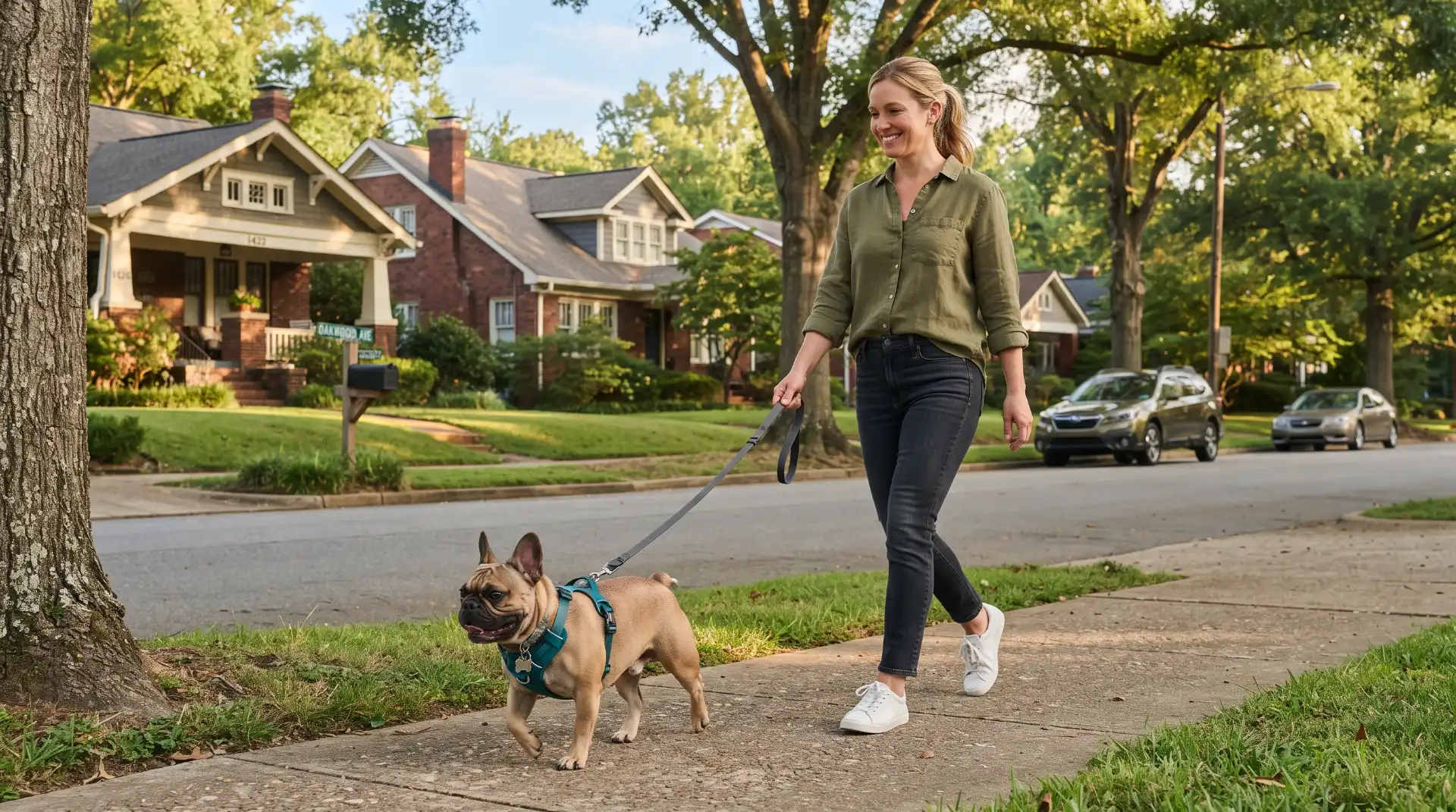
Taking a French Bulldog for a daily walk can be one of the best ways to provide exercise, mental stimulation, and quality time together. However, many owners quickly discover that walking a Frenchie is not always as simple as attaching a leash and heading outside. French Bulldogs can become excited by people, other dogs, interesting smells, bicycles, cars, squirrels, and unfamiliar surroundings, which can make an otherwise peaceful walk difficult to manage.
French Bulldog leash training helps your dog understand how to behave while walking with you in different environments. The objective is not necessarily to make your Frenchie walk in a perfectly strict heel for an entire outing. Instead, good leash manners should allow your dog to explore safely while remaining responsive to your direction and avoiding constant pulling, sudden lunges, or dangerous movements toward roads and other hazards.
Leash training is especially useful for French Bulldogs because the breed has particular physical characteristics that owners need to consider. Their short muzzles and compact body structure mean that exercise intensity, temperature, and breathing should be considered when planning outdoor activities. A well-trained Frenchie is easier to guide away from dangerous situations and can enjoy walks without unnecessary physical or emotional stress.
The American Kennel Club’s French Bulldog breed information provides additional background on the breed’s characteristics and care considerations. Owners should also discuss exercise requirements and any individual concerns with their veterinarian, particularly if their Frenchie has breathing difficulties, weight concerns, or other health considerations.
Understanding Your French Bulldog Before Leash Training
Before beginning leash training, it helps to understand your Frenchie’s individual personality. Some French Bulldogs naturally prefer to stay close to their owners, while others are extremely curious and want to investigate almost everything they encounter outside. A Frenchie that appears stubborn during a walk may actually be distracted, overstimulated, uncertain about a new environment, or simply interested in an unfamiliar smell.
Outdoor environments are considerably more stimulating than most homes. A quiet living room may contain only a handful of sounds and smells, while an American neighborhood can expose your Frenchie to vehicles, lawn equipment, children, bicycles, dogs, birds, people, and hundreds of unfamiliar scents. Expecting a dog to immediately ignore all of these distractions can make training unnecessarily difficult.
Instead, think of leash training as a gradual learning process. Your Frenchie should first learn basic leash skills in a calm environment before being expected to demonstrate those skills in a busy park or on a crowded sidewalk. By increasing distractions gradually, you give your dog more opportunities to succeed and build confidence.
Choosing the Right Harness and Leash
The equipment you use can make leash training easier, although no harness or leash can replace consistent training. Many French Bulldog owners choose a properly fitted harness because it provides a practical way to manage the dog without relying on pressure around the neck. The harness should fit securely while allowing normal movement and should not rub against the dog’s skin.
Because French Bulldogs have distinctive body shapes, owners should check the fit carefully rather than assuming that a harness designed for another breed will work equally well. You should be able to place your fingers between the harness and the dog’s body without the equipment being excessively loose. The dog should also not be able to easily back out of it when walking.
A standard fixed-length leash is often useful for basic leash training because it gives the handler predictable control. Extremely long or retractable leashes can make certain training exercises more difficult because the distance between dog and owner changes constantly. Once your Frenchie has reliable walking habits, you can determine which leash style works best for your normal walking environments.
Before every outing, quickly inspect the leash clip, harness straps, and attachment points. This is particularly important before walking near roads, parking lots, or crowded public areas because equipment failure can create a dangerous situation.
Start French Bulldog Leash Training Inside the Home
One of the easiest ways to make leash training less stressful is to begin indoors. Before your Frenchie needs to deal with traffic, unfamiliar dogs, and outdoor noises, allow the dog to become comfortable wearing its harness in a familiar environment.
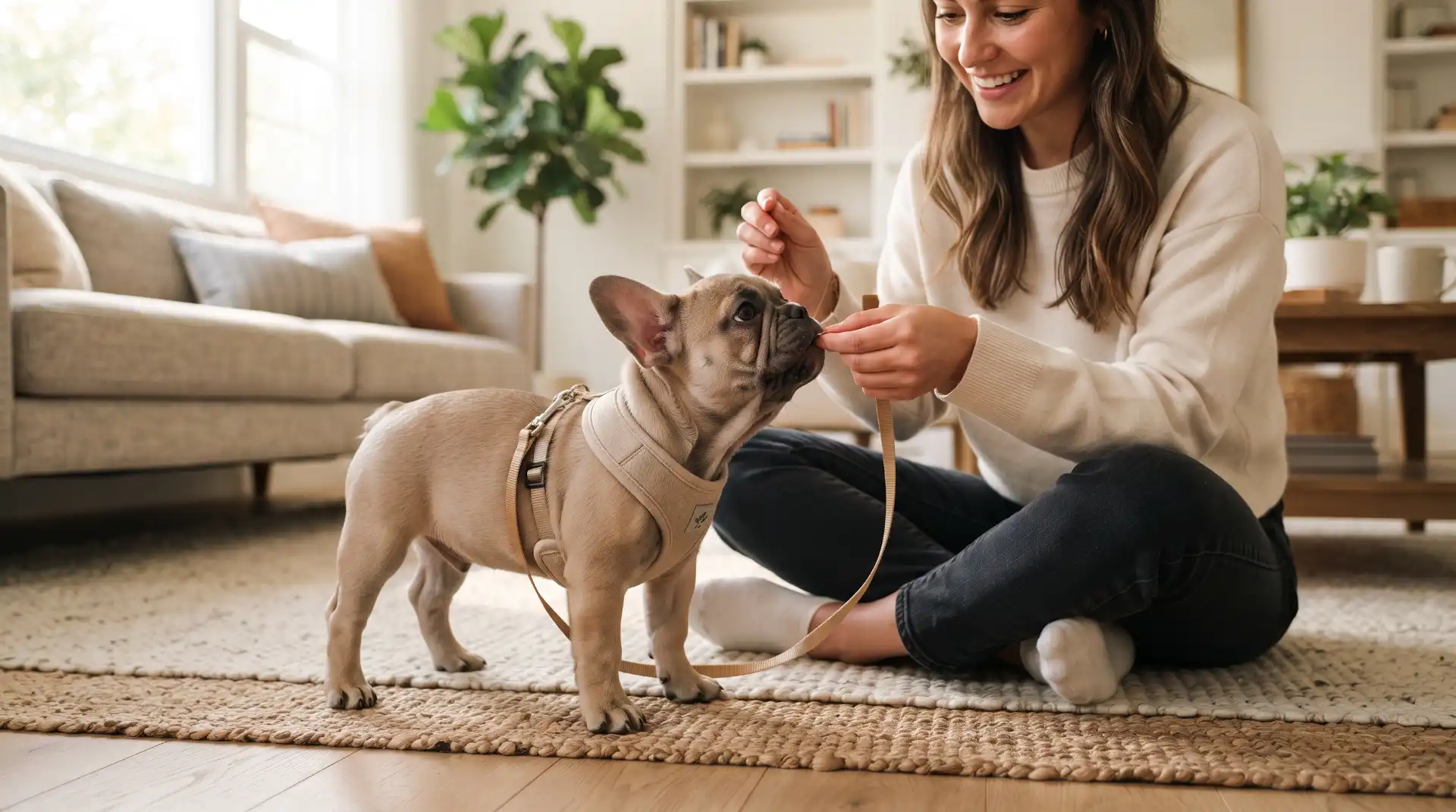
Put the harness on for a short period and immediately associate it with positive experiences. You can offer a small treat, praise your dog, or engage in a favorite calm activity while the harness is being worn. If your Frenchie scratches at the harness or seems uncomfortable, avoid turning the introduction into a physical struggle, and instead give the dog time to adjust gradually.
Once the harness becomes familiar, attach the leash while remaining inside. Allow your Frenchie to walk around while you supervise and keep the leash loose. Rather than pulling the dog toward you, encourage your Frenchie to voluntarily follow your movement.
When your dog follows you for a few steps, provide praise or a small reward. Repeating this exercise teaches an important lesson: staying connected to the owner can lead to positive experiences.
Teach Your Frenchie to Focus on You
Attention training is one of the most valuable foundations for successful leash walking. Your Frenchie will encounter countless distractions outside, so being able to redirect the dog’s attention can be more useful than trying to physically control every movement.
Begin in a quiet room and say your dog’s name in a cheerful voice. When your Frenchie turns toward you, reward the response immediately with praise or a small treat. Repeat the exercise several times until your dog begins to associate its name with looking toward you.
As your Frenchie improves, practice the same behavior in slightly more distracting locations. You can move from the living room to a hallway, then to a yard, and eventually to a quiet outdoor area. This gradual progression helps your dog understand that the attention cue applies in different environments.
The goal is not to force your Frenchie to stare at you throughout the entire walk. Dogs should have opportunities to sniff and explore appropriate surroundings, but they should also be able to shift their attention back to their owner when necessary.
Teaching Loose-Leash Walking
Loose-leash walking should be one of the primary goals of French Bulldog leash training. A loose leash allows your dog to explore without constantly pulling against you and makes it easier to maintain control when unexpected situations occur.
Start in a quiet environment where there are very few distractions. Walk several steps with your Frenchie and reward the dog whenever the leash remains loose and the dog stays reasonably close to you. Continue this process in short intervals rather than expecting your dog to walk perfectly for an extended period.
If your Frenchie begins pulling, avoid automatically pulling harder in the opposite direction. Turning the leash into a constant physical contest can create frustration for both of you. Instead, calmly stop or change direction, wait for your dog to reconnect with you, and then continue when the leash becomes loose again.
With consistent practice, your Frenchie can learn that pulling does not automatically make the walk continue. Calm walking, on the other hand, can lead to movement, praise, treats, and opportunities to explore.
What to Do When Your Frenchie Pulls
Pulling usually has a reason behind it, and identifying that reason can help you choose the right training response. Your Frenchie may pull because it wants to reach another dog, investigate a smell, greet a person, move toward a familiar destination, or simply walk faster than you.
Rather than correcting every instance of pulling with physical force, try to determine what your dog is trying to reach. If your Frenchie is pulling toward an interesting smell, for example, you can wait for the leash to become loose before allowing the dog to investigate the area. This teaches the Frenchie that calm behavior can actually lead to the reward it wanted.
The same principle can be used around other distractions. If your Frenchie sees another dog and begins pulling, increase the distance and work on getting your dog’s attention before moving closer. Your goal should be to keep the dog in a state where it can still think and respond rather than waiting until it becomes completely overwhelmed.
Reward Good Walking Behavior
Positive reinforcement is an important part of successful leash training. Whenever your Frenchie performs a behavior you want to see again, make that behavior worthwhile through praise, treats, play, or another reward your dog values.
Timing matters because the reward should be connected to the behavior. If your Frenchie walks calmly for several steps, reward that behavior while it is happening or immediately afterward. This helps the dog understand which action produced the positive outcome.
Small treats can be particularly useful during early training because they allow you to provide frequent reinforcement without giving your dog large quantities of food. As your Frenchie becomes more reliable, you can gradually reduce the frequency of food rewards while continuing to use praise, sniffing opportunities, and other forms of reinforcement.
Training should remain enjoyable for both you and your dog. If your Frenchie becomes frustrated or overly tired, ending the session on a successful behavior can be more productive than continuing until the dog loses interest.
Gradually Introduce Outdoor Environments
Your Frenchie may walk beautifully inside your house but behave completely differently once the front door opens. This is normal because the outdoor environment introduces many new distractions at once.
Begin somewhere quiet, such as a calm section of your yard or a low-traffic sidewalk. Give your Frenchie time to look around and process the new environment while rewarding calm behavior.
Once your dog can walk comfortably in that setting, gradually introduce more stimulating locations. You might move from a quiet residential street to a busier neighborhood sidewalk and eventually to a park with more people and dogs.
Avoid increasing every difficulty at the same time. If your Frenchie is still learning basic leash manners, taking the dog directly into a crowded festival or busy downtown area can make success unlikely. Training works better when challenges are introduced in manageable steps.
Helping Your Frenchie Ignore Other Dogs
Other dogs are among the most common distractions during walks. Some French Bulldogs become excited because they want to play, while others may become nervous or frustrated when another dog approaches.
Your Frenchie does not need to greet every dog it sees. Teaching your dog that another animal can pass without requiring an interaction is an important part of safe public walking.
Begin by maintaining enough distance that your Frenchie can notice another dog without immediately reacting. When your dog looks at the other animal and then returns attention to you, provide a reward. Repeating this process helps create a habit of checking in with the owner instead of automatically pulling toward the distraction.
If your Frenchie starts barking, lunging, or pulling intensely, move farther away rather than trying to force the dog to remain close to the trigger. As your dog’s ability to remain calm improves, you can gradually practice at shorter distances.
Teaching Safe Behavior Near Streets and Curbs
Walking near roads requires a different level of caution because even a brief loss of control can have serious consequences. A French Bulldog should never be allowed to run freely toward a street simply because traffic appears quiet.
You can teach your Frenchie to slow down and pause whenever you approach a curb. Stop with your dog before reaching the roadway and wait while you check the surroundings. Use the same routine consistently so your dog begins to associate the curb with stopping rather than rushing forward.
This skill can also be useful around driveways and parking lots. Vehicles can move unexpectedly in these locations, and a dog that suddenly pulls away can be difficult to control.
Training can improve your dog’s response, but it should never replace physical control near traffic. Keep your Frenchie securely attached to its leash and remain attentive whenever you are near moving vehicles.
French Bulldog Leash Training During Hot Weather
Weather is an especially important consideration when walking a French Bulldog in the United States. Summers can produce very high temperatures in many regions, while humidity can make conditions even more difficult for dogs that already have challenges with heat regulation.
French Bulldogs have short muzzles, so owners should take signs of breathing difficulty and overheating seriously. Avoid strenuous activity during the hottest part of the day and consider cooler times such as early morning or later evening when local conditions permit.
Hot pavement can also become uncomfortable for your dog’s paws. Before beginning a walk, consider the surface temperature and whether the route provides enough shade. Carrying water for longer outings can also be helpful during warm weather.
Your dog’s behavior should determine when a walk needs to slow down or end. If your Frenchie is struggling, unusually tired, breathing heavily, or showing other concerning signs, move to a cooler environment and seek veterinary advice when appropriate.
The American Veterinary Medical Association provides general veterinary information that can help pet owners better understand responsible animal care and safety.
Recognizing When Your Frenchie Needs a Break
French Bulldogs are not designed for long-distance endurance activities, and individual exercise tolerance can vary considerably. Age, body condition, fitness level, weather, and individual health can all influence how much walking is appropriate.
During training, watch your dog’s overall behavior rather than focusing only on the distance covered. A Frenchie that begins slowing significantly, repeatedly stopping, or showing signs of discomfort may need a break.
Puppies may need particularly short training sessions because they are still developing physically. Older dogs may also require shorter walks or more frequent rest periods depending on their individual needs.
The goal of leash training is not to complete a certain number of miles. The goal is to create safe and enjoyable walking habits that fit your dog’s physical abilities.
How to Stop Pulling Without Creating More Frustration
When a Frenchie pulls repeatedly, owners can become frustrated and start using more physical pressure. However, constant tension can make the walk stressful and may not teach the dog what behavior is actually expected.
Instead, make the desired behavior clear. When your Frenchie pulls, pause or calmly redirect the dog. When the leash becomes loose and your dog reconnects with you, reward that moment and continue walking.
This process may seem slow at first, particularly with a dog that has been pulling for a long time. However, consistency helps your Frenchie understand that loose-leash walking is what allows the walk to continue.
You should also remember that dogs repeat behaviors that produce useful results. If pulling occasionally allows your Frenchie to reach a favorite tree, another dog, or an interesting smell, the pulling behavior may continue because it has been rewarded unintentionally.
Make Sniffing Part of the Walk
A successful walk does not have to involve constant obedience exercises. Sniffing is a natural and important part of how dogs investigate their environment, and allowing appropriate opportunities to sniff can make walks more satisfying.
You can incorporate sniffing into your training routine by using it as a reward. For example, after your Frenchie walks calmly for a short distance, you can allow the dog to investigate an appropriate patch of grass.
This creates a useful connection between good leash behavior and freedom to explore. Your dog learns that walking calmly does not mean losing all opportunities to investigate the environment.
A balanced walk can therefore include both structured walking and relaxed exploration. This approach often makes training feel more natural rather than turning every outdoor trip into a strict obedience exercise.
Teaching Your Frenchie to Handle Unexpected Sounds
Outdoor environments contain sounds that your Frenchie may not encounter at home. Garbage trucks, construction equipment, motorcycles, sirens, barking dogs, lawnmowers, and loud vehicles can all produce sudden reactions.
If your dog becomes startled, give it enough space to recover. Avoid dragging the Frenchie toward the source of the noise because forcing a frightened dog closer can increase its stress.
Instead, move to a quieter area and use familiar cues and rewards. Once your Frenchie relaxes, you can gradually expose the dog to similar sounds from a safe distance.
Confidence grows through controlled experiences. Your Frenchie does not need to love every sound, but learning that unusual noises do not automatically mean danger can make future walks easier.
Walking Around Cars, Bicycles, and Scooters
Moving objects can create significant distractions during walks. Cars, bicycles, electric scooters, skateboards, and delivery vehicles may pass quickly and unexpectedly.
Practice these situations from a safe distance. When your Frenchie notices a moving object but remains calm, reward the dog and encourage continued attention toward you.
As your dog becomes more comfortable, you can practice in locations with slightly more activity. However, always maintain a safe distance from traffic and moving vehicles.
Do not assume that a trained dog understands traffic danger. Even an obedient French Bulldog may suddenly chase a moving object if sufficiently excited, so physical control remains essential.
Practicing in American Neighborhoods
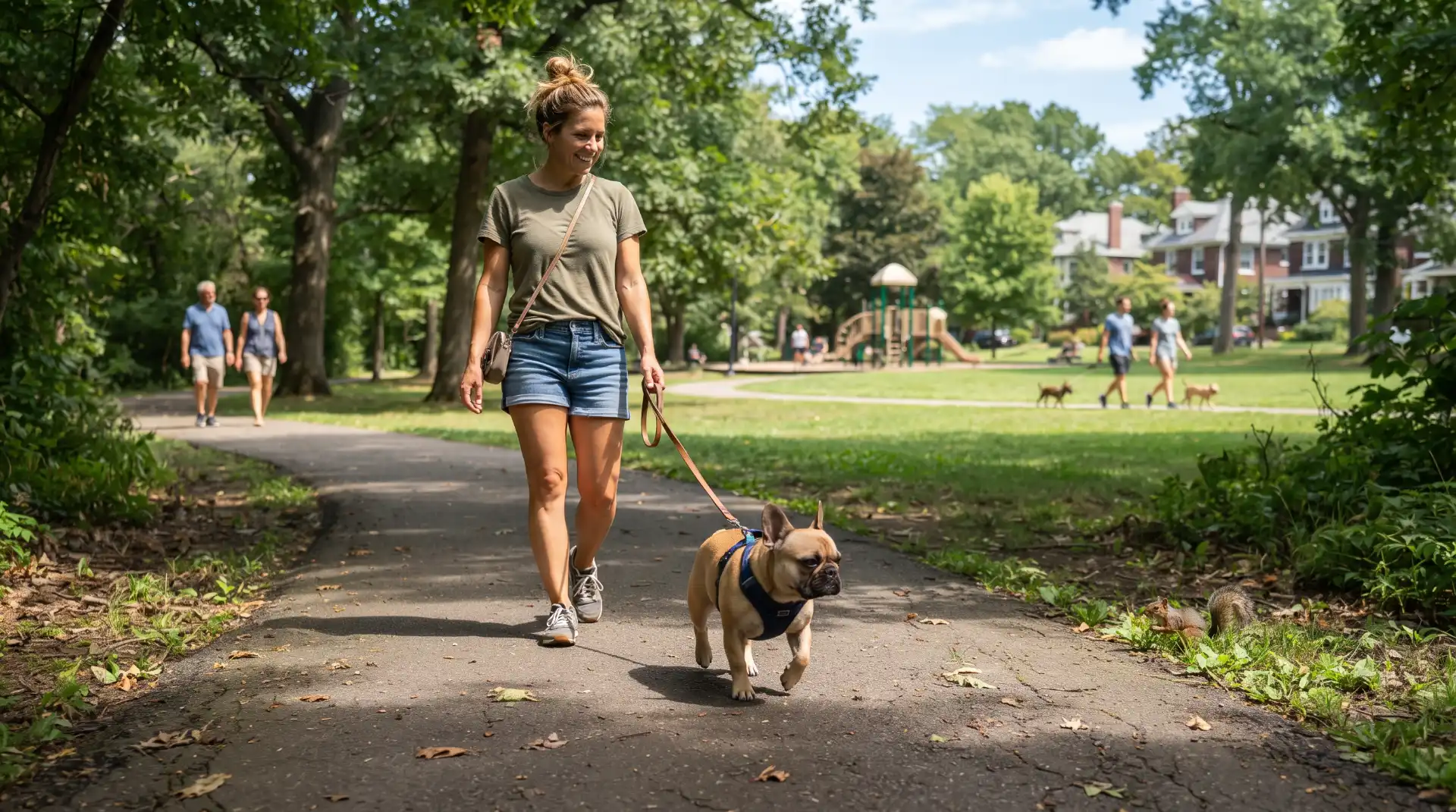
Neighborhood walks are excellent opportunities to develop practical leash skills because they provide a mixture of familiar and unfamiliar distractions. Your Frenchie may encounter mail carriers, children, neighbors, other dogs, lawn equipment, parked cars, and occasional traffic.
Rather than trying to eliminate all distractions, use them as controlled training opportunities. When your Frenchie notices something interesting, encourage the dog to remain calm and reward attention toward you.
You should also vary your routes occasionally once your Frenchie has developed basic confidence. Different streets provide different sounds, smells, surfaces, and experiences, helping your dog become more adaptable.
However, new routes should still be appropriate for your dog’s physical ability and the weather conditions. A longer or more stimulating route is not automatically a better route.
French Bulldog Leash Training for Puppies
Puppy leash training should focus on creating positive associations rather than achieving long walks. A young Frenchie can first become familiar with wearing a harness indoors and then gradually learn to follow the owner while attached to a leash.
Keep early sessions short enough that your puppy remains interested. Reward simple behaviors such as looking toward you, walking a few steps without pulling, and calmly responding to its name.
As the puppy grows, gradually introduce outdoor experiences. The exact pace should depend on the puppy’s development and your veterinarian’s recommendations regarding exercise and disease-prevention considerations.
Early training can make later walking much easier because the puppy learns from the beginning that the leash is part of a calm and rewarding routine.
Training an Adult French Bulldog
An adult French Bulldog can learn leash manners even if pulling has been happening for years. You may need additional patience if your dog has already learned that pulling successfully gets it where it wants to go.
Start by identifying the situations that cause the greatest difficulty. Your Frenchie might pull immediately after leaving the house, react to other dogs, chase moving objects, or become distracted by every smell.
Once you understand the pattern, practice in an environment where you can control the level of distraction. Reward the behaviors you want and gradually increase the difficulty as your dog becomes more reliable.
Adult dogs can make excellent training progress when owners establish clear expectations and maintain consistency. Avoid comparing your Frenchie with another dog because each animal has its own history, temperament, and learning pace.
When Professional Dog Training Can Help
Some leash problems are more complicated than ordinary pulling. If your Frenchie regularly lunges at other dogs, reacts intensely to strangers, becomes extremely fearful outdoors, or cannot be safely controlled, professional assistance may be appropriate.
A qualified dog trainer can observe the behavior and help determine which situations are causing the reaction. A veterinary behavior professional may also be appropriate when significant fear, anxiety, aggression, or other behavioral concerns are involved.
When selecting professional help, look for trainers who can clearly explain their methods and who prioritize humane, reward-based approaches. Your veterinarian may also be able to recommend appropriate training or behavioral resources in your area.
Professional support does not mean that an owner has failed. In many cases, getting guidance early can make training more structured and help prevent difficult behaviors from becoming more established.
Common French Bulldog Leash Training Mistakes
One common mistake is expecting a Frenchie to become an excellent walker after only a few training sessions. Dogs need repetition and practice, and progress can vary depending on age, previous experiences, personality, and the environment.
Another mistake is allowing pulling sometimes while discouraging it at other times. If pulling occasionally results in reaching an exciting destination, your dog may continue trying because the behavior has produced a reward in the past.
Introducing too many distractions too quickly can also slow progress. A dog that has only practiced indoors may struggle when suddenly placed in a crowded park filled with dogs, bicycles, children, and unfamiliar noises.
Owners should also avoid turning every walk into a battle. Calm redirection, appropriate rewards, and consistent expectations generally create a clearer learning experience than constant physical corrections.
Creating a Consistent Walking Routine
A predictable routine can help your Frenchie understand what happens before, during, and after a walk. Preparation should begin calmly rather than with frantic excitement at the sight of the harness.
Before opening the door, wait for your dog to settle enough to focus on you. Attach the leash securely and begin the walk without allowing your Frenchie to immediately drag you toward the sidewalk.
During the walk, combine periods of loose-leash walking with opportunities to sniff and explore. This gives your Frenchie both structure and enrichment while allowing you to reinforce appropriate behavior.
Consistency among family members is also important. Everyone who walks the dog should use similar expectations regarding pulling, greetings, stopping, and responding to cues.
Making Walks Safer for Children and Families
Good leash manners make daily walks easier for the entire household. A French Bulldog that stays reasonably close and responds to its owner is easier to manage when people, dogs, bicycles, or vehicles suddenly appear.
Families should establish clear rules about who handles the leash and how the dog should be approached during walks. Young children should be supervised when interacting with or walking a dog, particularly near roads or unfamiliar animals.
It is also helpful for everyone in the household to use the same verbal cues. If one person rewards pulling while another stops the walk whenever pulling occurs, the Frenchie may receive inconsistent information.
A family-wide approach can make the training process much more predictable for the dog.
Maintaining Good Leash Manners Over Time
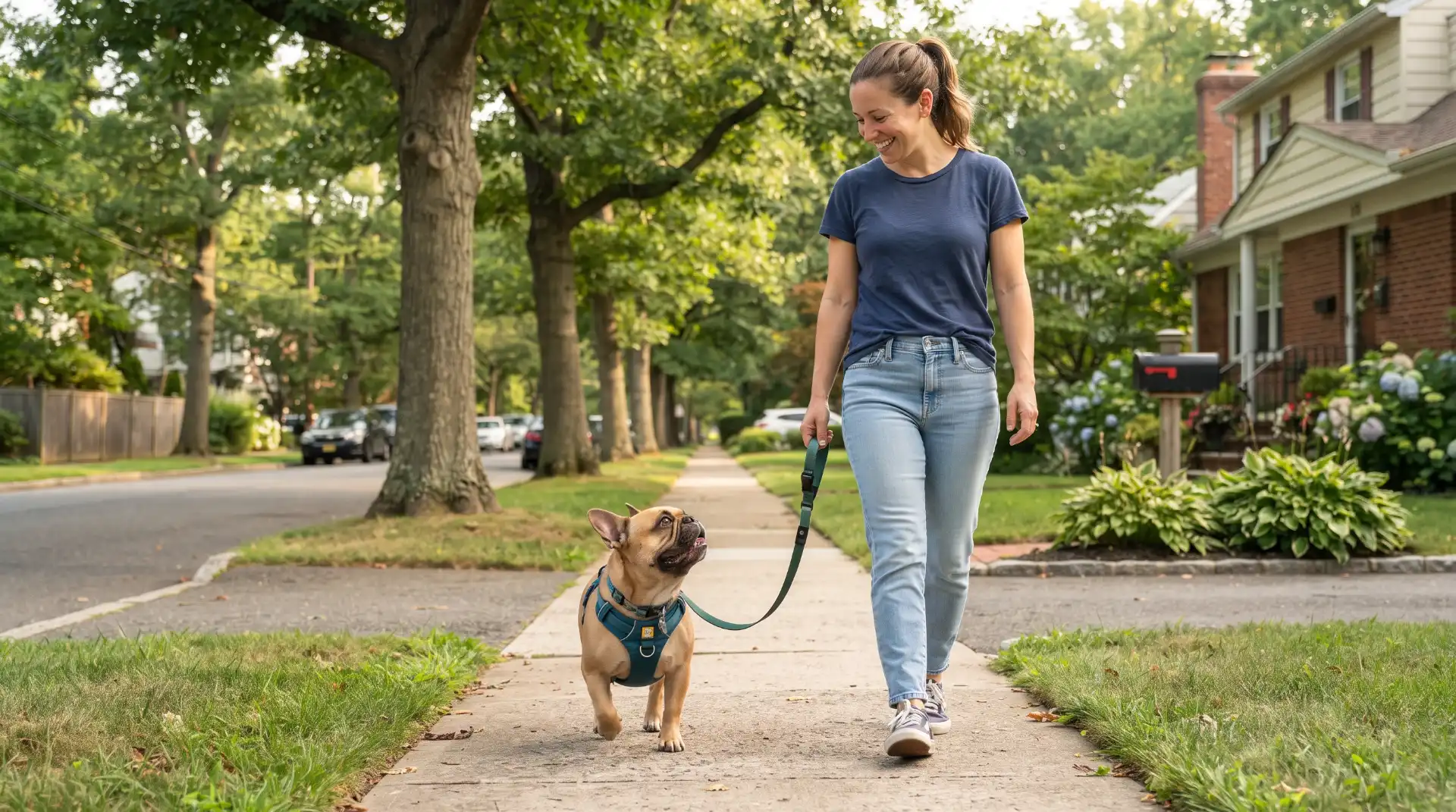
Leash training should continue throughout your Frenchie’s life, although formal training sessions can gradually become less frequent. Everyday walks provide natural opportunities to reinforce the behaviors your dog has already learned.
Continue rewarding calm walking occasionally, particularly in challenging environments. You can use treats less often as the behavior becomes reliable while still providing praise, sniffing opportunities, and other rewards.
It is also useful to practice familiar skills in different places. A Frenchie that can walk calmly in one neighborhood may need additional practice in a busy park or unfamiliar part of town.
Regular reinforcement helps prevent old habits from returning and gives your dog continued opportunities to succeed.
A Simple Long-Term Approach to French Bulldog Leash Training
The most effective leash-training plan is usually gradual, consistent, and realistic. Start by making your Frenchie comfortable with the harness and leash indoors, then teach the dog to follow you and respond to its name in a low-distraction environment.
Once those skills become familiar, move outside to a quiet area. Reward loose-leash walking and attention while gradually introducing ordinary neighborhood distractions.
As your Frenchie becomes more confident, practice around additional distractions such as other dogs, bicycles, pedestrians, and moderate traffic. Always increase difficulty gradually and maintain enough distance for your dog to remain responsive.
The process does not need to be rushed. A few successful minutes of training can be more valuable than a long walk in which your Frenchie becomes overwhelmed.
Frequently Asked Questions About French Bulldog Leash Training
What is the best way to start leash training a French Bulldog?
Start indoors by introducing a properly fitted harness and allowing your Frenchie to become comfortable wearing it. Attach the leash and reward your dog for calmly following you around the home before gradually moving the training outdoors.
How can I stop my French Bulldog from pulling?
Reward your Frenchie whenever the leash remains loose and your dog stays appropriately close. When pulling begins, calmly stop or change direction rather than continuing forward under constant leash tension, and reward your dog once attention returns to you.
Should French Bulldogs use a harness for walking?
Many owners prefer a properly fitted harness for French Bulldogs because it provides a practical way to manage the dog while reducing reliance on pressure around the neck. The harness should fit securely and allow normal movement without rubbing or restricting the dog.
Why does my Frenchie pull toward other dogs?
Your Frenchie may be excited, curious, frustrated, or interested in greeting the other dog. Practice at a distance where your dog can notice another animal without becoming overwhelmed, then reward calm behavior and attention toward you.
How long should a French Bulldog walk each day?
There is no single walking duration that is appropriate for every French Bulldog. Age, fitness, weather, body condition, individual health, and veterinary recommendations should all be considered, especially because French Bulldogs can be vulnerable to heat and breathing difficulties.
Can an older French Bulldog learn leash manners?
Adult and older French Bulldogs can learn new walking habits, although changing an established pulling behavior may take patience and consistent practice. Starting in a low-distraction environment and gradually increasing difficulty can make the process more manageable.
Is leash training important if my French Bulldog has a fenced yard?
A fenced yard can provide opportunities for safe outdoor activity, but it does not replace leash skills. Your Frenchie may eventually need to walk through neighborhoods, visit a veterinarian, travel, or navigate public areas where reliable leash manners are important.
Final Thoughts on French Bulldog Leash Training
French Bulldog leash training is about much more than preventing your dog from pulling. It teaches your Frenchie how to communicate with you, respond to distractions, move safely through public spaces, and enjoy outdoor experiences without constantly creating tension on the leash.
The most successful approach is usually gradual and positive. Begin indoors, introduce the harness and leash carefully, teach your Frenchie to focus on you, and reward calm walking before moving into increasingly distracting outdoor environments.
Remember that progress does not have to be perfect. Your Frenchie may have excellent walks one day and struggle with distractions the next, particularly when encountering a new environment or an exciting situation. Consistency, patience, and appropriate expectations can help your dog continue developing better habits.
Safety should always remain the priority. Keep your Frenchie under physical control near roads and moving vehicles, pay attention to weather conditions, provide appropriate breaks, and monitor your dog for signs of overheating or discomfort.
With regular practice, leash walking can become a comfortable part of everyday life rather than a constant struggle. Your Frenchie can learn to walk beside you, explore its surroundings, respond when called, and handle common distractions while enjoying the sights and smells of your neighborhood.