
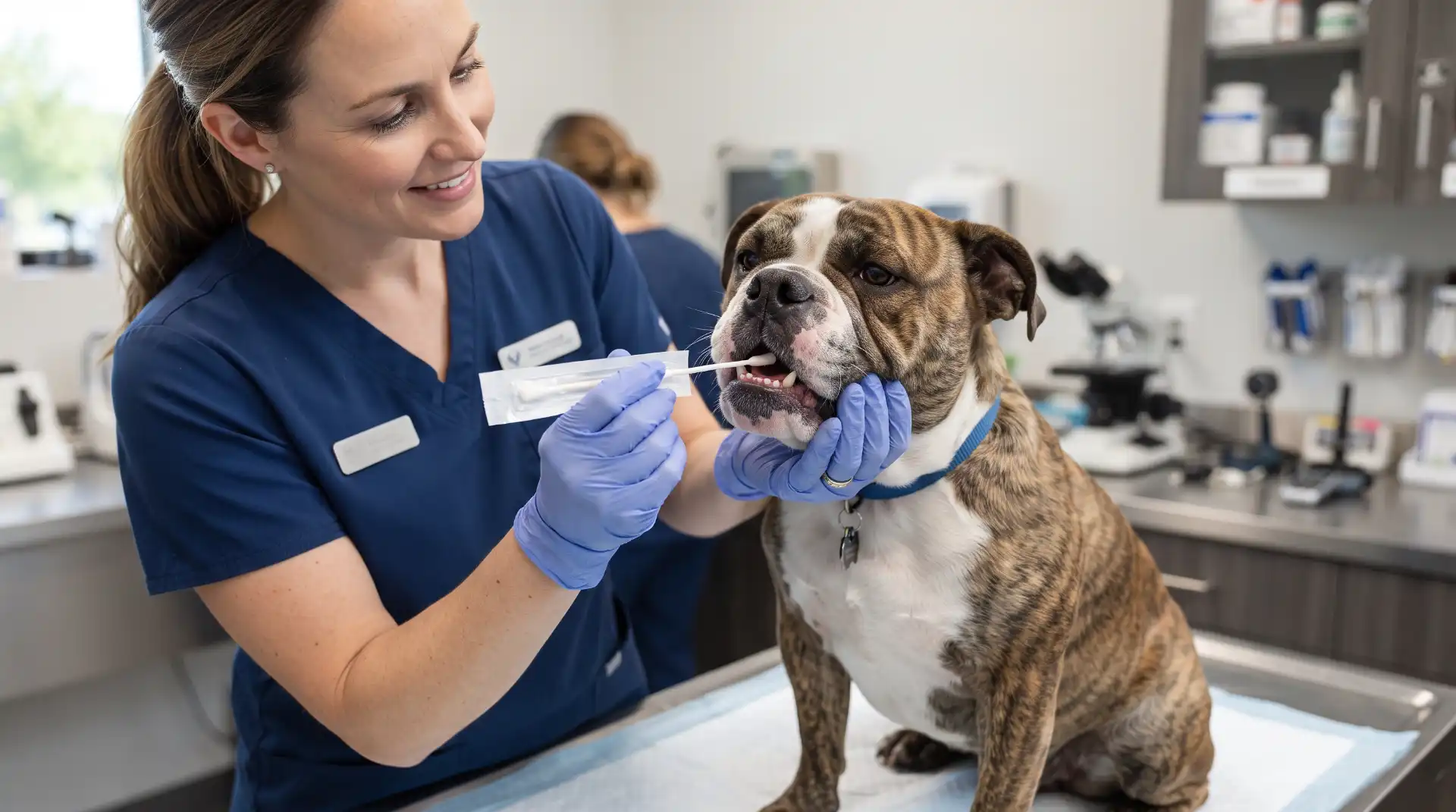
For Continental Bulldog owners, understanding a dog’s genetics can provide another piece of the puzzle when it comes to long-term health, responsible breeding, and informed veterinary care. DNA testing has become increasingly accessible in the United States, with cheek-swab kits and laboratory testing allowing owners to learn about genetic variants, traits, parentage, and other characteristics without requiring complicated procedures.
But DNA testing is often misunderstood. A genetic report does not provide a crystal ball that can tell an owner exactly how healthy a dog will be throughout its life. A positive genetic result does not always mean that a dog currently has a disease, and a negative result does not guarantee that a dog will never develop a particular health problem.
For Continental Bulldogs, this distinction is especially important. Genetic information can be useful, but it should be considered alongside veterinary examinations, family history, orthopedic screening, eye evaluations, lifestyle, nutrition, body condition, and other forms of health monitoring.
The American Kennel Club explains that canine DNA testing can serve several different purposes, including genetic identification, parentage verification, disease and trait testing, ancestry testing, and DNA banking. The science continues to develop, which means owners should interpret results carefully and understand what a particular test actually measures.
What Is Continental Bulldog DNA Testing?
Continental Bulldog DNA testing involves analyzing genetic material collected from an individual dog. For many consumer and veterinary-related tests, the sample is collected using a cheek swab. The laboratory then examines particular genetic markers or variants depending on the type of test ordered.
The basic concept sounds simple, but the information produced by the test can be much more complicated.
A DNA test may look for a specific genetic variant associated with a hereditary condition. It may also provide information about physical traits, genetic identity, parentage, or ancestry. Some large panels test hundreds of genetic markers, although not every marker is necessarily relevant to every breed.
This is one reason owners should avoid assuming that the largest available test panel is automatically the most useful one.
The American Kennel Club notes that canine DNA health tests can range from individual tests for a specific variant to large multiplex panels covering hundreds of variants. It also emphasizes that many variants included in broad panels may not be relevant to a particular breed.
For a Continental Bulldog, the most useful information is therefore not necessarily the longest report. Instead, owners should ask what each test means, whether the variant has been properly validated, whether it is relevant to the breed or individual family line, and how the result should affect veterinary monitoring.
Why Are Dog Owners Interested in Genetic Testing?
The growing interest in canine DNA testing reflects a broader shift toward preventive pet care.
Instead of waiting until a dog develops a problem, owners increasingly want information that may help them understand potential risks earlier. DNA testing can contribute to that process by identifying certain inherited variants before symptoms appear.
For example, a dog may carry a variant associated with a particular inherited condition while appearing completely healthy. Knowing that information could give the owner an opportunity to discuss appropriate monitoring with a veterinarian.
For breeders, genetic testing can have another purpose. Testing breeding dogs can help identify carriers and affected individuals for certain inherited conditions. When the inheritance pattern is well understood, breeders can use that information when planning future pairings.
However, genetic testing should not become the only measure used to evaluate a breeding dog.
A responsible breeding program considers multiple factors, including physical health, temperament, structure, orthopedic screening, family history, reproductive health, and the overall genetic diversity of the line.
Your existing guide on [choosing a responsible Continental Bulldog breeder] can serve as a useful companion resource for readers who want to understand why documented health testing and breeder transparency matter.
What Can a DNA Test Actually Tell You?
The answer depends entirely on the test.
There is no single category called “the dog DNA test.” Different laboratories offer different combinations of tests, and the results can answer very different questions.
Genetic Disease Variants
One of the most important uses of canine DNA testing is identifying specific genetic variants associated with inherited disease.
When a test is scientifically validated and appropriate for the breed, the result can tell an owner whether the dog has a particular variant or combination of variants.
However, the meaning of a positive result depends on how that condition is inherited.
Some inherited diseases follow relatively straightforward patterns. In other cases, genetics is considerably more complicated. A variant may increase risk without guaranteeing disease, or several genes and environmental factors may influence whether a dog eventually develops clinical signs.
The American Kennel Club specifically cautions that genetic health tests can identify variants associated with disease but do not necessarily mean that the dog currently has that disease.
That distinction should always be explained before an owner makes decisions based on a genetic report.
Carrier Status
Some tests can identify whether a dog is a carrier of a recessive genetic variant.
A carrier may not show signs of the associated disease but can potentially pass the variant to offspring.
This information can be particularly relevant to breeders.
Suppose a particular inherited disorder follows a recessive inheritance pattern. A breeder may discover that one otherwise healthy dog carries a variant. That result does not automatically mean the dog should never be bred. Instead, the breeder may need to understand the inheritance pattern and test potential mates so that breeding decisions reduce the risk of producing affected puppies.
This is one of the areas where genetic counseling and breed-specific expertise can be valuable.
Owners should therefore resist the temptation to interpret words such as “carrier,” “clear,” or “affected” without understanding the specific condition and inheritance pattern.
What Does “Clear,” “Carrier,” and “Affected” Mean?
Genetic test terminology can be confusing.
For a particular inherited condition, a report may classify a dog as clear, carrier, or affected. But these categories are not universal in meaning across every genetic test.
A “clear” result generally means that the tested variant was not detected under the methodology used by the laboratory.
A “carrier” result commonly means that the dog possesses a variant associated with a recessive condition but does not have two copies of that particular variant.
An “affected” result may indicate that the dog has the genetic combination associated with a condition. However, whether that means clinical disease will occur depends on the specific disorder, inheritance pattern, penetrance, and scientific evidence supporting the test.
This is why an owner should read the laboratory’s interpretation rather than relying on a generic definition found online.
Some genetic variants have incomplete penetrance, meaning that not every dog with the variant necessarily develops the associated disease. The American Kennel Club notes that these situations require additional context when interpreting results.
DNA Testing Does Not Replace a Veterinary Examination
This is perhaps the most important point in the entire discussion.
A DNA test is not a substitute for a physical examination.
Your veterinarian can evaluate things that a genetic test cannot directly measure, including body condition, movement, joint function, heart and lung sounds, eyes, ears, teeth, skin, neurological function, and overall physical condition.
Some health problems are influenced by many genes and environmental factors rather than one identifiable mutation. Others may have no clinically useful genetic test available.
A dog can therefore have a reassuring DNA report and still develop a health condition later in life.
The reverse can also happen. A dog may have a genetic variant associated with a disease but never develop meaningful clinical signs.
For that reason, genetic testing works best as one component of a broader preventive-care strategy.
Your existing [Continental Bulldog preventive care guide] covers the broader approach to routine veterinary examinations, vaccinations, nutrition, parasite prevention, weight management, dental care, and ongoing monitoring.
How DNA Testing Relates to Continental Bulldog Health
Continental Bulldogs can experience a range of health concerns, including orthopedic, respiratory, skin, and eye issues. Your existing health articles already cover several of these areas, including [common Continental Bulldog health problems] and [Continental Bulldog hip dysplasia].
Genetic testing can sometimes contribute useful information, but owners should not assume that every condition affecting a Continental Bulldog has a simple DNA test.
Hip dysplasia provides a good example.
Hip dysplasia has an important hereditary component, but evaluating a dog’s hips involves orthopedic assessment and imaging rather than relying on a single consumer DNA result. The Orthopedic Foundation for Animals maintains health databases and screening programs involving radiographic and other veterinary evaluations.
This illustrates the difference between genetic testing and health screening.
A DNA test asks a genetic question.
An orthopedic examination asks a structural and functional question.
Both types of information can be valuable, but they are not interchangeable.
DNA Testing and Hip Dysplasia
Continental Bulldog owners who are concerned about joint health should be especially careful about online claims suggesting that DNA testing alone can determine whether a dog will develop hip dysplasia.
Hip dysplasia is influenced by genetics as well as developmental and environmental factors. A dog’s body condition, growth, exercise, and other factors can influence the expression and severity of orthopedic problems.
For this reason, appropriate veterinary orthopedic screening remains important.
Your existing article on [Continental Bulldog hip dysplasia] explains the condition, warning signs, screening, and management in greater detail.
Genetic information can potentially contribute to a larger picture of hereditary risk, but it should not be treated as a replacement for radiographic evaluation or a veterinary orthopedic assessment.
Can DNA Testing Predict Future Disease?
Sometimes it can identify increased genetic risk, but prediction is rarely as simple as owners expect.
A genetic variant can be strongly associated with a particular disease in some situations. In other cases, the relationship between the variant and actual disease is more complicated.
The distinction between risk and certainty is crucial.
If a test identifies a disease-associated variant, the correct question is not necessarily, “Will my dog get this disease?”
A better question may be, “What does this variant mean for my dog’s individual risk, and is there any veterinary monitoring that should be considered?”
That question allows a veterinarian or qualified genetic professional to put the result into context.
The American Kennel Club has warned that some direct-to-consumer genetic results can be difficult to interpret and that scientific evidence varies among tests. It recommends looking beyond a single test when assessing a dog’s health.
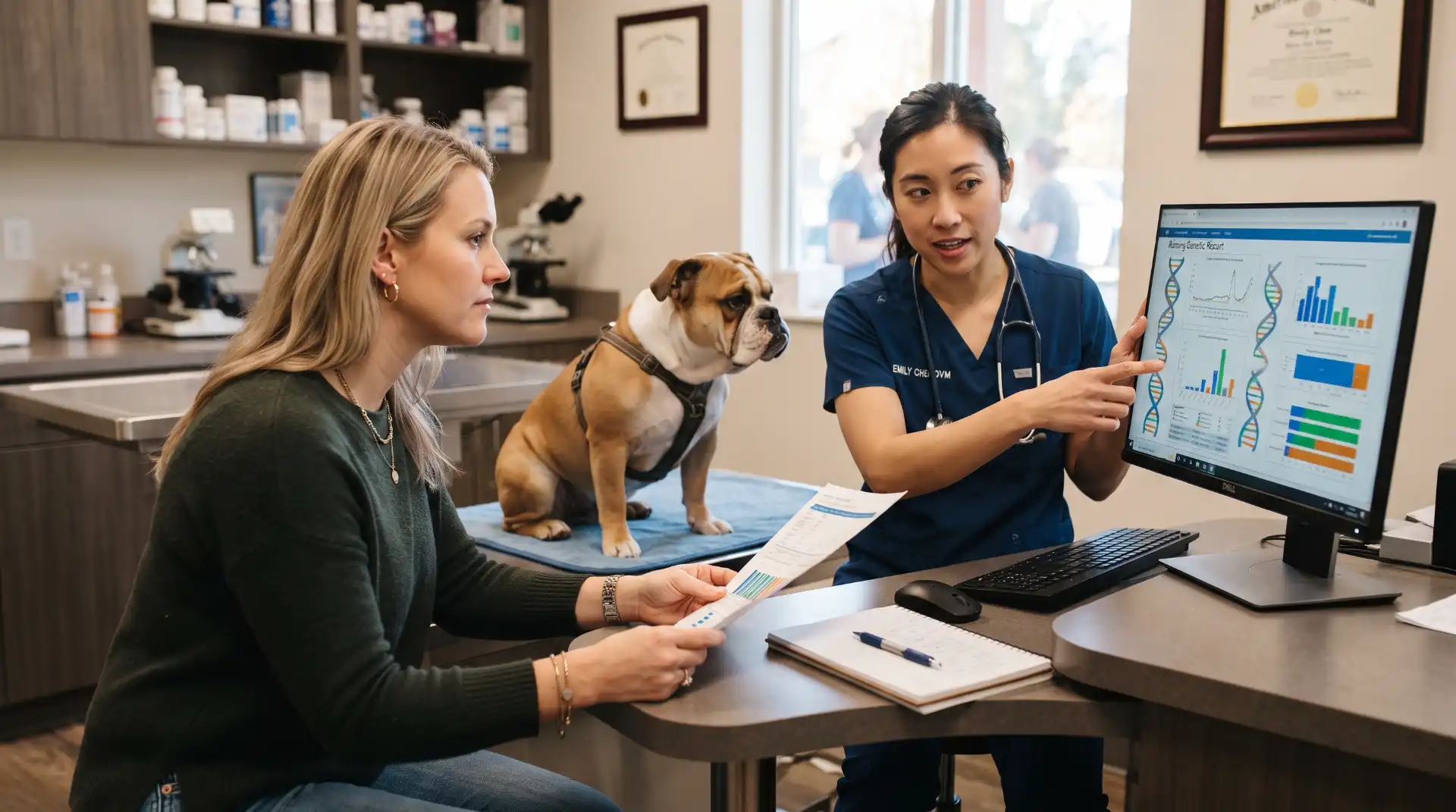
Why Breed-Specific Testing Matters
A major issue with large DNA panels is that more information does not automatically mean more useful information.
A commercial panel may advertise hundreds of health and trait markers. That may sound impressive, but many variants may have little relevance to a particular breed.
The AKC currently explains that its DNA + Health program includes more than 328 markers, while also emphasizing that breeders should focus on tests relevant to their particular breed. It notes that not every genetic variant has been validated in every breed.
This principle is important for Continental Bulldog owners.
Before ordering a test, find out which conditions are actually relevant to the breed, whether the specific test has good scientific support, and whether the result has a clear interpretation.
For breeding decisions, the breeder should also consider information from the broader family line rather than focusing on one individual result.
What About Ancestry DNA Tests?
Some dog DNA companies also offer breed ancestry testing.
These tests can be entertaining for owners who have a dog with an uncertain background. However, ancestry testing has limitations.
For a Continental Bulldog with documented pedigree information, ancestry testing generally provides a different type of information than a health-focused genetic test.
Breed ancestry databases depend on reference populations and the quality of the underlying samples. The AKC notes that ancestry testing is primarily useful for dogs with unknown heritage and should not be treated as a definitive purity test for purebred dogs.
For owners who already know their Continental Bulldog’s lineage, the more important genetic questions may involve health, parentage, or genetic diversity rather than ancestry percentages.
DNA Parentage Testing
DNA profiling can also be used to verify parentage.
This can be useful in breeding programs where accurate pedigree records are important.
Parentage testing uses genetic markers to establish whether a dog is genetically consistent with a particular parentage record. The information can help breeders maintain accurate records and verify relationships.
For responsible breeding programs, accurate identification becomes increasingly valuable as health-testing information is combined with pedigrees and family health histories.
A genetic health result is much more useful when owners and breeders can be confident that the result belongs to the correct dog.
How Is a Continental Bulldog DNA Sample Collected?
For many consumer tests, DNA collection is straightforward.
A cheek swab is commonly used. The owner or veterinarian collects cells from inside the dog’s mouth and sends the sample to the laboratory.
The American Kennel Club’s current DNA + Health testing system, for example, uses cheek swabs and requires two swabs for its testing process.
Although cheek-swab collection is convenient, sample quality still matters.
Owners should follow the laboratory’s instructions carefully. Dogs should generally not be allowed to contaminate the sample with another animal’s DNA, food, or other material before collection.
If a sample is rejected because of contamination or insufficient genetic material, the laboratory may require another sample.
For certain veterinary or research applications, blood or other tissue may be used. The appropriate sample depends on the purpose of the testing.
How Long Does Canine DNA Testing Take?
Turnaround times vary by laboratory and test.
Some companies may return results within a few weeks, while more comprehensive panels may take longer.
Owners should check the laboratory’s current estimated processing time before purchasing a test, especially if the results are needed for a breeding program or veterinary consultation.
For example, the AKC has stated that its DNA + Health results are delivered after laboratory processing, with current published estimates of approximately four to five weeks after the sample reaches the laboratory.
Processing times can change, so owners should always confirm current information directly with the testing provider.
How Should Owners Choose a DNA Testing Company?
Choosing a testing provider deserves more attention than simply comparing the number of markers included in each package.
Look for transparency about the laboratory, methodology, tested variants, scientific evidence, interpretation of results, and privacy policies.
A reputable provider should explain what its results mean rather than simply presenting a long list of medical conditions.
Owners should also determine whether the laboratory provides information about the specific genetic variant being tested. The American Kennel Club notes that testing methods can differ and that direct and indirect tests have different considerations.
It is also worth asking whether the results can be verified, whether the company maintains quality standards, and whether professional support is available for complicated results.
For breeding-related testing, it can be useful to discuss the laboratory with a veterinarian or experienced breed-health professional before ordering a large panel.
What Should You Do If Your Continental Bulldog Tests Positive?
A positive result can be alarming, but owners should avoid immediately assuming the worst.
First, read the laboratory’s explanation of the result.
Next, identify exactly what variant was detected and what condition it is associated with.
Then determine the inheritance pattern and whether the variant has incomplete penetrance or other limitations.
Finally, discuss the result with your veterinarian.
Your veterinarian can help determine whether any additional monitoring, diagnostic testing, or changes in care are appropriate.
In some situations, the genetic result may have little immediate effect on daily care. In others, it could justify additional monitoring.
The key is to connect the genetic information to the individual dog rather than treating the laboratory report as a diagnosis.
What If the Result Is Negative?
A negative result can be reassuring, but it should also be interpreted carefully.
If a test accurately detects a specific genetic variant and the dog does not possess that variant, the result can provide useful information about that particular mutation.
However, it does not mean that the dog is free from every possible inherited disorder.
There may be other genetic variants that the test does not examine. Some diseases have multiple genetic causes. Others are influenced by environmental factors or combinations of genes.
A negative DNA test should therefore never be interpreted as a general guarantee of perfect health.
Regular veterinary care remains necessary.
DNA Testing for Continental Bulldog Breeders
DNA testing can be especially useful for breeders when applied responsibly.
The goal should not be to produce a generation in which every potentially undesirable genetic variant has simply been eliminated at any cost.
Genetic diversity also matters.
The AKC explains that eliminating all dogs carrying a particular variant may sometimes reduce genetic diversity and unintentionally remove other valuable genetic characteristics from a breed. Breeding decisions therefore require broader consideration than simply selecting every dog that receives a “clear” result.
For a Continental Bulldog breeding program, genetic testing should ideally be part of a larger health strategy.
That strategy can include pedigree analysis, documented health histories, physical examinations, orthopedic screening, eye examinations, reproductive health, temperament, structure, and appropriate genetic testing.
The goal is to make informed breeding decisions based on the whole dog and the broader family line.
Why Family Health History Still Matters
DNA testing can be powerful, but it does not tell the entire story.
A dog’s parents, siblings, grandparents, and previous offspring can provide valuable information about how health conditions actually appear within a family.
For example, if several related dogs develop the same condition despite testing negative for a particular known mutation, that may indicate that the condition involves another genetic factor or a more complex inheritance pattern.
This is why breeders should maintain detailed records.
Health information becomes more valuable when it is tracked over generations.
For puppy buyers, asking about family health history can therefore be just as important as asking whether a parent has a particular DNA certificate.
Can Genetic Testing Help With Preventive Care?
In some cases, yes.
If a validated genetic test identifies a meaningful risk, the result may help a veterinarian decide whether additional monitoring is appropriate.
However, owners should avoid turning every genetic result into a medical intervention.
A dog with a particular genetic variant may require no immediate treatment. The appropriate response could simply be awareness and routine monitoring.
For example, if a genetic result is associated with a condition affecting a particular organ system, the veterinarian may recommend watching for certain clinical changes or performing specific examinations when appropriate.
The test becomes useful because it contributes context to veterinary care.
It is not useful when it creates unnecessary fear or false confidence.

Genetic Testing and the Future of Continental Bulldog Health
Canine genetics is advancing quickly.
Scientists continue to identify genetic variants associated with inherited diseases, traits, and other characteristics. Larger databases and improved sequencing technologies may eventually provide more precise information about complex diseases.
The canine genome was first mapped in 2005, and research has continued to expand our understanding of canine genetic variation. The AKC notes that genomic research is continuing to provide new opportunities for studying inherited conditions and breed health.
For Continental Bulldog owners, this means today’s genetic report should not necessarily be viewed as the final word.
A test that is unavailable or poorly understood today may become better validated in the future.
DNA banking may therefore have value in certain breeding and research settings. Preserving genetic material alongside accurate health and pedigree records can help researchers and breeders revisit samples as technology improves.
What Owners Should Ask Before Ordering a DNA Test
Before purchasing a test, think about what you actually want to learn.
Are you interested in inherited disease risks? Parentage? Traits? Ancestry? Breeding decisions? Or are you simply curious about your dog’s genetics?
The answer will determine which type of test makes sense.
For a health-focused test, ask whether the condition is relevant to Continental Bulldogs, whether the genetic variant has been validated, what a positive result means, what a negative result means, and whether professional interpretation is available.
For breeding dogs, ask whether the results can be documented and verified and whether the testing company provides information that can be incorporated into a broader breeding-health program.
The Orthopedic Foundation for Animals maintains a list of canine DNA tests and provides information about submitting eligible genetic test results to its database.
A Practical Way to Use DNA Results
The best way to think about genetic testing is as another source of information.
Start with your dog’s medical history.
Add the family history.
Consider physical examinations and appropriate health screenings.
Then add genetic information where scientifically relevant.
Finally, discuss meaningful findings with your veterinarian or another qualified canine genetics professional.
This approach avoids the two most common mistakes: believing that DNA testing can predict everything, or dismissing genetic testing as useless because it cannot predict everything.
The reality is somewhere in between.
When the science behind a test is strong and the result is relevant to the individual dog, genetic information can be valuable.
Continental Bulldog DNA Testing: The Bigger Picture
DNA testing gives Continental Bulldog owners access to information that was once available primarily through specialized research and breeding programs.
A simple cheek swab can now provide information about certain genetic variants, traits, parentage, and other characteristics. For breeders, properly interpreted genetic results can support more informed planning. For pet owners, genetic information can sometimes provide additional context for conversations with their veterinarian.
But DNA testing should never be treated as a complete health certificate.
A Continental Bulldog can have a favorable genetic profile and still develop health problems. Another dog can carry a disease-associated variant and remain healthy for its entire life. The meaning of a result depends on the specific genetic variant, the condition involved, inheritance pattern, scientific evidence, and individual circumstances.
For that reason, responsible owners should view DNA testing as one tool within a larger health strategy.
Regular veterinary examinations, appropriate preventive care, responsible nutrition, maintaining a healthy body condition, monitoring mobility and behavior, and choosing breeding dogs based on comprehensive health information all remain important.
For breeders and prospective puppy owners, transparency is equally important. Ask for actual health-testing documentation rather than relying solely on verbal assurances. Look at family history, veterinary screening, and the overall health of the dogs involved.
The most useful genetic test is not necessarily the one with the longest list of conditions. It is the one that provides scientifically meaningful information relevant to the dog being tested.
For Continental Bulldog families in the United States, that balanced approach can make DNA testing a valuable part of responsible ownership without allowing a laboratory report to replace veterinary judgment.
External Authority Resource: For additional information about canine genetic testing, health testing, and interpretation, readers can consult the American Kennel Club’s veterinary-reviewed resources on [DNA health testing considerations] and the Orthopedic Foundation for Animals’ database of available canine DNA tests.
This article is for general educational purposes and is not a substitute for veterinary diagnosis or individualized medical advice. Continental Bulldog owners should discuss genetic test results and health-screening decisions with a licensed veterinarian.