
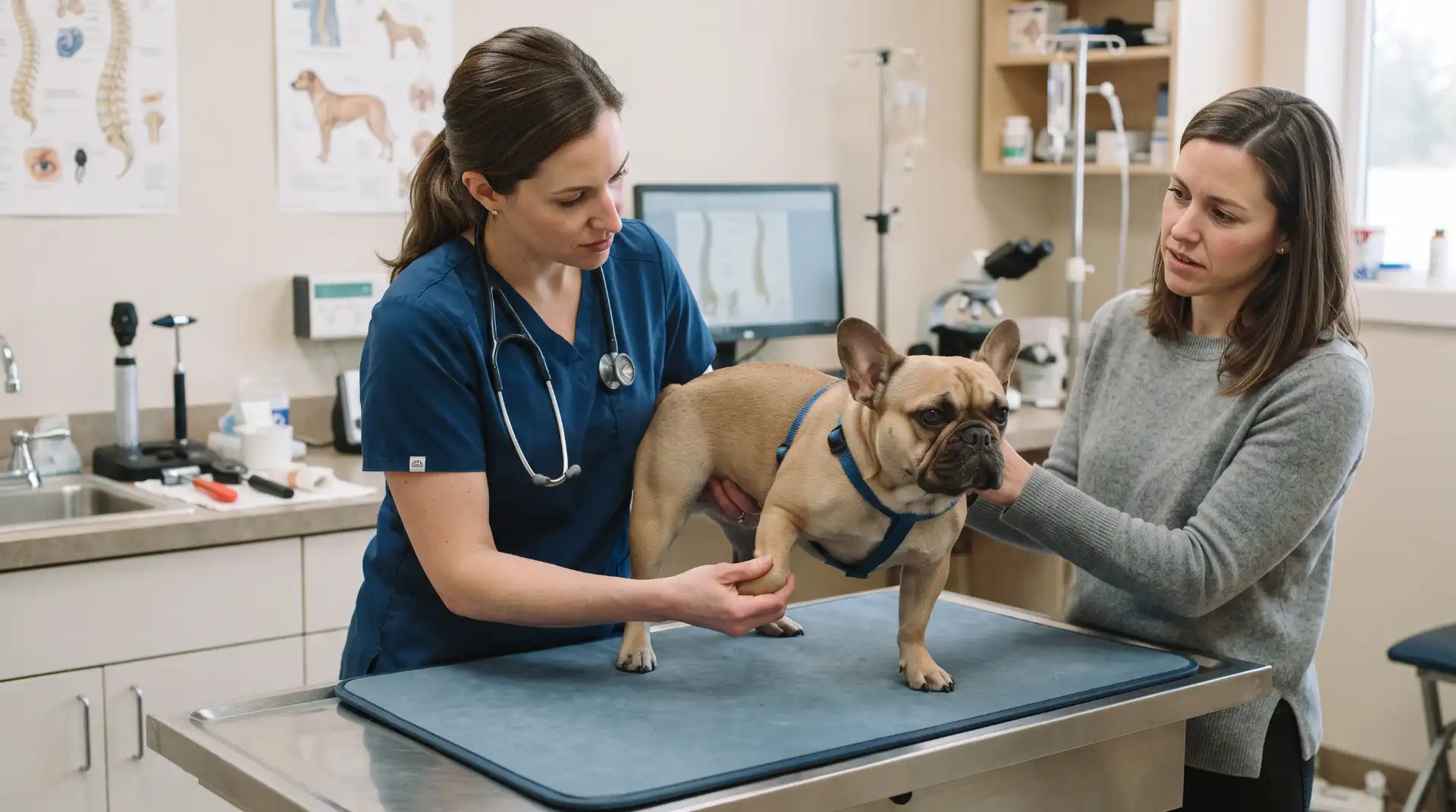
French Bulldogs are known for their affectionate personalities, compact bodies, expressive faces, and distinctive appearance. They are also a breed with several health concerns that responsible owners need to understand, including problems involving the spine. One of the most important conditions to recognize is intervertebral disc disease, commonly called IVDD.
French Bulldog IVDD occurs when one or more of the discs between the vertebrae become degenerated, damaged, displaced, or ruptured and potentially place pressure on the spinal cord or nearby nerves. Depending on the location and severity of the problem, a dog may experience anything from mild discomfort and reluctance to move to significant weakness, loss of coordination, paralysis, and bladder or bowel problems.
French Bulldogs are among the breeds recognized as predisposed to IVDD. Cornell University’s College of Veterinary Medicine specifically lists French Bulldogs among chondrodystrophic breeds associated with increased risk for Type I IVDD. Chondrodystrophy refers to a body shape characterized by relatively shortened limbs, and changes in disc development can occur early in life in dogs with this body type.
Understanding French Bulldog IVDD does not mean assuming that every Frenchie will develop a spinal disorder. Many French Bulldogs live active lives without experiencing severe disc disease. However, knowing the warning signs can help owners recognize a potentially serious problem before neurological damage becomes more advanced.
For US dog owners, the most important principle is simple: unusual back or neck pain, weakness, difficulty walking, or sudden changes in mobility deserve prompt veterinary attention.
What Is IVDD in Dogs?
The spine is made up of individual vertebrae connected by flexible joints and separated by intervertebral discs. These discs function partly as cushions between the bones and allow the spine to move while helping protect the spinal cord.
Each disc has an outer fibrous portion and a softer inner portion. When discs degenerate, their structure and ability to withstand normal forces can change. In some cases, disc material can protrude or rupture and place pressure on the spinal cord or spinal nerves.
That pressure can interfere with the communication between the brain and the rest of the body. The resulting signs depend heavily on where the affected disc is located and how much compression or injury has occurred.
Cornell explains that IVDD can involve disc degeneration that makes a disc more likely to herniate, while disc herniation refers to the process that can result in spinal cord compression and clinical signs. Veterinary professionals sometimes use IVDD and related terminology interchangeably in everyday discussions.
In a French Bulldog, the condition can affect either the neck or the back. A cervical disc problem may produce neck pain and changes involving the front or rear limbs, while a thoracolumbar problem may particularly affect the hind legs and coordination.
The severity can vary considerably. A dog might initially appear uncomfortable but still walk normally. Another dog may suddenly become uncoordinated or unable to stand.
This variation is one reason owners should not attempt to determine the seriousness of a suspected disc problem solely by observing the dog at home.
Why Are French Bulldogs at Risk of IVDD?
Breed structure is an important part of the discussion surrounding French Bulldog IVDD. French Bulldogs have a compact, short-legged body shape that falls within the broader group of chondrodystrophic breeds associated with premature disc degeneration.
Cornell notes that in chondrodystrophic dogs, the soft center of the intervertebral disc can undergo premature changes early in life. These changes can contribute to Type I IVDD. French Bulldogs are specifically included among the breeds with this predisposition.
Genetics also play a role. Cornell’s veterinary information explains that an FGF4 retrogene insertion on chromosome 12 is associated with chondrodystrophy and increased risk of Type I IVDD in certain dog populations. However, the genetic variant does not explain every case. Other genetic, lifestyle, and environmental factors may contribute to an individual dog’s overall risk.
This is important for owners because breed predisposition should be viewed as a risk factor rather than a prediction. Having a French Bulldog does not mean that IVDD is inevitable.
Age can also influence disc health. Degenerative changes can develop over time, although chondrodystrophic dogs can experience disc disease at relatively young ages compared with dogs without the same predisposition. VCA identifies French Bulldogs among breeds with a high incidence of intervertebral disc disease and notes that degenerative disc disease commonly affects middle-aged dogs, although individual circumstances vary.

Early Signs of French Bulldog IVDD
One of the biggest challenges with IVDD is that the earliest symptoms may be subtle. A French Bulldog does not necessarily begin by showing obvious paralysis or an inability to walk.
Pain may be the first indication.
A dog that normally enjoys being picked up might suddenly resist. A Frenchie that usually jumps onto the couch may stop attempting it. The dog might become quieter, move more slowly, hold its head differently, or appear uncomfortable when changing positions.
Some dogs vocalize, while others become unusually withdrawn. A dog may also react differently when the neck or back is touched.
Cornell lists signs such as reluctance to jump or walk, discomfort when being lifted, vocalization with movement, an unusual response to being touched, a stiff neck, an arched back, and changes in coordination among the clinical signs associated with Type I IVDD.
Owners should pay attention to changes from their dog’s normal behavior rather than looking for one specific symptom.
For example, a French Bulldog that suddenly chooses to stay on the floor instead of following the family around may simply seem tired at first. However, if that change is accompanied by stiffness, pain, hesitation on stairs, or difficulty getting up, a veterinary examination is appropriate.
Walking Changes Can Be an Important Warning
Changes in walking are among the signs that deserve particular attention.
A French Bulldog with spinal cord compression may develop an unsteady gait. The dog may stumble, cross its legs, drag its toes, or appear to have difficulty knowing where its feet are positioned.
A common sign described in veterinary medicine is “knuckling,” where the dog places the paw incorrectly or drags the top of the paw against the ground rather than placing the foot normally.
Cornell describes hind-leg weakness, knuckling, paw dragging, and ataxia, or loss of coordination, among possible signs of Type I IVDD.
Owners may initially interpret these changes as clumsiness. French Bulldogs can already have distinctive movement because of their body structure, so subtle neurological abnormalities can sometimes be difficult to recognize.
Taking a short video of an unusual gait can be useful when contacting your veterinarian, particularly if the dog’s movement returns to normal before the appointment. However, owners should not repeatedly make a dog walk or move simply to document symptoms if the dog appears painful.
Neck Pain Can Look Different From Back Pain
Not every French Bulldog with IVDD will show obvious problems in the hind legs.
When a disc problem affects the neck, the dog may show signs such as reluctance to turn the head, stiffness, unusual posture, crying when moved, or discomfort when the collar or neck area is handled.
A dog may also lower its head or avoid looking toward its food and water bowls because bending or turning the neck is uncomfortable.
Cornell notes that dogs with spinal disc problems may avoid turning their head in one direction and can display neck or back pain, depending on the affected region.
For French Bulldogs, this is particularly important because owners may initially mistake neck discomfort for a minor muscle problem.
Any unexplained pain involving the neck should be evaluated by a veterinarian, especially when it is accompanied by weakness, stumbling, changes in posture, or reluctance to move.
Severe Signs of IVDD Require Urgent Veterinary Attention
The most serious presentations of French Bulldog IVDD can involve significant weakness or paralysis.
A dog that suddenly cannot stand, cannot walk normally, is dragging one or more limbs, or has rapidly worsening neurological signs needs urgent veterinary care.
Loss of bladder or bowel control can also occur with serious spinal problems. Cornell describes incontinence among possible signs of severe intervertebral disc disease.
A sudden inability to walk should not be treated as something that can safely wait until a routine veterinary appointment.
The American College of Veterinary Surgeons explains that the severity of spinal cord damage can range from coordination problems to loss of voluntary movement and, in severe cases, loss of pain sensation. The extent of neurological damage and how long the spinal cord has been affected can influence the potential for recovery.
If a French Bulldog suddenly loses the ability to walk, owners should minimize unnecessary movement and contact an emergency veterinary hospital or veterinarian for instructions on safe transportation.
What Causes an IVDD Episode?
Owners often assume that a dramatic event must have caused a disc rupture. Sometimes a fall, jump, collision, or other physical event occurs immediately before symptoms become obvious, but that does not necessarily mean the activity created the underlying disc disease.
Degenerated discs may already be vulnerable before a seemingly minor movement causes symptoms to appear.
VCA explains that disc rupture can occur after relatively small movements such as a minor fall or jump, with chronic disc degeneration already present underneath the event.
This distinction is important because owners should not blame themselves if their French Bulldog develops IVDD after jumping from a couch or moving quickly during play.
The movement may have been the final event that caused an already compromised disc to rupture or shift.
At the same time, preventing unnecessary high-impact activities is still a sensible part of protecting a Frenchie’s spine.
Weight Management Matters
Maintaining a healthy body weight is one of the practical things owners can do to support overall musculoskeletal health.
Extra body weight can place additional physical demands on a dog’s joints and spine. Cornell recommends maintaining an ideal body condition as part of managing risk and reducing stress on the spine in dogs affected by disc disease.
French Bulldogs can be especially challenging to assess visually because their compact bodies can make a small amount of excess weight less obvious.
Rather than relying only on appearance, owners should discuss ideal body condition and weight with their veterinarian. A veterinary professional can evaluate the dog’s frame, muscle condition, age, activity level, and other health considerations.
Weight management should also be approached gradually. Crash diets or dramatic exercise increases are not appropriate for a dog with suspected spinal pain.
Reducing Jumping Can Help Protect the Spine
Many French Bulldogs enjoy sleeping on couches, climbing onto beds, and following their owners around the house. Unfortunately, repeated jumping down from elevated surfaces can create unnecessary impact.
Owners concerned about IVDD can modify the home environment so the dog has fewer reasons to jump.
A stable ramp can provide a safer way to access a couch or other permitted surface. Some households may decide that keeping the dog on the floor is the simplest option.
Stairs deserve similar consideration. A few steps may not cause a problem for every dog, but a French Bulldog with known disc disease or a history of spinal pain may need stricter activity modification.
Cornell specifically recommends reducing activities that place stress on the spine, including jumping on and off furniture, and suggests steps or ramps as ways to reduce jumping.
The goal is not to eliminate normal movement. Controlled walking and appropriate activity are generally preferable to a lifestyle where a dog is constantly jumping, twisting, or launching itself from furniture.
Choosing a Harness for a French Bulldog
A harness can be useful for some French Bulldogs, particularly when owners want to reduce pressure around the neck.
However, a harness is not automatically appropriate simply because a dog has IVDD. The fit, design, and individual dog’s condition all matter.
Cornell notes that low-stress options, including front-clip harness arrangements, may be recommended for dogs with disc concerns.
Owners should ask their veterinarian which walking equipment is appropriate if their French Bulldog has neck pain or a diagnosed spinal condition.
A properly fitted harness should allow normal movement without rubbing, restricting the shoulders, or creating pressure points.
Exercise and French Bulldog IVDD
Exercise is a complicated subject when IVDD is involved.
A healthy French Bulldog generally benefits from appropriate physical activity, but an affected dog may need strict activity restriction during an acute episode. The correct amount of movement depends on the dog’s diagnosis, neurological status, treatment plan, and recovery stage.
If a veterinarian prescribes strict rest, owners should take that instruction seriously. Allowing a dog to run around the house because it “looks better” can create problems during the healing period.
Cornell describes conservative management for some disc cases as involving pain medication and strict rest, while more severe cases may require surgery.
During recovery, the veterinarian may gradually introduce controlled walking or rehabilitation exercises.
This is different from complete inactivity forever. Once the acute phase has passed, controlled rehabilitation may help restore strength and mobility under professional guidance.
How Veterinarians Diagnose IVDD
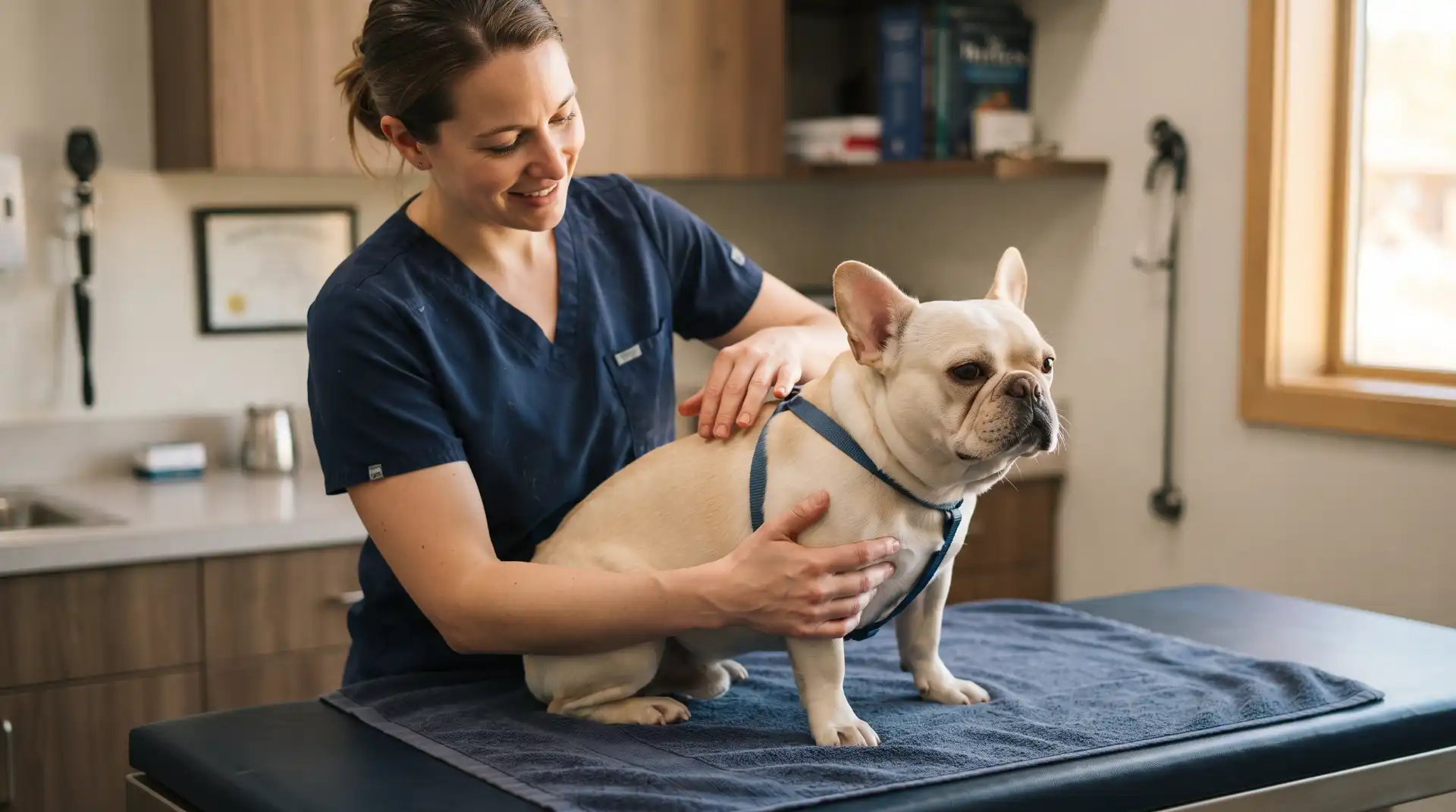
A diagnosis of French Bulldog IVDD begins with the dog’s medical history and physical and neurological examination.
The veterinarian will want to know when the signs began, whether they are getting worse, whether the dog experienced a fall or other event, whether the dog has pain, and whether there have been changes in walking, urination, or bowel movements.
The examination helps determine where along the nervous system the problem may be located.
X-rays can provide useful information about the spine, but they cannot always establish exactly what is happening to the spinal cord or identify every disc problem.
Cornell explains that X-rays may show changes such as disc calcification or decreased disc space, while advanced imaging such as MRI or CT can provide more detailed information.
MRI is particularly important when significant neurological symptoms are present or when a precise diagnosis is needed before surgery.
Depending on the case, a general veterinarian may recommend referral to a veterinary neurologist or specialty hospital.
Treatment Options for French Bulldog IVDD
Treatment depends on the severity of the disease.
Some dogs with relatively mild symptoms may be managed medically. This can involve strict activity restriction, veterinarian-prescribed pain control, anti-inflammatory medication, and other supportive measures.
Owners should never give a French Bulldog human pain medication unless specifically instructed by a veterinarian. Some medications that are routinely used by people can be dangerous for dogs.
For dogs with more significant neurological problems, surgery may be recommended to remove disc material that is compressing the spinal cord.
The American College of Veterinary Surgeons explains that disc rupture can produce spinal cord compression and neurological dysfunction, with treatment decisions depending on the severity and characteristics of the disease.
Surgery can be a major procedure, but in appropriate cases it may be an important part of preventing further neurological deterioration and providing an opportunity for recovery.
The decision between conservative management and surgery should be made with a veterinarian, and potentially a veterinary neurologist or surgeon, rather than based on internet descriptions alone.
Recovery After IVDD Treatment
Recovery can require considerable patience.
A French Bulldog may need confinement, restricted movement, assistance standing or walking, and careful monitoring during the early recovery period. If surgery has been performed, the veterinary team will provide specific instructions about wound care, medication, activity, and follow-up appointments.
The home environment should be arranged to prevent unnecessary jumping and slipping.
Hard floors can be challenging for a dog with weakness. Non-slip surfaces or strategically placed rugs can give the dog better traction while moving through the home.
Owners may also need to help with bathroom breaks, depending on the dog’s neurological function.
Rehabilitation may become an important part of the recovery process. Cornell notes that rehabilitation programs can include controlled exercises and techniques such as underwater treadmill work in appropriate patients.
Recovery time varies considerably. Some dogs improve relatively quickly, while others require weeks or months of rehabilitation.
How Owners Can Make the Home Safer
A spinal-friendly home does not need to look like a veterinary hospital. Small changes can make everyday life safer for a French Bulldog.
Furniture that encourages repeated jumping can be restricted. Ramps can replace jumps where appropriate. Slippery floors can be covered with non-slip runners. Food and water can be positioned so a recovering dog does not need to climb or stretch awkwardly.
The dog’s sleeping area should provide comfortable support while remaining easy to enter and exit.
During recovery, owners should also control interactions with other pets. Even a friendly dog can accidentally cause injury through rough play, chasing, or wrestling.
Children should be taught to avoid picking up a recovering French Bulldog unless an adult and veterinarian have determined that handling is safe.
These precautions are especially important because dogs do not always understand their physical limitations while recovering.
What Owners Should Do if They Suspect IVDD
If a French Bulldog develops mild but unusual signs such as back pain, reluctance to move, stiffness, or a change in walking, the owner should contact a veterinarian promptly.
If the dog suddenly becomes unable to stand or walk, develops rapidly worsening weakness, or shows severe pain, emergency veterinary evaluation is appropriate.
Until professional advice is obtained, owners should avoid unnecessary movement, running, jumping, stairs, and rough play.
Do not repeatedly test the dog’s ability to walk. Do not stretch the dog’s neck or back. Do not attempt spinal manipulation or chiropractic adjustments without veterinary direction.
Transport should be as controlled as possible. If the dog is unable to walk, supporting the body on a firm, stable surface may help minimize unnecessary spinal movement while the owner follows veterinary instructions.
The goal during a suspected emergency is not to diagnose the condition at home. The goal is to prevent additional injury while getting professional care.
Could IVDD Be Prevented?
There is no guaranteed way to prevent French Bulldog IVDD.
Genetic predisposition means that some dogs are inherently more susceptible than others. Owners cannot change their dog’s genetics, and normal everyday care cannot eliminate the possibility of disc disease.
However, responsible management can reduce avoidable stresses on the spine.
Keeping the dog at an appropriate weight, providing controlled exercise, reducing repeated jumping from furniture, using safe walking equipment, and addressing pain or mobility changes early are all sensible components of preventive care.
Cornell emphasizes maintaining an ideal weight and modifying activities to reduce spinal stress, including using ramps or steps to limit jumping.
Preventive care should therefore focus on risk reduction rather than promising that IVDD can be completely avoided.
The Importance of Regular Veterinary Visits
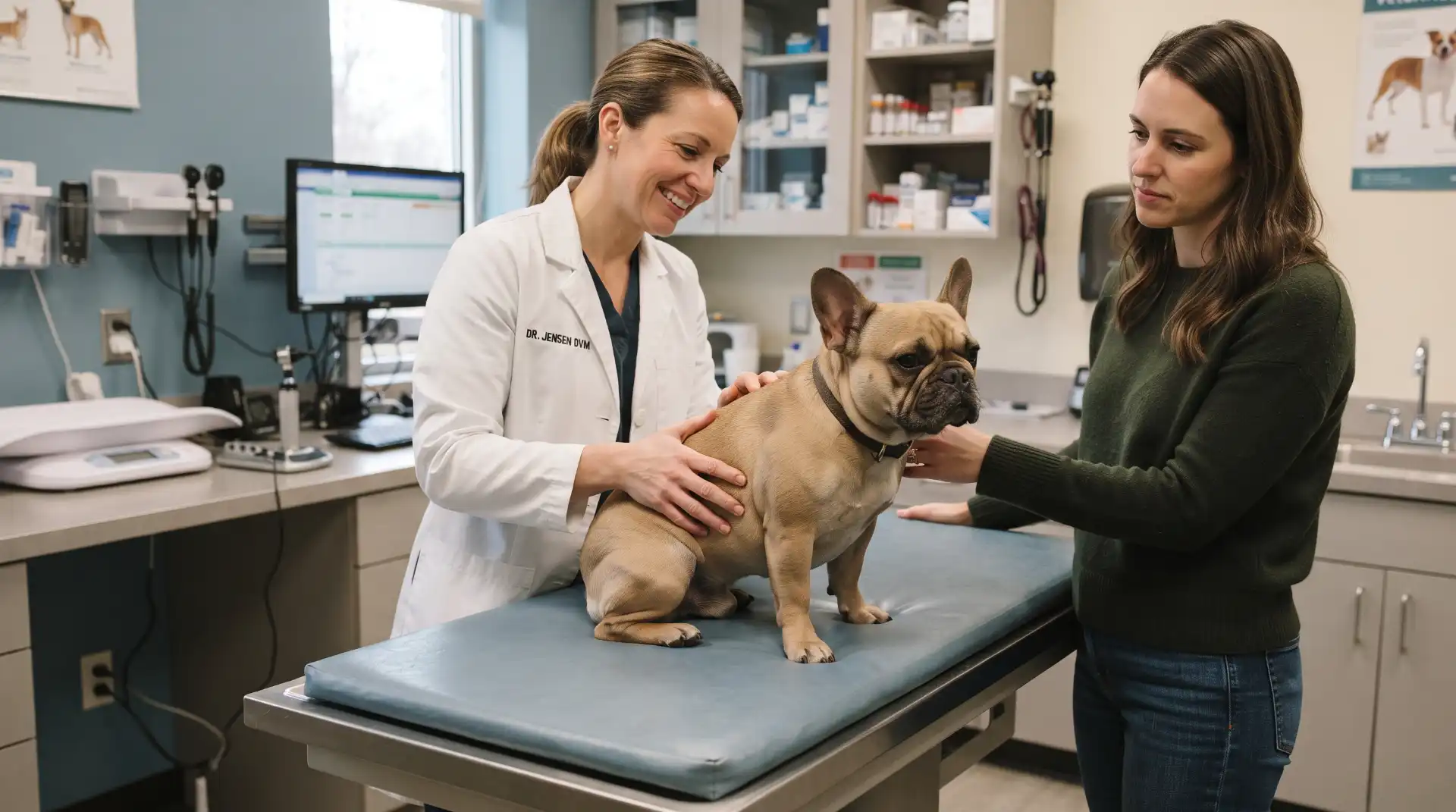
Routine veterinary examinations provide an opportunity to monitor a French Bulldog’s weight, mobility, body condition, and general health.
Owners should mention even subtle mobility changes during appointments. A veterinarian may be able to distinguish between normal variation, orthopedic problems, muscle injuries, neurological disease, and spinal conditions.
This distinction matters because IVDD is not the only condition that can cause weakness or difficulty walking.
Cornell notes that spinal symptoms can overlap with other problems, including soft tissue injuries, infections, autoimmune conditions, and tumors. A proper diagnostic evaluation is therefore important before treatment is selected.
Living With a French Bulldog at Risk for IVDD
A French Bulldog with an increased risk of IVDD can still enjoy a happy and fulfilling life.
Owners do not need to treat every movement as dangerous. Instead, they can create sensible routines that encourage controlled activity and minimize unnecessary high-impact behavior.
Regular walks appropriate to the dog’s health, interactive games that do not involve repeated jumping, mental stimulation, training, and time with family can all contribute to quality of life.
For a dog with a previous IVDD episode, the activity plan should be individualized by the veterinary team.
The key is balance. Complete fear of movement can reduce fitness and quality of life, while uncontrolled high-impact activity can create unnecessary risks.
Frequently Asked Questions About French Bulldog IVDD
Is IVDD common in French Bulldogs?
French Bulldogs are considered a breed predisposed to intervertebral disc disease. Cornell lists French Bulldogs among chondrodystrophic breeds associated with increased risk of Type I IVDD. However, breed predisposition does not mean every French Bulldog will develop the condition.
What is the first sign of IVDD in a French Bulldog?
Pain can be one of the earliest signs. Owners may notice reluctance to move, hesitation before jumping, stiffness, unusual posture, discomfort when being picked up, or changes in walking. Early symptoms can be subtle, so unexplained changes should be discussed with a veterinarian.
Can a French Bulldog recover from IVDD?
Recovery depends on the severity and location of the disc problem, neurological function, treatment, and other individual factors. Some dogs respond to conservative treatment, while others require surgery and rehabilitation. Early veterinary assessment is important because severe neurological disease can be time-sensitive.
Should French Bulldogs with IVDD use a harness?
A veterinarian may recommend a properly fitted harness, particularly when minimizing pressure on the neck is important. However, the appropriate design depends on the dog’s individual condition. Cornell notes that low-stress harness options may be considered for dogs with disc concerns.
Can jumping cause IVDD?
A jump can coincide with the onset of symptoms, but the underlying disc may already have been degenerating. VCA notes that disc rupture can occur after relatively minor movements in dogs with underlying degeneration.
Should I let my French Bulldog use stairs?
There is no universal answer for every dog. Healthy dogs may manage stairs differently from dogs with diagnosed or suspected spinal disease. For French Bulldogs with IVDD concerns, owners should ask their veterinarian whether stairs should be restricted and whether a ramp or another arrangement would be safer.
Is IVDD an emergency?
It can be. Mild pain may not require emergency hospitalization, but sudden inability to walk, rapidly worsening weakness, severe pain, or significant neurological changes warrant prompt veterinary evaluation. Severe spinal cord compression can cause permanent neurological damage.
Final Thoughts
French Bulldog IVDD is a serious condition, but understanding the risks can help owners respond appropriately and create a safer environment for their dogs.
The breed’s chondrodystrophic body structure and genetic factors can increase susceptibility to disc degeneration and Type I IVDD. Because the condition can range from pain and stiffness to weakness, loss of coordination, and paralysis, recognizing changes in normal behavior is especially important.
Owners can support spinal health by maintaining an appropriate body condition, controlling high-impact activities, reducing unnecessary jumping, providing safe footing, using appropriate walking equipment, and following veterinary recommendations.
Most importantly, unusual pain or neurological changes should not be dismissed as ordinary French Bulldog behavior. A dog that suddenly becomes reluctant to move, develops an abnormal gait, cries when handled, or loses the ability to walk needs professional veterinary assessment.
For additional veterinary information about IVDD, the American College of Veterinary Surgeons provides an authoritative overview of intervertebral disc disease, including clinical severity and treatment considerations. American College of Veterinary Surgeons — Intervertebral Disc Disease
Cornell University’s College of Veterinary Medicine also provides detailed information about chondrodystrophy and IVDD, including breed predisposition, clinical signs, diagnosis, treatment, and risk-reduction strategies. Cornell University College of Veterinary Medicine — CDDY/IVDD
French Bulldogs bring enormous personality into relatively small bodies. With informed ownership, appropriate veterinary care, and thoughtful attention to mobility and spinal health, owners can take practical steps to help their Frenchies remain comfortable, active, and engaged with family life.